. 1998 Aug;117(4):1423-31.
doi: 10.1104/pp.117.4.1423.

Dedicated roles of plastid transketolases during the early onset of isoprenoid biogenesis in pepper fruits1

Affiliations

Dedicated roles of plastid transketolases during the early onset of isoprenoid biogenesis in pepper fruits1

F Bouvier et al. Plant Physiol. 1998 Aug.

Abstract

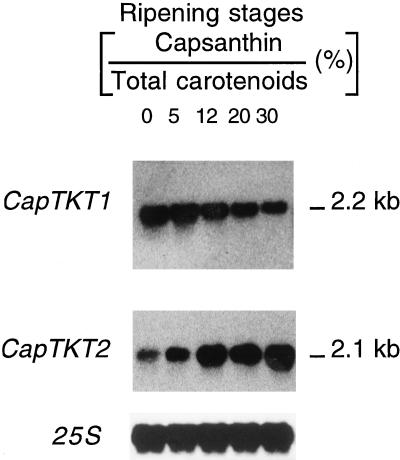
Isopentenyl diphosphate (IPP), which is produced from mevalonic acid or other nonmevalonic substrates, is the universal precursor of isoprenoids in nature. Despite the presence of several isoprenoid compounds in plastids, enzymes of the mevalonate pathway leading to IPP formation have never been isolated or identified to our knowledge. We now describe the characterization of two pepper (Capsicum annuum L.) cDNAs, CapTKT1 and CapTKT2, that encode transketolases having distinct and dedicated specificities. CapTKT1 is primarily involved in plastidial pentose phosphate and glycolytic cycle integration, whereas CapTKT2 initiates the synthesis of isoprenoids in plastids via the nonmevalonic acid pathway. From pyruvate and glyceraldehyde-3-phosphate, CapTKT2 catalyzes the formation of 1-deoxy-xylulose-5-phosphate, the IPP precursor. CapTKT1 is almost constitutively expressed during the chloroplast-to-chromoplast transition, whereas CapTKT2 is overexpressed during this period, probably to furnish the IPP necessary for increased carotenoid biosynthesis. Because deoxy-xylulose phosphate is shared by the plastid pathways of isoprenoid, thiamine (vitamin B1), and pyridoxine (vitamin B6) biosynthesis, our results may explain why albino phenotypes usually occur in thiamine-deficient plants.


Figures
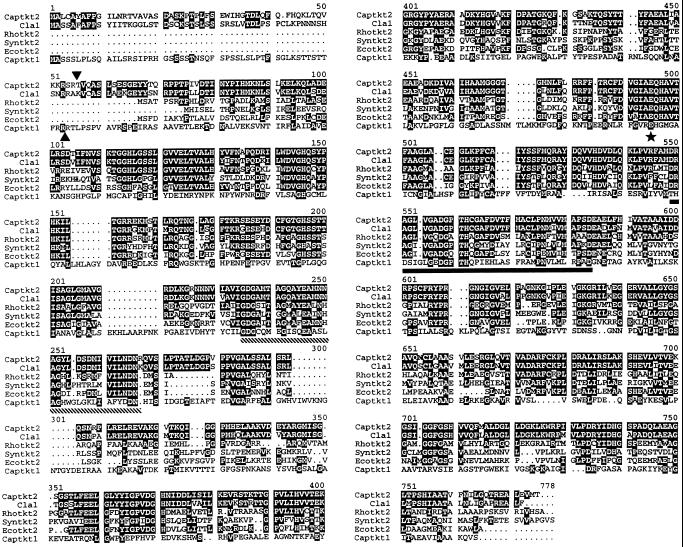
Figure 1
Figure 1
Sequence alignment of CapTKT1 and CapTKT2 proteins with related gene products. Black boxes indicate identity between CapTKT1 (Captkt1) (accession no. Y15781) and CapTKT2 (Captkt2) (accession no. Y15782) with ClaI protein from Arabidopsis (Cla1) (Mandel et al., 1996), putative Rhodobacter (Rhotkt2) (accession no. P26242), Synechocystis (Syntkt2) (accession no. D90903), and E. coli (Ecotkt2) (accession no. P77488) transketolases. The underlined domain fits to the consensus thiamin diphosphate-binding site (striped bar), which is well conserved among various thiamine-dependent enzymes (Hawkins et al., 1989; Schenk et al., 1997), and the transketolase motifs (Schenk et al., 1997) are indicated by the striped and solid bars. The invariant Glu residue thought to be specific for transketolase activity is indicated by a star. The arrowheads indicate the amino terminus of the recombinant proteins expressed in E. coli.
Figure 2
Figure 2
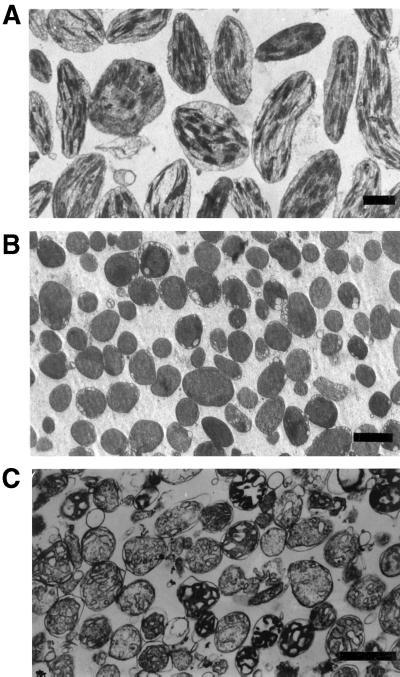
Electron micrograph showing the purity of pepper cell organelles used for CapTKT2 localization in chloroplasts (A), chromoplasts (B), and mitochondria (C). Bars, 1 μm.
Figure 3
Figure 3
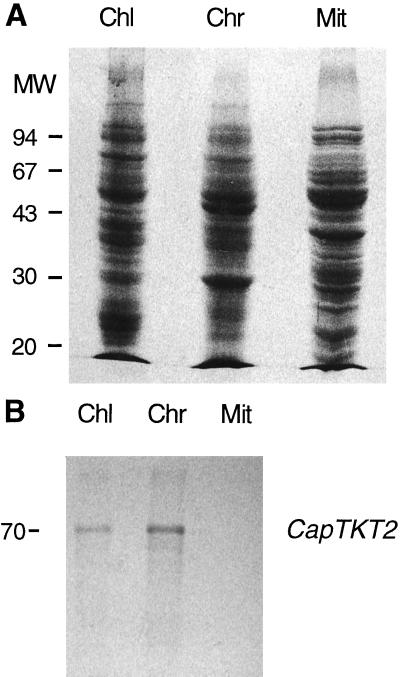
SDS-PAGE and immunoblot analysis of CapTKT. A, Coomassie blue-stained gel of proteins isolated from chloroplasts (Chl), chromoplasts (Chr), and mitochondria (Mit). B, Immunoblot analysis of organelle proteins shown in A with anti-CapTKT2. For both A and B, molecular mass (MW) markers are shown on the left in kD.
Figure 4
Figure 4
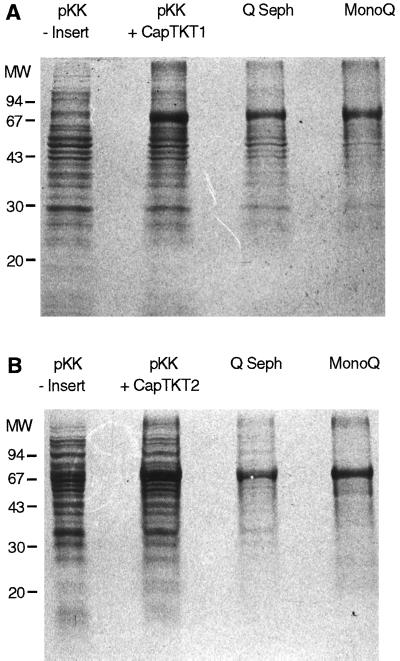
Purification of recombinant CapTKT1 and CapTKT2. A and B, Coomassie blue-stained gel of proteins representative of recombinant CapTKT1 and CapTKT2 purification after IPTG induction. Lanes from left to right include: total proteins from E. coli harboring control vector (pKK-Insert); vector plus insert (pKK+CapTKT1 in A and pKK+CapTKT2 in B); and pooled active fractions from the Q-Sepharose Fast-Flow (Q Seph) and Mono-Q HR (MonoQ) columns. For both A and B, molecular mass (MW) markers are shown on the left in kD.
Figure 5
Figure 5
Analysis of CapTKT1 and CapTKT2 mRNAs during chloroplast-to-chromoplast differentiation in pepper fruit. Identical amounts of total RNA (20 μg) were blotted onto each lane and hybridized with the specified probes. Top to bottom, CapTKT1 cDNA, CapTKT2 cDNA, and pepper fruit probe coding for 25S rRNAs used as a standard probe. Chloroplast-to-chromoplast differentiation stages were characterized by the level of the chromoplast-specific carotenoid capsanthin.
Figure 6
Figure 6
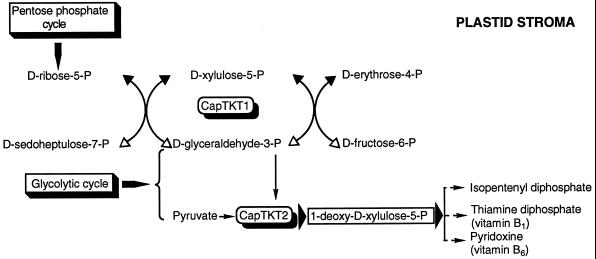
Metabolic specificities of plastid CapTKT1 and CapTKT2. Due to its flexibility, CapTKT1 integrates the plastid stroma pentose phosphate and glycolytic cycles, whereas CapTKT2 catalyzes an irreversible condensation between d-glyceraldehyde-3-phosphate and pyruvate to yield 1-deoxy-xylulose-5-phosphate. The latter is further channeled to the formation of IPP, thiamine, or pyridoxine. P, Phosphate.

References

    1. Arigoni D, Sagner S, Latzel C, Eisenreich W, Bacher A, Zenk MH. Terpenoid biosynthesis from 1-deoxy-d-xylulose in higher plants by intramolecular skeletal rearrangement. Proc Natl Acad Sci USA. 1997;94:10600–10605. - PMC - PubMed
    1. Bach TJ, Lichtenthaler HK. Inhibition by mevilonin of plant growth, sterol formation and pigment accumulation. Physiol Plant. 1983;59:50–60.
    1. Bernacchia G, Schwall G, Lottspeich F, Salamini F, Bartels D. The transketolase gene family of the resurrection plant Craterostigma plantagineum: differential expression during the rehydratation phase. EMBO J. 1995;14:610–618. - PMC - PubMed
    1. Bolte J, Demuynck C, Samaki H. Utilization of enzymes in organic chemistry: transketolase catalyzed synthesis of ketoses. Tetrahedron Lett. 1987;28:5525–5528.
    1. Bouvier F, d'Harlingue A, Camara B. Molecular analysis of carotenoid cyclase inhibition. Arch Biochem Biophys. 1997;346:53–64. - PubMed

Publication types

Associated data

LinkOut - more resources