


Prevalence of and factors associated with visceral leishmaniasis in human immunodeficiency virus type 1-infected patients in southern Spain
- PMID: 9705366
- PMCID: PMC105136
- DOI: 10.1128/JCM.36.9.2419-2422.1998
Prevalence of and factors associated with visceral leishmaniasis in human immunodeficiency virus type 1-infected patients in southern Spain
Abstract
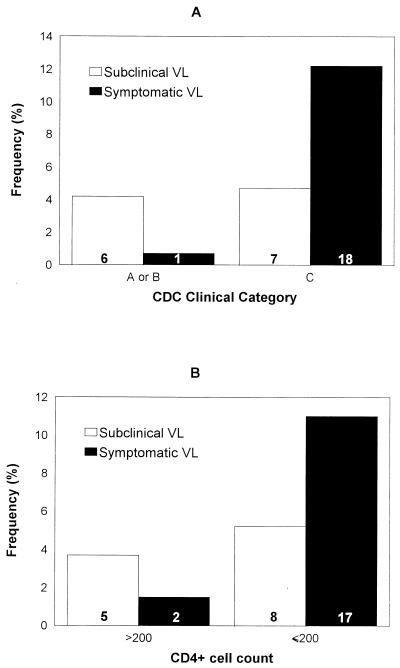
The actual prevalence of visceral leishmaniasis among human immunodeficiency type 1 (HIV-1)-infected patients in the Mediterranean basin remains unknown. There is also controversy about the risk factors for Leishmania infantum and HIV-1 coinfection. To appraise the prevalence of visceral leishmaniasis in patients infected with HIV-1 in southern Spain and to identify factors associated with this disease, 291 HIV-1 carriers underwent a bone marrow aspiration, regardless of their symptoms. Giemsa-stained samples were searched for Leishmania amastigotes. Thirty-two (11%) patients showed visceral leishmaniasis. Thirteen (41%) patients had subclinical cases of infection. Centers for Disease Control and Prevention (CDC) clinical category C was the factor most strongly associated with this disease (adjusted odds ratio [OR], 1.88 [95% confidence interval, 1.22 to 2.88]), but patients with subclinical cases of infection were found in all CDC categories. Female sex was negatively associated with visceral leishmaniasis (adjusted OR, 0.42 [95% confidence interval, 0.18 to 0.97]). Intravenous drug users showed a higher prevalence than the remaining patients (13.3 versus 4.9%; P = 0.04), but such an association was not independent. These results show that visceral leishmaniasis is a very prevalent disease among HIV-1-infected patients in southern Spain, with a high proportion of cases being subclinical. Like other opportunistic infections, subclinical visceral leishmaniasis can be found at any stage of HIV-1 infection, but symptomatic cases of infection appear mainly when a deep immunosuppression is present. There is also an association of this disease with male sex and intravenous drug use.
Figures
References
-
- Acedo Sánchez C, Martín Sánchez J, Vélez Bernal I D, Sanchís Marín M C, Louassini M, Maldonado J A, Morillas Márquez F. Leishmaniasis eco-epidemiology in the Alpujarra region (Granada province, southern Spain) Int J Parasitol. 1996;25:303–310. - PubMed
-
- Albrecht H, Sobottka I, Emminger C, Jablonowski H, Just G, Stoehr A, Kubin T, Salzberger B, Lutz T, van Lunzen J. Visceral leishmaniasis emerging as an important opportunistic infection in HIV-infected persons living in areas nonendemic for Leishmania donovani. Arch Pathol Lab Med. 1996;120:189–198. - PubMed
-
- Alvar J, Gutiérrez-Solar B, Molina R, López-Vélez R, García-Camacho A, Martínez P, Laguna F, Cercenado E, Galmes A. Prevalence of Leishmania infection among AIDS patients. Lancet. 1992;339:1427. - PubMed
-
- Alvar J, Gutiérrez-Solar B, Pachón I, Calbacho E, Ramírez M, Vallés R, Guillén J L, Cañavete C, Amela C. AIDS and Leishmania infantum. New approaches for a new epidemiological problem. Clin Dermatol. 1996;14:541–546. - PubMed
-
- Alvar J, Jiménez M. Could infected drug users be potential Leishmania infantum reservoirs? AIDS. 1994;8:6. - PubMed
Publication types
MeSH terms
LinkOut - more resources
Full Text Sources
Medical
