


doi: 10.1128/JCM.36.9.2443-2446.1998.
Strategy for optimizing DNA amplification in a peripheral blood PCR assay used for diagnosis of human brucellosis
Affiliations
- PMID: 9705371
- PMCID: PMC105141
- DOI: 10.1128/JCM.36.9.2443-2446.1998
Item in Clipboard
Strategy for optimizing DNA amplification in a peripheral blood PCR assay used for diagnosis of human brucellosis
J Clin Microbiol.
1998 Sep.
Abstract
We studied two of the possible factors which can interfere with specific DNA amplification in a peripheral-blood PCR assay used for the diagnosis of human brucellosis. We found that high concentrations of leukocyte DNA and heme compounds inhibit PCR. These inhibitors can be efficiently suppressed by increasing the number of washings to four or five and decreasing the amount of total DNA to 2 to 4 microg, thereby avoiding false-negative results.
Figures
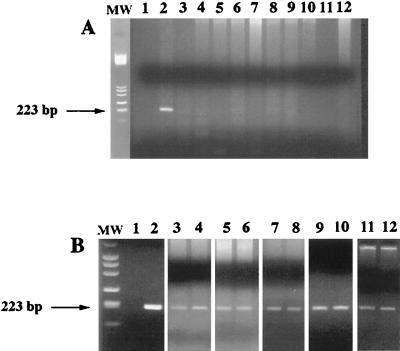
(A) Agarose gel electrophoresis and ethidium bromide staining. Lane MW, DNA ladder; lane 1, no DNA added; lane 2, positive control (B. abortus B-19 DNA); lanes 3 to 12, DNAs from five patients with brucellosis for which PCR was carried out in duplicate, with two washings and high concentrations of total DNA. (B) Results for DNA in samples from the same five patients, with the number of washing steps increased to four or five and the amount of total DNA decreased to 2 to 4 μg. The photocomposition of the figure was obtained from the original Polaroid films with a ScanJed IIcx scanner (Hewlett-Packard, Corvallis, Oreg.). After the initial image was scanned and saved as a TIFF file, the file was opened in Adobe Photoshop, version 3.0 (Adobe System, Inc., Seattle, Wash.).
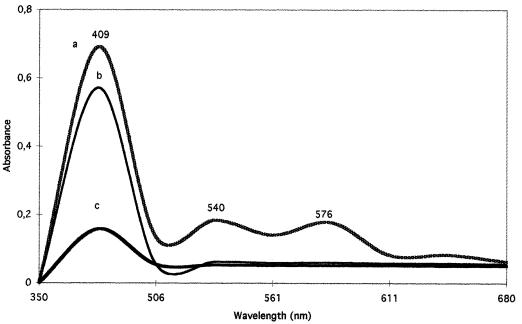
Spectra at 350 to 680 nm of hemoglobin from an erythrocyte lysis solution (a), after two washings of the leukocyte pellet with ammonium acetate in the DNA purification step (b), and after four washings of the leukocyte pellet under the same conditions (c). The spectral peaks at 540 and 576 nm are characteristic of oxyhemoglobin. The spectral peak at 409 nm (Soret band) is characteristic of porphyrins and heme compound derivatives.
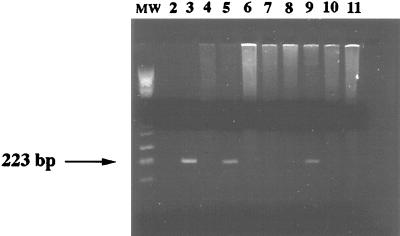
Agarose gel electrophoresis and ethidium bromide staining. Lane MW, DNA ladder; lane 2, no DNA added; lane 3, positive control (B. abortus B-19 DNA); lanes 4 and 6, DNAs from a patient with brucellosis and a healthy subject, respectively, after two washings and with total DNA amounts within the correct range (2 to 4 μg); lanes 5 and 7, DNAs from a patient with brucellosis and a healthy subject, respectively, after four washings and with total DNA amounts within the correct range (2 to 4 μg); lanes 8 and 10, DNAs from a patient with brucellosis and a healthy subject, respectively, after four washings and with large amounts of total DNA (8 to 11 μg); lanes 9 and 11, DNAs from a patient with brucellosis and a healthy subject, respectively, after four washings and with total DNA amounts within the correct range (2 to 4 μg).
References
-
- Akane A, Matsubara K, Nakamura H, Takahashi S, Kimura K. Identification of the heme compound copurified with deoxyribonucleic acid (DNA) from bloodstains, a major inhibitor of polymerase chain reaction (PCR) amplification. J Forensic Sci. 1994;39:362–372. - PubMed
-
- Akane A, Matsubara K, Nakamura H, Takahashi S, Kimura K. Purification of highly degraded DNA by gel filtration for PCR. BioTechniques. 1994;16:235–238. - PubMed
-
- Akane A. Hydrogen peroxide decomposes the heme compound in forensic specimens and improves the efficiency of PCR. BioTechniques. 1996;21:392–394. - PubMed
-
- Baily G G, Krahn J B, Drasar B S, Stoker N G. Detection of Brucella melitensis and Brucella abortus by DNA amplification. J Trop Med Hyg. 1992;95:271–275. - PubMed
Publication types
MeSH terms
Substances
LinkOut - more resources
Full Text Sources
Other Literature Sources
