. 1998 Sep;36(9):2634-9.
doi: 10.1128/JCM.36.9.2634-2639.1998.

Typing of dengue viruses in clinical specimens and mosquitoes by single-tube multiplex reverse transcriptase PCR

Affiliations

Typing of dengue viruses in clinical specimens and mosquitoes by single-tube multiplex reverse transcriptase PCR

E Harris et al. J Clin Microbiol. 1998 Sep.

Abstract

In recent years, dengue viruses (serotypes 1 to 4) have spread throughout tropical regions worldwide. In many places, multiple dengue virus serotypes are circulating concurrently, which may increase the risk for the more severe form of the disease, dengue hemorrhagic fever. For the control and prevention of dengue fever, it is important to rapidly detect and type the virus in clinical samples and mosquitoes. Assays based on reverse transcriptase (RT) PCR (RT-PCR) amplification of dengue viral RNA can offer a rapid, sensitive, and specific approach to the typing of dengue viruses. We have reduced a two-step nested RT-PCR protocol to a single-tube reaction with sensitivity equivalent to that of the two-step protocol (1 to 50 PFU) in order to maximize simplicity and minimize the risk of sample cross-contamination. This assay was also optimized for use with a thermostable RT-polymerase. We designed a plasmid-based internal control that produces a uniquely sized product and can be used to control for both reverse transcription or amplification steps without the risk of generating false-positive results. This single-tube RT-PCR procedure was used to type dengue viruses during the 1995 and 1997-1998 outbreaks in Nicaragua. In addition, an extraction procedure that permits the sensitive detection of viral RNA in pools of up to 50 mosquitoes without PCR inhibition or RNA degradation was developed. This assay should serve as a practical tool for use in countries where dengue fever is endemic, in conjunction with classical methods for surveillance and epidemiology of dengue viruses.


Figures
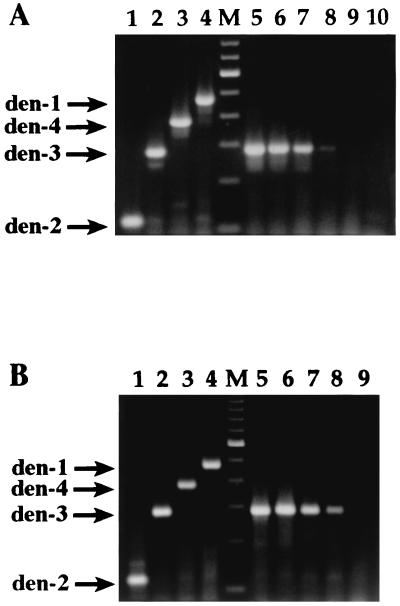
FIG. 1
FIG. 1
Detection and typing of dengue virus by using two versions of the RT-PCR assay. (A) Reverse transcription with RAV-2 RT and amplification with Taq DNA polymerase; (B) reverse transcription and amplification with the bifunctional enzyme rTth. (A and B) Lanes 1, dengue-2 (den-2); lanes 2, dengue-3 (den-3); lanes 3, dengue-4 (den-4); lanes 4, dengue-1 (den-1); lanes M, 100-bp ladder (lowest band shown, 100 bp); lanes 5 to 8, dengue-3 at 1,000, 100, 10, and 1 PFU, respectively. (A) Lane 9, 0 pfu; lane 10, water (negative control). (B) Lane 9, water. Expected product sizes are as follows: dengue-2, 119 bp; dengue-3, 290 bp; dengue-4, 389 bp; dengue-1, 482 bp.
FIG. 2
FIG. 2
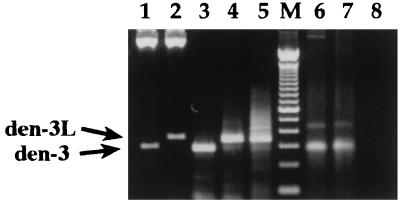
Uniquely sized internal control. Lanes 1 and 2, authentic dengue-3 amplicon (den-3) and dengue-3 amplicon containing the 54-bp insert (den-3L), respectively, excised from pBD3 and pBD3L with EcoRI and BamHI; lanes 3 to 5, RT-PCR products derived from pBD3, pBD3L, and the DNase-treated in vitro transcript of pBD3L, respectively; lane M, 100-bp ladder (lowest band shown, 100 bp); lane 6, in vitro transcript of pBD3L; lane 7, DNase-treated in vitro transcript of pBD3L; lane 8, RNase-treated in vitro transcript of pBD3L. Expected product sizes are as follows: dengue-3, 290 bp; dengue-3L, 350 bp.
FIG. 3
FIG. 3
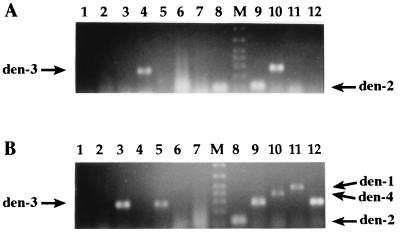
RT-PCR detection and typing of dengue virus in serum from patients infected during the 1995 epidemic in Nicaragua. RNA was extracted from serum samples and was amplified by the two-enzyme single-tube RT-PCR assay as described in Materials and Methods. (A) Lane 1, negative control (water); lanes 2 to 8, 11, and 12, samples from patients from the Atlantic coast of Nicaragua (Bluefields); lane M, Amplisize DNA size standards (lowest band shown, 100 bp); lane 9, dengue-2 (den-2) RNA (positive control); lane 10, dengue-3 (den-3) RNA (positive control). (B) Lanes 1 to 7, samples from patients from the Atlantic coast of Nicaragua (Bluefields); lane M, Amplisize DNA size standards (lowest band shown, 100 bp); lane 8, dengue-2 (den-2) RNA (positive control); lane 9, dengue-3 (den-3) RNA (positive control); lane 10, dengue-4 (den-4) RNA (positive control); lane 11, dengue-1 (den-1) RNA (positive control); lane 12, sample from a patient from central Nicaragua (Chontales). Expected products sizes are as follows: dengue-2, 119 bp; dengue-3, 290 bp; dengue-4, 389 bp; dengue-1, 482 bp.
FIG. 4
FIG. 4
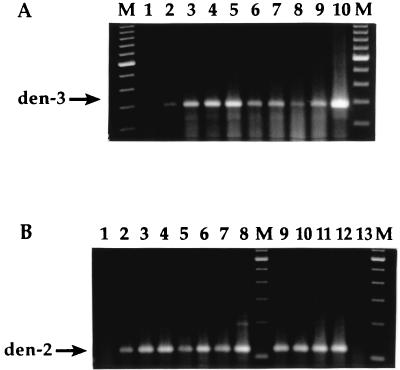
(A) Detection of dengue virus in pools of mosquitoes by RT-PCR. A total of 350 PFU of dengue-3 (den-3) was added to pools of mosquitoes, which were then macerated. RNA was extracted as described in Materials and Methods, and one-fourth of the extract was amplified by RT-PCR (RAV-2 RT–Taq polymerase). Lanes 2, 4, 6, and 8, silica particle eluate; lanes 3, 5, 7, and 9, pellet. Lane 1, water (negative control); lanes 2 and 3, 0 mosquitoes; lanes 4 and 5, 5 mosquitoes; lanes 6 and 7, 25 mosquitoes; lanes 8 and 9, 50 mosquitoes; lane 10, dengue-2 RNA (positive control); lane M, 100-bp ladder (lowest band shown, 200 bp). (B) Detection of dengue virus in laboratory-infected mosquitoes. Mosquitoes were inoculated with dengue-2 (den-2; strain 16681) and were frozen at −70°C on the indicated days postinoculation. RNA was extracted and amplified by RT-PCR (RAV-2 RT–Taq polymerase). Lane 1, 5 uninfected mosquitoes; lane 2, one mosquito, one day postinoculation; lane 3, one mosquito, 2 days postinoculation; lane 4, one mosquito, 3 days postinoculation; lane 5, one mosquito, 4 days postinoculation; lane 6, one mosquito, 6 days postinoculation; lane 7, one mosquito, 7 days postinoculation; lane 8, one mosquito, 21 days postinoculation; lane M, 100-bp ladder (lowest band shown, 100 bp); lane 9, five mosquitoes, 2 days postinoculation; lane 10, five mosquitoes, 7 days postinoculation; lane 11, five mosquitoes frozen 2 days after natural death; lane 12, dengue-2 RNA (positive control); lane 13, water (negative control).

References

    1. Belli A, Rodriguez B, Avilés H, Harris E. Simplified PCR detection of New World Leishmania from clinical specimens. Am J Trop Med Hyg. 1998;58:102–109. - PubMed
    1. Centers for Disease Control and Prevention. Dengue type 3 infection—Nicaragua and Panama, October-November, 1994. Morbid Mortal Weekly Rep. 1995;44:21–24. - PubMed
    1. Centers for Disease Control and Prevention. Outbreak of acute febrile illness and pulmonary hemorrhage—Nicaragua, 1995. JAMA. 1995;274:1668. - PubMed
    1. Chan S-Y, Kautner I M, Lam S-K. The influence of antibody levels in dengue diagnosis by polymerase chain reaction. J Virol Methods. 1994;49:315–322. - PubMed
    1. Chevet E, Lemaitre G, Katinka M D. Low concentrations of tetramethylammonium chloride increase yield and specificity of PCR. Nucleic Acids Res. 1995;23:3343–3344. - PMC - PubMed

Publication types