


Detection of Helicobacter pylori in stool specimens by PCR and antigen enzyme immunoassay
- PMID: 9705436
- PMCID: PMC105206
- DOI: 10.1128/JCM.36.9.2772-2774.1998
Detection of Helicobacter pylori in stool specimens by PCR and antigen enzyme immunoassay
Abstract
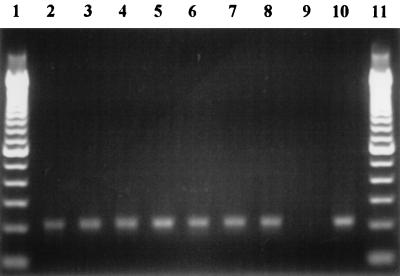
A highly sensitive seminested PCR assay to detect Helicobacter pylori DNA in feces was developed. PCR with stool specimens and a novel antigen enzyme immunoassay (EIA) for H. pylori detection in feces were evaluated as diagnostic tools and in follow-up with samples from 63 infected and 37 noninfected persons. Infected individuals received eradication therapy followed by endoscopic follow-up 35 days after the start of treatment. At that time, a second stool specimen was obtained from 55 of these patients. Before eradication, the sensitivity of PCR was 93.7% and that of EIA 88.9%. Specificities were 100 and 94.6%, respectively. Of the 55 follow-up specimens, 41 originated from patients from whom H. pylori had been eradicated. Of these, 21 were still positive by PCR and 13 were positive by EIA, indicating that 1 month may be too short a period for follow-up evaluation of stool specimens by these tests.
Figures
References
-
- Banatvala N, Mayo K, Megraud F, Jennings R, Deeks J J, Feldman R A. The cohort effect and Helicobacter pylori. J Infect Dis. 1993;168:219–221. - PubMed
-
- Blaser M J. Gastric Campylobacter-like organisms, gastritis and peptic ulcer disease. Gastroenterology. 1987;93:371–383. - PubMed
-
- Hopkins R J, Morris J G. Helicobacter pylori: the missing link in perspective. Am J Med. 1994;97:265–277. - PubMed
MeSH terms
Substances
LinkOut - more resources
Full Text Sources
Other Literature Sources
Medical
