


Generation of a strong mutator phenotype in yeast by imbalanced base excision repair
- PMID: 9707589
- PMCID: PMC21450
- DOI: 10.1073/pnas.95.17.9997
Generation of a strong mutator phenotype in yeast by imbalanced base excision repair
Abstract
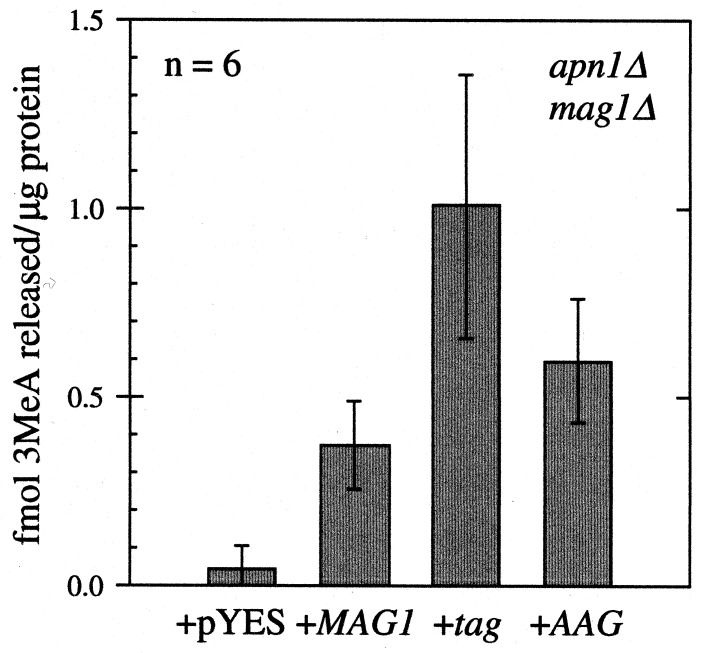
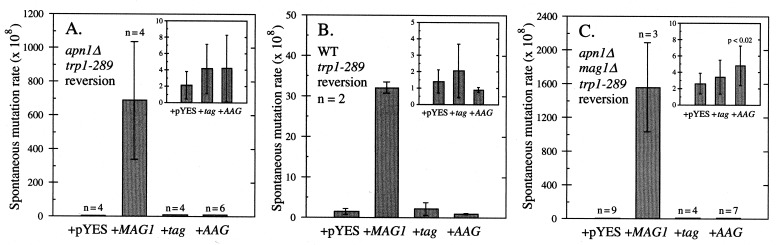
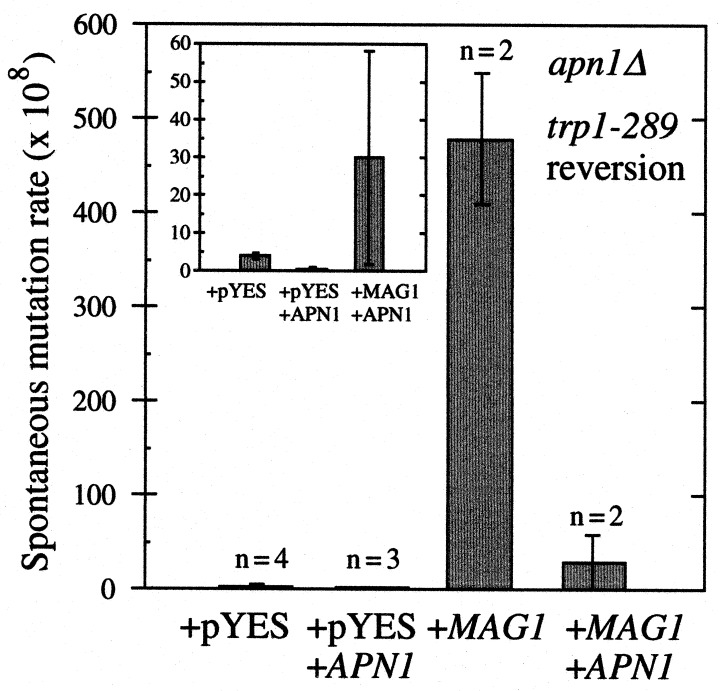
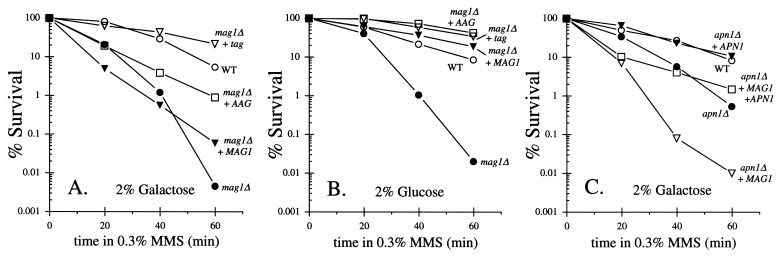
Increased spontaneous mutation is associated with increased cancer risk. Here, by using a model system, we show that spontaneous mutation can be increased several hundred-fold by a simple imbalance between the first two enzymes involved in DNA base excision repair. The Saccharomyces cerevisiae MAG1 3-methyladenine (3MeA) DNA glycosylase, when expressed at high levels relative to the apurinic/apyrimidinic endonuclease, increases spontaneous mutation by up to approximately 600-fold in S. cerevisiae and approximately 200-fold in Escherichia coli. Genetic evidence suggests that, in yeast, the increased spontaneous mutation requires the generation of abasic sites and the processing of these sites by the REV1/REV3/REV7 lesion bypass pathway. Comparison of the mutator activity produced by Mag1, which has a broad substrate range, with that produced by the E. coli Tag 3MeA DNA glycosylase, which has a narrow substrate range, indicates that the removal of endogenously produced 3MeA is unlikely to be responsible for the mutator effect of Mag1. Finally, the human AAG 3-MeA DNA glycosylase also can produce a small (approximately 2-fold) but statistically significant increase in spontaneous mutation, a result which could have important implications for carcinogenesis.
Figures
References
-
- Friedberg E C, Walker G C, Siede W. DNA Repair and Mutagenesis. Washington, DC: Am. Soc. Microbiol.; 1995.
-
- Lawrence C W. Adv Genet. 1982;21:173–254. - PubMed
-
- Miller J H. Annu Rev Microbiol. 1996;50:625–643. - PubMed
-
- Hall M, Johnson R T. Mol Aspects Med. 1996;17:235–383. - PubMed
-
- Wilson D M, Engelward B P, Samson L. In: DNA Damage and Repair: Biochemistry, Genetics and Cell Biology. Nickoloff J A, Hoekstra M F, editors. Vol. 1. Totowa, NJ: Humana Press; 1997.
Publication types
MeSH terms
Substances
Grants and funding
LinkOut - more resources
Full Text Sources
Other Literature Sources
Molecular Biology Databases
Miscellaneous
