


Restriction endonuclease-mediated selective polymerase chain reaction: a novel assay for the detection of K-ras mutations in clinical samples
- PMID: 9708798
- PMCID: PMC1852993
- DOI: 10.1016/S0002-9440(10)65581-2
Restriction endonuclease-mediated selective polymerase chain reaction: a novel assay for the detection of K-ras mutations in clinical samples
Abstract
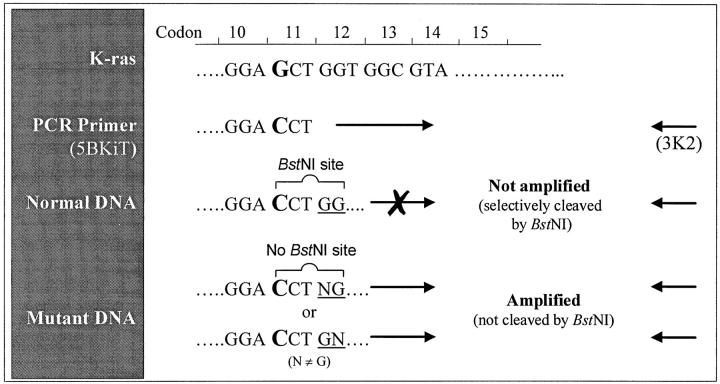
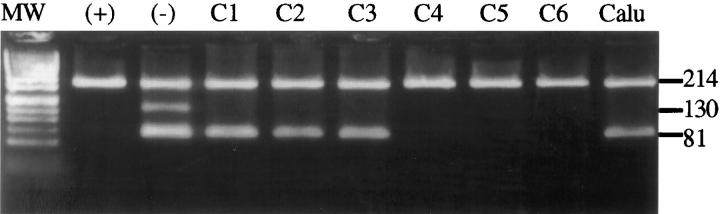
The enriched polymerase chain reaction (PCR) assay has been used extensively in the detection of ras gene mutations in many types of human malignancies. Although it is very sensitive, it has a number of features that limit its use in the routine diagnostic laboratory. The aim of this study was to develop a novel enriched PCR strategy, in which the concurrent activity of the restriction enzyme BstNI and Taq polymerase allowed the amplification of mutant K-ras while inhibiting the formation of wild-type product. This restriction endonuclease-mediated selective PCR assay uses three sets of primers, together with BstNI, in the reaction mix, and the amplification products are analyzed by gel electrophoresis. The reliability of the restriction endonuclease-mediated selective PCR assay to detect activated K-ras was determined in a variety of clinical samples, including 139 fresh colorectal carcinomas and 113 paraffin-embedded blocks from 80 separate tumors of the colon and rectum, pancreas, breast, or kidney. Codon 12 mutations of the K-ras oncogene were identified in DNA from both fresh and paraffin-embedded tumors in a rapid, sensitive, and reproducible manner. Mutations were detected in 33 (24%) of the fresh colorectal cancers and 16 (20%) of the paraffin-embedded tumors. These results were 97% concordant in cases in which paraffin blocks and fresh specimens from the same tumor were available for analysis. We conclude that restriction endonuclease-mediated selective PCR is a sensitive, rapid, and robust assay for the detection of point mutations in a variety of clinical samples. Importantly, there is no need for manipulation of the sample once the PCR has been set up, and therefore, the chance of contamination is significantly reduced. In contrast to previous assays, restriction endonuclease-mediated selective PCR is not labor intensive, and its format is suitable for use in routine diagnostic laboratory.
Figures

References
-
- Barbacid M: ras genes. Annu Rev Biochem 1987, 56:779-827 - PubMed
-
- Almoguera C, Shibata D, Forrester K, Martin J, Arnheim N, Perucho M: Most human carcinomas of the exocrine pancreas contain mutant c-K-ras genes. Cell 1988, 53:549-554 - PubMed
-
- Bos JL: ras oncogenes in human cancer: a review. Cancer Res 1989, 49:4682-4689 - PubMed
-
- Vogelstein B, Fearon ER, Hamilton SR, Kern SE, Preisinger AC, Leppert M, Nakamura Y, White R, Smits AMM, Bos JI: Genetic alterations during colorectal-tumor development. N Engl J Med 1988, 319:525-532 - PubMed
-
- Sidransky D, Tokino Y, Hamilton SR, Kinzler KW, Levin B, Frost P, Vogelstein B: Identification of ras oncogene mutations in the stool of patients with curable colorectal tumors. Science 1992, 256:102-105 - PubMed
Publication types
MeSH terms
Substances
LinkOut - more resources
Full Text Sources
Other Literature Sources
Miscellaneous
