Effectiveness of the postcoital test: randomised controlled trial
- PMID: 9712594
- PMCID: PMC28641
- DOI: 10.1136/bmj.317.7157.502
Effectiveness of the postcoital test: randomised controlled trial
Abstract
Objectives: To investigate the impact of the postcoital test on the pregnancy rate among subfertile couples and on the number of other diagnostic tests and treatments.
Design: Randomised controlled study.
Setting: A university and two non-university teaching hospitals in the Netherlands.
Subjects: New couples at infertility clinics, 1 March 1993 to 1 October 1995; randomisation to an intervention group (series of infertility investigations that include the postcoital test) or to a control group (series excluding the test).
Main outcome measure: Cumulative pregnancy rate.
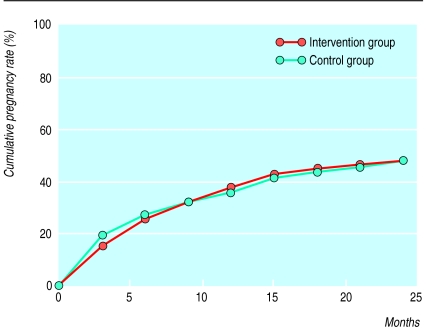
Results: Of 736 consecutive new couples, 444 fulfilled the inclusion criteria and consented to participate (intervention group, 227; control group, 217). Treatment was given more often in the intervention group than in the control group (54% v 41%; difference 13% (95% confidence interval 4% to 22%)). Yet cumulative pregnancy rates at 24 months in the intervention group (49% (42% to 55%)) and the control group (48% (42% to 55%)) were closely similar (difference 1% (-9.0% to 9.0%)).
Conclusion: Routine use of the postcoital test in infertility investigations leads to more tests and treatments but has no significant effect on the pregnancy rate.
Figures
Comment in
-
Cerebral sinus thrombosis and oral contraceptives. There are limits to predictability.BMJ. 1998 Aug 22;317(7157):483-4. doi: 10.1136/bmj.317.7157.483. BMJ. 1998. PMID: 9712588 Free PMC article. No abstract available.
-
Postcoital testing. Criterion for positive test was not given.BMJ. 1999 Apr 10;318(7189):1007; author reply 1008-9. doi: 10.1136/bmj.318.7189.1007a. BMJ. 1999. PMID: 10195980 Free PMC article. No abstract available.
-
Postcoital testing. Male partner should be assessed.BMJ. 1999 Apr 10;318(7189):1007-8; author reply 1008-9. BMJ. 1999. PMID: 10336277 No abstract available.
-
Postcoital testing. Postcoital test should be performed as routine infertility test.BMJ. 1999 Apr 10;318(7189):1008-9. BMJ. 1999. PMID: 10336278 No abstract available.
References
-
- Sims JM. Clinical notes on uterine surgery (with special reference to the management of the sterile condition). London: Robert Hardwicke; 1866.
-
- Oei SG, Keirse MJNC, Bloemenkamp KWM, Helmerhorst FM. European postcoital tests: opinions and practice. Br J Obstet Gynaecol. 1995;102:621–624. - PubMed
-
- Griffith CS, Grimes DA. The validity of the postcoital test. Am J Obstet Gynecol. 1990;162:615–620. - PubMed
-
- Oei SG, Helmerhorst FM, Keirse MJNC. When is the postcoital test normal: a critical appraisal. Hum Reprod. 1995;10:1711–1714. - PubMed
-
- Glazener CMA, Coulson C, Lambert PA, Watt EM, Hinton RA, Kelly NJ, et al. The value of artificial insemination with husband’s semen in infertility due to failure of postcoital sperm-mucus penetration-controlled trial of treatment. Br J Obstet Gynaecol. 1987;94:774–778. - PubMed
Publication types
MeSH terms
LinkOut - more resources
Full Text Sources
Medical