. 1998 Sep;66(9):4290-8.
doi: 10.1128/IAI.66.9.4290-4298.1998.

Involvement of the Haemophilus ducreyi gmhA gene product in lipooligosaccharide expression and virulence

Affiliations

Involvement of the Haemophilus ducreyi gmhA gene product in lipooligosaccharide expression and virulence

B A Bauer et al. Infect Immun. 1998 Sep.

Abstract

The lipooligosaccharide (LOS) present in the outer membrane of Haemophilus ducreyi is likely a virulence factor for this sexually transmitted pathogen. An open reading frame in H. ducreyi 35000 was found to encode a predicted protein that had 87% identity with the protein product of the gmhA (isn) gene of Haemophilus influenzae. In H. influenzae type b, inactivation of the gmhA gene caused the synthesis of a significantly truncated LOS which possessed only lipid A and a single 2-keto-3-deoxyoctulosonic acid molecule (A. Preston, D. J. Maskell, A. Johnson, and E. R. Moxon, J. Bacteriol. 178:396-402, 1996). The H. ducreyi gmhA gene was able to complement a gmhA-deficient Escherichia coli strain, a result which confirmed the identity of this gene. When the gmhA gene of H. ducreyi was inactivated by insertion of a cat cartridge, the resultant H. ducreyi gmhA mutant, 35000.252, expressed a LOS that migrated much faster than wild-type LOS in sodium dodecyl sulfate-polyacrylamide gel electrophoresis. When the wild-type H. ducreyi strain and its isogenic gmhA mutant were used in the temperature-dependent rabbit model for dermal lesion production by H. ducreyi, the gmhA mutant was found to be substantially less virulent than the wild-type parent strain. The H. ducreyi gmhA gene was amplified by PCR from the H. ducreyi chromosome and cloned into the pLS88 vector. When the H. ducreyi gmhA gene was present in trans in gmhA mutant 35000.252, expression of the gmhA gene product restored the virulence of this mutant to wild-type levels. These results indicate that the gmhA gene product of H. ducreyi is essential for the expression of wild-type LOS by this pathogen.


Figures
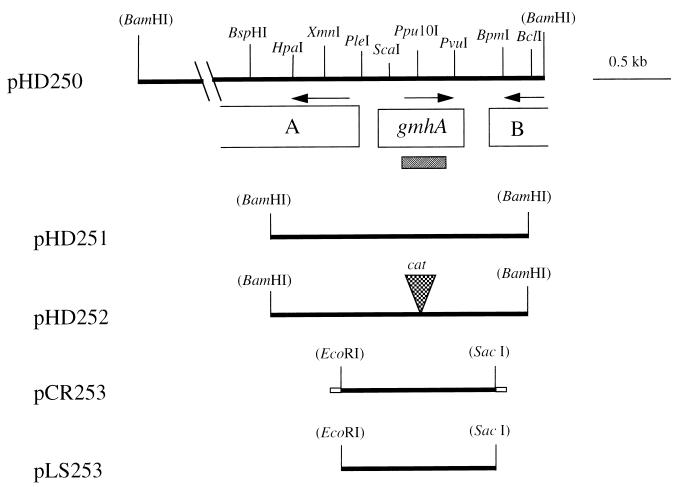
FIG. 1
FIG. 1
Partial restriction map of the H. ducreyi 35000 chromosomal DNA insert in pHD250 and related plasmids. A and B indicate incomplete ORFs upstream and downstream of gmhA, respectively. Restriction sites in parentheses indicate vector cloning sites. Arrows indicate the predicted direction of transcription. The cross-hatched bar beneath the gmhA gene indicates the 330-bp probe used for the Southern blot analysis shown in Fig. 4. Plasmid pHD251 contains a 1.6-kb PCR product. A cat cartridge was ligated into the Ppu10I site of pHD251 to construct pHD252. Plasmid pCR253 is pCR2.1 with a 1-kb PCR product containing the gmhA gene and flanking DNA; the small boxes on the ends of this insert represent nucleotides involved in cloning into the pCR2.1 vector. Plasmid pLS253 is pLS88 with the aforementioned 1-kb PCR product cloned into the EcoRI and SacI sites of this vector.
FIG. 2
FIG. 2
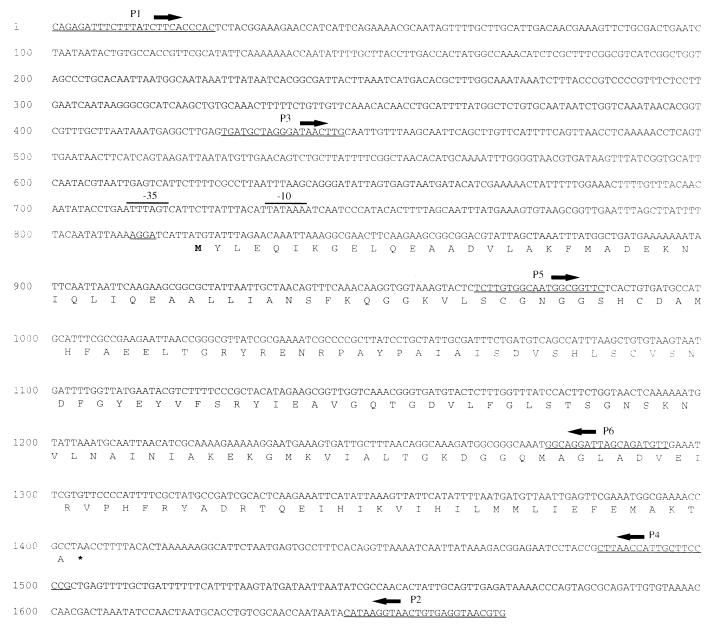
Nucleotide sequence and deduced amino acid sequence of the H. ducreyi 35000 gmhA gene and its predicted protein product; the sequence is from the DNA insert in pHD251 (Fig. 1). Lines above the sequence show putative −10 and −35 regions. A putative Shine-Dalgarno site is underlined. Oligonucleotide primers used in PCR are underlined and labeled P1 to P6 with directional arrows.
FIG. 3
FIG. 3
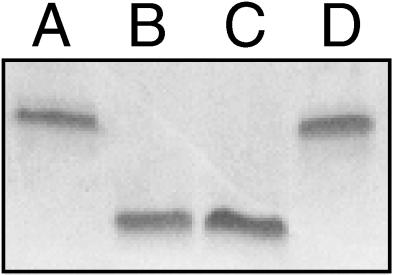
SDS-PAGE analysis of LPSs expressed by gmhA-deficient E. coli χ711 and related E. coli strains. LPS present in proteinase K-treated whole-cell lysates was resolved by Tricine-SDS-PAGE and stained with silver. Lanes: A, E. coli χ705 with a wild-type E. coli gmhA gene; B, E. coli χ711; C, E. coli χ711 containing the pCR2.1 vector; D, E. coli χ711 containing pCR253 with the wild-type H. ducreyi gmhA gene.
FIG. 4
FIG. 4
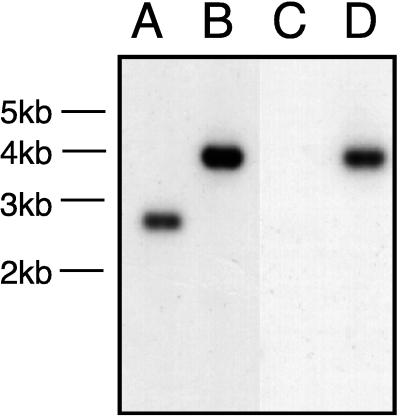
Southern blot analysis of chromosomal DNA preparations from wild-type H. ducreyi 35000 (lanes A and C) and isogenic gmhA mutant 35000.252 (lanes B and D). Chromosomal DNAs were digested with AflIII, resolved by agarose gel electrophoresis, and probed with either a 330-bp PCR product derived from the H. ducreyi gmhA gene (lanes A and B) or the cat cartridge (lanes C and D). Size markers are on the left side of the figure.
FIG. 5
FIG. 5
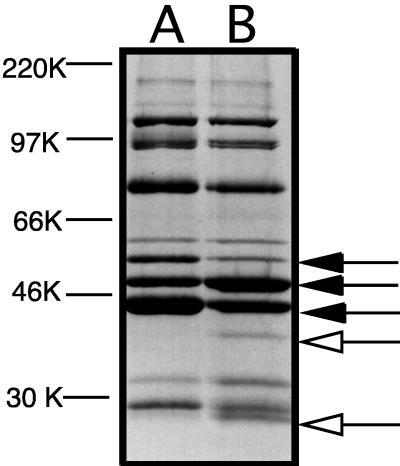
Comparison of outer membrane proteins from wild-type and mutant H. ducreyi strains. Proteins present in the Sarkosyl-insoluble cell envelope fraction from wild-type parent strain 35000 (lane A) and isogenic gmhA mutant 35000.252 (lane B) were resolved by SDS-PAGE and stained with Coomassie blue. The three closed arrows indicate major outer membrane proteins whose relative abundances in these two strains were different. The two open arrows indicate the two proteins which were present in the mutant but absent in the wild-type parent strain. Molecular weight markers (in thousands [K]) are shown on the left side of the figure.
FIG. 6
FIG. 6
Characterization of the LOSs expressed by wild-type, mutant, and complemented mutant strains of H. ducreyi. LOS present in proteinase K-treated whole-cell lysates was resolved by SDS-PAGE and either stained with silver (panel 1) or transferred to nitrocellulose for Western blot analysis with the H. ducreyi LOS-specific MAb 3E6 (panel 2). Lanes: A, wild-type strain 35000; B, rfaK (lbgB) mutant 35000.7; C, isogenic gmhA mutant 35000.252; D, 35000.252(pLS88); E, 35000.252(pLS253).

References

    1. Ahmed H J, Frisk A, Mansson J-E, Schweda E K H, Lagergard T. Structurally defined epitopes of Haemophilus ducreyi lipooligosaccharides recognized by monoclonal antibodies. Infect Immun. 1997;65:3151–3158. - PMC - PubMed
    1. Alfa M J, DeGagne P A, Totten P A. Haemophilus ducreyi hemolysin acts as a contact cytotoxin and damages human foreskin fibroblasts in cell culture. Infect Immun. 1996;64:2349–2352. - PMC - PubMed
    1. Altschul S F, Gish W, Miller W, Myers E W, Lipman D J. Basic local alignment search tool. J Mol Biol. 1990;215:403–410. - PubMed
    1. Ausubel F M, Brent R, Kingston R E, Moore D D, Smith J A, Seidman J G, Struhl K. Current protocols in molecular biology. New York, N.Y: Green Publishing Associates and Wiley Interscience; 1990.
    1. Barcak G J, Chandler M S, Redfield R J, Tomb J. Genetic systems in Haemophilus influenzae. Methods Enzymol. 1991;204:321–342. - PubMed

Publication types

MeSH terms

Associated data

LinkOut - more resources