


Genomic analysis of a pathogenicity island in uropathogenic Escherichia coli CFT073: distribution of homologous sequences among isolates from patients with pyelonephritis, cystitis, and Catheter-associated bacteriuria and from fecal samples
- PMID: 9712795
- PMCID: PMC108533
- DOI: 10.1128/IAI.66.9.4411-4417.1998
Genomic analysis of a pathogenicity island in uropathogenic Escherichia coli CFT073: distribution of homologous sequences among isolates from patients with pyelonephritis, cystitis, and Catheter-associated bacteriuria and from fecal samples
Abstract
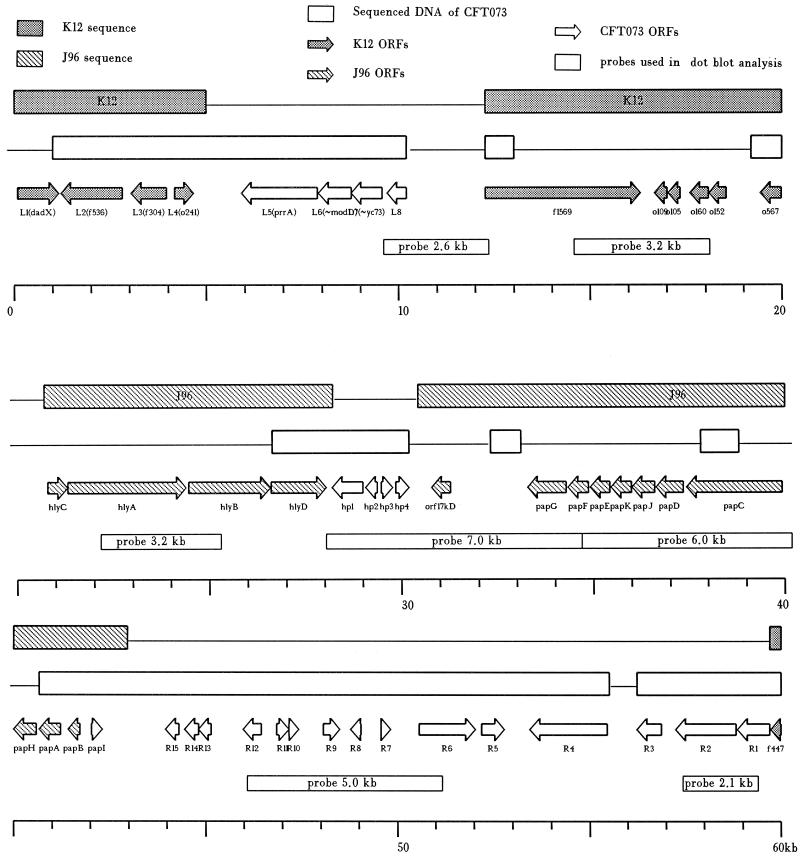
Urinary tract infection is the most frequently diagnosed kidney and urologic disease and Escherichia coli is by far the most common etiologic agent. Uropathogenic strains have been shown to contain blocks of DNA termed pathogenicity islands (PAIs) which contribute to their virulence. We have defined one of these regions of DNA within the chromosome of a highly virulent E. coli strain, CFT073, isolated from the blood and urine of a woman with acute pyelonephritis. The 57,988-bp stretch of DNA has characteristics which define PAIs, including a size greater than 30 kb, the presence of insertion sequences, distinct segmentation of K-12 and J96 origin, GC content (42.9%) different from that of total genomic DNA (50.8%), and the presence of virulence genes (hly and pap). Within this region, we have identified 44 open reading frames; of these 44, 10 are homologous to entries in the complete K-12 genome sequence, 4 are nearly identical to the sequences of E. coli J96 encoding the HlyA hemolysin, 11 encode P fimbriae, and 19 show no homology to J96 or K-12 entries. To determine whether sequences found within the junctions of the PAI of CFT073 were common to other uropathogenic strains of E. coli, 11 probes were isolated along the length of the PAI and were hybridized to dot blots of genomic DNA isolated from clinical isolates (67 from patients with acute pyelonephritis, 38 from patients with cystitis, 49 from patients with catheter-associated bacteriuria, and 27 from fecal samples). These sequences were found significantly more often in strains associated with the clinical syndromes of acute pyelonephritis (79%) and cystitis (82%) than in those associated with catheter-associated bacteriuria (58%) and in fecal strains (22%) (P < 0.001). From these regions, we have identified a putative iron transport system and genes other than hly and pap that may contribute to the virulent phenotype of uropathogenic E. coli strains.
Figures
References
-
- Blattner F R, Plunkett III G, Bloch C A, Perna N T, Burland V, Riley M, Collado-Vides J, Glasner J D, Rode C K, Mayhew G F, Gregor J, Davis N W, Kirkpatrick H A, Goeden M A, Rose D J, Mau B, Shao Y. The complete genome sequence of Escherichia coli K-12. Science. 1997;277:1453–1462. - PubMed
-
- Blum G, Falbo V, Caprioli A, Hacker J. Gene clusters encoding the cytotoxic necrotizing factor type 1, Prs-fimbriae, and α-hemolysin form of the pathogenicity island II of the uropathogenic Escherichia coli strain J96. FEMS Microbiol Lett. 1995;126:189–196. - PubMed
-
- Brown E A, D’Ari R, Newman E. A relationship between l-serine degradation and methionine biosynthesis in Escherichia coli K-12. J Gen Microbiol. 1990;136:1017–1023. - PubMed
-
- Deonier R C. Native insertion sequence elements: locations, distributions, and sequence relationships. In: Neidhardt F C, Curtiss III R, Ingraham J L, Lin E C C, Low K B, Magasanik B, Reznikoff W S, Riley M, Schaechter M, Umbarger H E, editors. Escherichia coli and Salmonella: cellular and molecular biology. Washington, D.C: ASM Press; 1996. pp. 2220–2011.
Publication types
MeSH terms
Substances
Associated data
- Actions
- Actions
- Actions
- Actions
Grants and funding
LinkOut - more resources
Full Text Sources
Other Literature Sources
Molecular Biology Databases
Research Materials
Miscellaneous
