


Chitinolytic activity in Chromobacterium violaceum: substrate analysis and regulation by quorum sensing
- PMID: 9721280
- PMCID: PMC107452
- DOI: 10.1128/JB.180.17.4435-4441.1998
Chitinolytic activity in Chromobacterium violaceum: substrate analysis and regulation by quorum sensing
Abstract
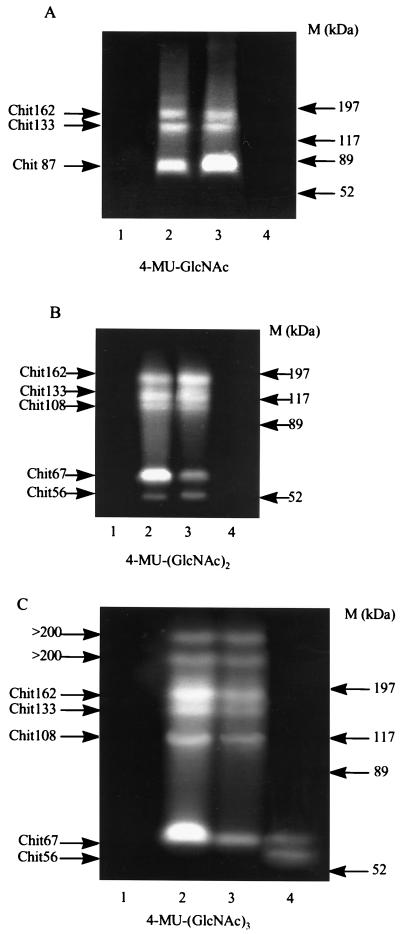
Quorum sensing control mediated by N-acyl homoserine lactone (AHL) signaling molecules has been established as a key feature of the regulation of exoenzyme production in many gram-negative bacteria. In Chromobacterium violaceum ATCC 31532 a number of phenotypic characteristics, including production of the purple pigment violacein, hydrogen cyanide, antibiotics, and exoproteases are known to be regulated by the endogenous AHL N-hexanoyl-L-homoserine lactone (HHL). In this study we show that C. violaceum produces a set of chitinolytic enzymes whose production is regulated by HHL. The chitinolytic activity was induced in strains grown in the presence of chitin as the sole carbon source and quantitated in the secreted proteins by using p-nitrophenol analogs of disaccharide, trisaccharide, and tetrasaccharide oligomers of N-acetylglucosamine. By using 4-methylumbelliferyl analogs of the same oligomers of N-acetylglucosamine as substrates for proteins separated and renatured by sodium dodecyl sulfate-polyacrylamide gel electrophoresis, at least six enzymes were detected: a chitobiase with high specificity to a dimeric substrate of 87 kDa, two N-acetylglucosaminidases with apparent molecular masses of 162 and 133 kDa, two endochitinases of 108 and 67 kDa, and a chitobiosidase of 56 kDa. In addition, two unidentified bands of >205 kDa were found where a tetrameric chitin derivative was used as a substrate. A pleiotropic mini-Tn5 mutant of C. violaceum (CV026) that is defective in HHL production and other quorum-sensing-regulated factors was also found to be completely deficient in chitinolytic activity. Growth of this mutant on minimal medium with chitin supplemented with culture supernatant from the C. violaceum wild-type strain or 10 microM synthetic HHL restored chitinase production to the level shown by the parental strain. These results constitute the most complete evidence so far for regulation of chitinolytic activity by AHL signaling in a gram-negative bacterium.
Figures
References
-
- Bassler B L, Yu C, Lee Y C, Roseman S. Chitin utilization by marine bacteria. Degradation and catabolism of chitin oligosaccharides by Vibrio furnissii. J Biol Chem. 1991;266:24276–24286. - PubMed
-
- Brurberg M B, Nes I F, Eijsink V G H. Comparative studies of chitinases A and B from Serratia marcescens. Microbiology. 1996;142:1581–1589. - PubMed
-
- Chernin L, Gafni A, Moses-Koch R, Gerson U, Szteinberg A. Chitinolytic activity of the acaropathogenic fungi Hirsutella thompsonii and Hirsutella necatrix. Can J Microbiol. 1997;43:440–446.
Publication types
MeSH terms
Substances
LinkOut - more resources
Full Text Sources
Other Literature Sources
Molecular Biology Databases
