. 1998 Sep 1;95(18):10728-33.
doi: 10.1073/pnas.95.18.10728.

An SmtB-like repressor from Synechocystis PCC 6803 regulates a zinc exporter

Affiliations

An SmtB-like repressor from Synechocystis PCC 6803 regulates a zinc exporter

C Thelwell et al. Proc Natl Acad Sci U S A. .

Abstract

ORF slr0798, now designated ziaA, from Synechocystis PCC 6803 encodes a polypeptide with sequence features of heavy metal transporting P-type ATPases. Increased Zn2+ tolerance and reduced 65Zn accumulation was observed in Synechococcus PCC 7942, strain R2-PIM8(smt), containing ziaA and upstream regulatory sequences, compared with control cells. Conversely, reduced Zn2+ tolerance was observed following disruption of ziaA in Synechocystis PCC 6803, and ziaA-mediated restoration of Zn2+ tolerance has subsequently been used as a selectable marker for transformation. Nucleotide sequences upstream of ziaA, fused to a promoterless lacZ gene, conferred Zn2+-dependent beta-galactosidase activity when introduced into R2-PIM8(smt). The product of ORF sll0792, designated ZiaR, is a Zn2+-responsive repressor of ziaA transcription. Reporter gene constructs lacking ziaR conferred elevated Zn2+-independent expression from the ziaA operator-promoter in R2-PIM8(smt). Gel retardation assays detected ZiaR-dependent complexes forming with the zia operator-promoter and ZiaR-DNA binding was enhanced by treatment with a metal-chelator in vitro. Two mutants of ZiaR (C71S/C73S and H116R) bound to, and repressed expression from, the ziaA operator-promoter but were unable to sense Zn2+. Metal coordination to His-imidazole and Cys-thiolate ligands at these residues of ZiaR is thus implicated in Zn2+-perception by Synechocystis PCC 6803.


Figures

Figure 1
Figure 1
Physical map of the zia genes. The ziaA and ziaR genes from Synechocystis PCC 6803, corresponding to ORFs slr0798 and sll0792 in the fully sequenced genome, are shown with an adjacent ORF sll0793, and shaded rectangles coincide with ORFs. ORFs slr0798 and sll0792 have previously been referred to as pacS and pacR, respectively (18), based on similarity of the product of slr0798 to the copper transporter PacS from Synechococcus PCC 7942. The annealing positions of primers used during the generation of plasmid constructs are indicated (vertical lines). An expanded 26-bp region of the zia operator–promoter is marked with arrows to show a degenerate 12-2-12 hyphenated inverted repeat. Nucleotides that are conserved in a similar inverted repeat within the smtA operator–promoter are marked (asterisk) and include guanines (or complement) shown by methylation protection assays to be protected by SmtB (21) (underlined). The site of insertion of a Km resistance gene cassette to disrupt ziaA in Synechocystis PCC 6803 is indicated.
Figure 2
Figure 2
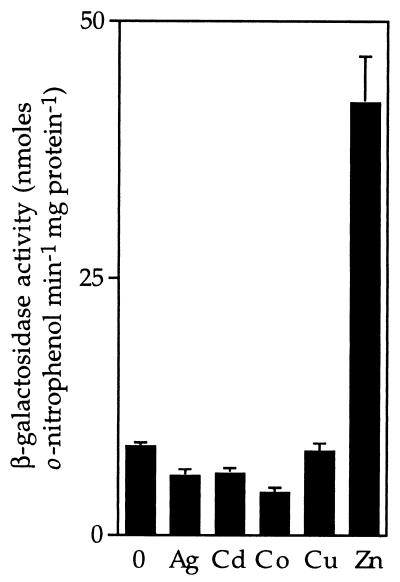
Metal-induced expression from the ziaA operator–promoter. R2-PIM8(smt) cells carrying pLAC549 were grown with no metal supplement or in the presence of maximum permissive concentrations of Ag+ (0.9 μM), Cd2+ (1.5 μM), Co2+ (3 μM), Cu2+ (9 μM), or Zn2+ (2 μM) for ≈20 h immediately before assay. The data points represent the means of three separate assays with SD.
Figure 3
Figure 3
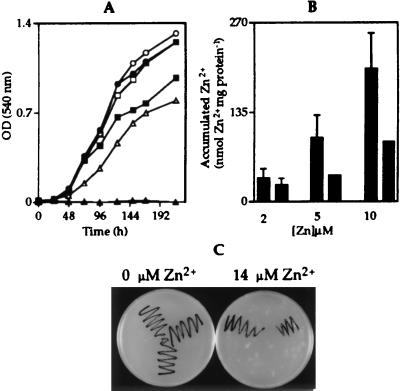
(A) Growth of R2-PIM8(smt) cells containing pLACPB2 (filled symbols) or pZIA (open symbols) in Allens medium supplemented with 0 (circles), 2 (squares), or 10 (triangles) μM Zn2+. Cells were inoculated at a density of 1 × 10⁶ cells ml−1, and growth was monitored by measuring the OD540. Data points represent the mean values from three separate cultures with SD (values too small to be visible above or below symbols). (B) 65Zn accumulated by R2-PIM8(smt) cells containing pLACPB2 (first bar in each pair) or pZIA (second bar in each pair) exposed to 2, 5, or 10 μM Zn2+ for 1 h. Data points represent the mean values from three separate cultures with SD. (C) Colonies of wild-type Synechocystis PCC 6803 (top left), the ziaA mutant (bottom center), or ziaA-restored cells (top right) were streaked onto Kratz and Myers medium supplemented with 0 or 14 μM Zn2+.
Figure 4
Figure 4
In vitro analysis of ZiaR binding to the zia operator–promoter. Gel retardation assays were performed by using 3 fmol (0.5 ng) of 32P-labeled 160-bp zia operator–promoter (FP, free probe) incubated with ≈12 μg of protein extract from Synechocystis PCC 6803 or with 0.015 nmol (230 ng) of recombinant ZiaR. The levels of nonspecific competitor poly(dI-dC)⋅poly(dI-dC) (dI-dC) and 1,10-phenanthroline (1,10 Phe) added to the binding reactions are shown and the position of free probe is indicated (FP).
Figure 5
Figure 5
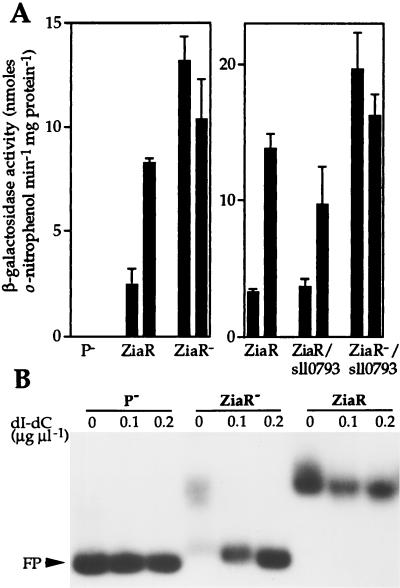
(A) β-Galactosidase activity in R2-PIM8(smt) cells containing pLACPB2 (P), pLAC549 (ZiaR), pLAC549-AMB (ZiaR), pLAC886 (ZiaR/sll0793), or pLAC886-AMB (ZiaR/sll0793). Cells were grown with no metal supplement (first bar in each pair) or in the presence of Zn2+ (2 μM) for ≈20 h immediately before assay (second bar in each pair). The data points represent the means of three separate assays with SD. (B) Gel retardation assays were performed by using 3 fmol of 160-bp zia operator–promoter as probe with ≈36 μg of protein extract from cells used in A. The levels of poly(dI-dC)⋅poly(dI-dC) used and the position of free probe (FP) are indicated.
Figure 6
Figure 6
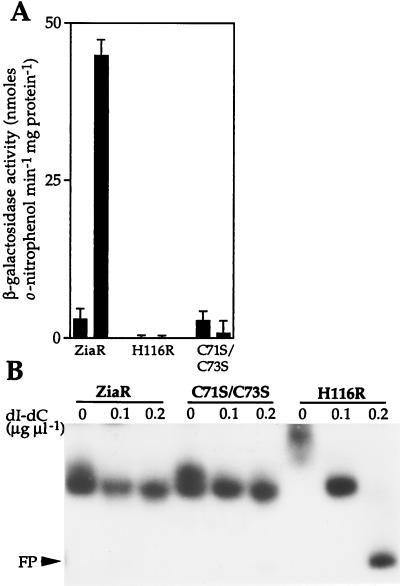
(A) Expression from the ziaA operator–promoter in R2-PIM8(smt) cells containing pLAC549 (ZiaR) or pLACPB2 with the ziaA operator–promoter and mutated ziaR (H116R or C71S/C73S) fused to lacZ. Cells were grown with no metal supplement (first bar in each pair) or in the presence of Zn2+ (2 μM) for ≈20 h immediately before assay (second bar in each pair). The data points represent the means of three separate assays with SD. (B) In vitro analysis of mutated ZiaR binding to the zia operator–promoter. Gel retardation assays were performed by using 3 fmol of 160-bp zia operator–promoter as probe with ≈36 μg of protein extract from cells used in A. The levels of poly(dI-dC)⋅poly(dI-dC) used and the position of free probe (FP) are indicated.

References

    1. Kaneko T, Sato S, Kotani H, Tanaka A, Asamizu E, Nakamura Y, Miyajima N, Sugiura M, Sasamoto S, Kimura T, et al. DNA Res. 1996;3:109–136. - PubMed
    1. Nucifora G, Chu L, Misra T K, Silver S. Proc Natl Acad Sci USA. 1989;86:3544–3548. - PMC - PubMed
    1. Phung L T, Ajlani G, Haselkorn R. Proc Natl Acad Sci USA. 1994;91:9651–9654. - PMC - PubMed
    1. Kanamaru K, Kashiwagi S, Mizuno T. Mol Microbiol. 1994;13:369–377. - PubMed
    1. Odermatt A, Suter H, Krapf R, Solioz M. J Biol Chem. 1993;268:12775–12779. - PubMed

Publication types

LinkOut - more resources