. 1998 Sep 1;95(18):10820-5.
doi: 10.1073/pnas.95.18.10820.

Endothelial cell death, angiogenesis, and microvascular function after castration in an androgen-dependent tumor: role of vascular endothelial growth factor

Affiliations

Endothelial cell death, angiogenesis, and microvascular function after castration in an androgen-dependent tumor: role of vascular endothelial growth factor

R K Jain et al. Proc Natl Acad Sci U S A. .

Abstract

The sequence of events that leads to tumor vessel regression and the functional characteristics of these vessels during hormone-ablation therapy are not known. This is because of the lack of an appropriate animal model and monitoring technology. By using in vivo microscopy and in situ molecular analysis of the androgen-dependent Shionogi carcinoma grown in severe combined immunodeficient mice, we show that castration of these mice leads to tumor regression and a concomitant decrease in vascular endothelial growth factor (VEGF) expression. Androgen withdrawal is known to induce apoptosis in Shionogi tumor cells. Surprisingly, tumor endothelial cells begin to undergo apoptosis before neoplastic cells, and rarefaction of tumor vessels precedes the decrease in tumor size. The regressing vessels begin to exhibit normal phenotype, i.e., lower diameter, tortuosity, vascular permeability, and leukocyte adhesion. Two weeks after castration, a second wave of angiogenesis and tumor growth begins with a concomitant increase in VEGF expression. Because human tumors often relapse following hormone-ablation therapy, our data suggest that these patients may benefit from combined anti-VEGF therapy.


Figures
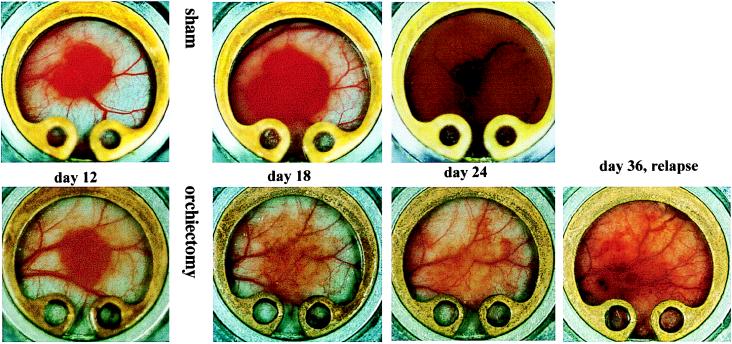
Figure 1
Figure 1
Tumor growth and angiogenesis in Shionogi male mammary carcinomas. (Upper) Before castration (day 12) and in sham-operated animals (days 18 and 24). (Lower) Before castration (day 12), during regression in castrated animals (days 18 and 24), and during relapse (day 36). Note decreased angiogenesis in regressing tumor and second wave of angiogenesis in relapsed tumors.
Figure 2
Figure 2
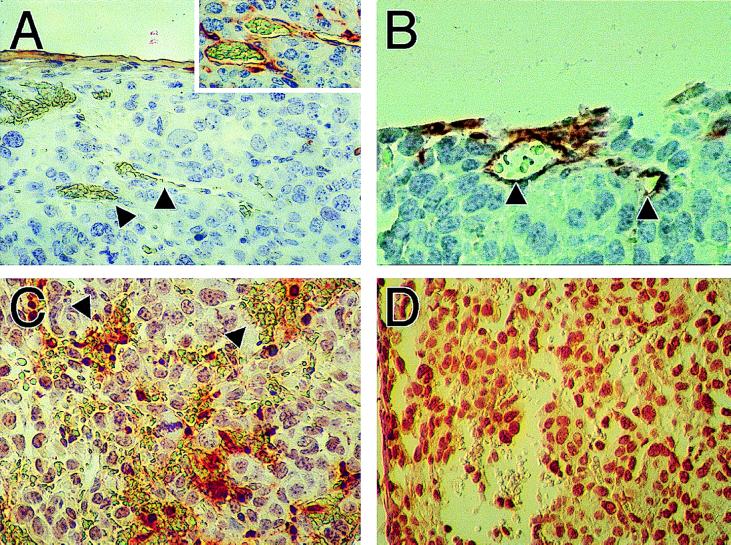
TUNEL analysis of tumors shows death of endothelial cells following castration, but preceding death of tumor cells. (A) Control tumors show absence of apoptosis in blood vessels. Inset confirms the integrity of blood vessels shown by arrows using lectin staining to visualize the endothelial cell lining on an adjacent slide. (B) TUNEL-positive blood vessels are seen 24 hr after castration, whereas the majority of tumor cells remain TUNEL-negative. Arrows show blood vessels identified on the basis of lumen filled with erythrocytes. (C) Forty-eight hours after castration, more TUNEL-positive cells are found in regions of hemorrhaging blood vessels. Arrows show pools of erythrocytes that are not surrounded by intact endothelium. Still, most tumor cells are TUNEL-negative. (D) By 6 days after castration, intact blood vessels are not seen and tumor cells are TUNEL-positive.
Figure 3
Figure 3
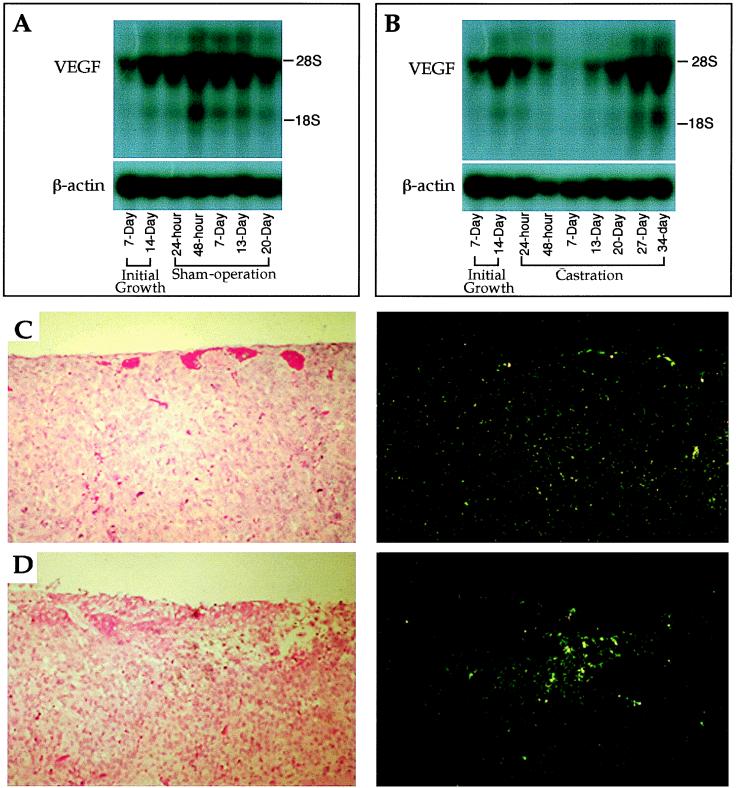
VEGF expression in tumors by Northern blot analysis (A and B) and in situ hybridization (C and D). (A and B) During the initial growth, total RNA was isolated from the tumors at 7 and 14 days after implantation of tumors. The sham operation and castration were performed on day 15 of initial growth. Total RNA was isolated from tumors at the time points of 24 and 48 hr, and 7, 13, 20, 27, and 34 days after surgery. The levels of VEGF mRNA steadily increased in control (sham-operated animals; A). In contrast, the VEGF messages dramatically decreased and became almost undetectable on day 7 in tumors in castrated animals (B). However, the transcription of VEGF began to be upregulated on day 13 after castration and steadily increased to the level that was indistinguishable from that of the control (B). (C) Control tumor brightfield (Left) and darkfield (Right) show homogeneous levels of VEGF expression. (D) Twenty-four hours after castration brightfield (Left) and darkfield (Right) show punctate expression characteristic of stress-induced VEGF expression, but VEGF expression level is lower elsewhere.

References

    1. Moon, W.-C., Choi, I. R. & Moon, S. Y. (1997) J. Urol., Suppl., 157, 223.
    1. Joseph I B J K, Nelson J D, Denmeade I S R, Isaacs J T. Clin Cancer Res. 1997;3:2507–2512. - PubMed
    1. Akakura K, Bruchovsky N, Goldenberg S L, Rennie P S, Buckley A R, Sullivan L D. Cancer. 1993;71:2782–2790. - PubMed
    1. Masai M, Suzuki H, Kuramochi H, Mikami H, Shimazaki J. Endocr J. 1994;41:709–715. - PubMed
    1. Halme M, Sjoholm B, Savola J M, Scheinin M. Biochim Biophys Acta. 1995;1266:207–214. - PubMed

Publication types

MeSH terms

LinkOut - more resources