. 1998 Sep 1;95(18):10866-71.
doi: 10.1073/pnas.95.18.10866.

A viral gene that activates lytic cycle expression of Kaposi's sarcoma-associated herpesvirus

Affiliations

A viral gene that activates lytic cycle expression of Kaposi's sarcoma-associated herpesvirus

R Sun et al. Proc Natl Acad Sci U S A. .

Abstract

Herpesviruses exist in two states, latency and a lytic productive cycle. Here we identify an immediate-early gene encoded by Kaposi's sarcoma-associated herpesvirus (KSHV)/human herpesvirus eight (HHV8) that activates lytic cycle gene expression from the latent viral genome. The gene is a homologue of Rta, a transcriptional activator encoded by Epstein-Barr virus (EBV). KSHV/Rta activated KSHV early lytic genes, including virus-encoded interleukin 6 and polyadenylated nuclear RNA, and a late gene, small viral capsid antigen. In cells dually infected with Epstein-Barr virus and KSHV, each Rta activated only autologous lytic cycle genes. Expression of viral cytokines under control of the KSHV/Rta gene is likely to contribute to the pathogenesis of KSHV-associated diseases.


Figures
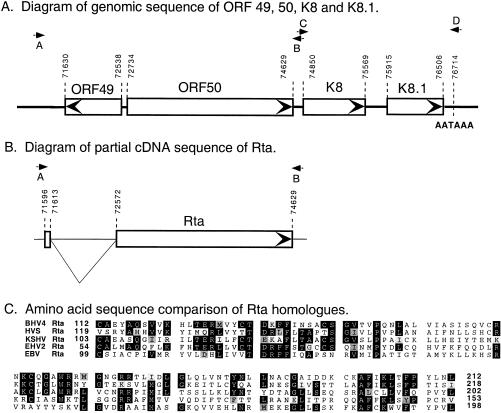
Figure 1
Figure 1
KSHV gene encoding the R transactivator (Rta). (A) Diagram of the genomic region containing the Rta gene. ORFs are shown in open boxes; the direction of the ORFs is indicated with an arrow inside the box. ORF 50 contains a portion of the Rta gene. Downstream of ORF 50 is an ORF (K8) that has weak homology with EBV BZLF1 (Z). Numbers indicate nucleotide positions in the KSHV sequence (24). The position of primers used for PCR amplification are shown with arrows; their sequences are found in Materials and Methods. A and B indicate positions of primers used to amplify the genomic region containing KSHV/Rta. C and D indicate positions of primers used to amplify genomic DNA containing ORF K8. The single polyadenylation site in this region, AATAAA, is located at position 76,714. (B) Diagram of a partial Rta cDNA clone used for transfection studies. The sequences between 71,613 and 72,572 were removed as an intron; the two open boxes indicate the fused Rta ORF. The start of the Rta mRNA present in infected cells is at position 71,513; the putative initiator methionine is at 71,596. KSHV/Rta is expressed as a 3.6-kb mRNA that contains the indicated mRNA splice involving Rta as well as several downstream splicing events involving K8. (C) Comparison of predicted amino acid sequences of the KSHV/Rta gene with homologues in other members of the gamma-herpesvirus group. Shown is a comparison of KSHV/Rta sequence from aa 103 to 202.
Figure 2
Figure 2
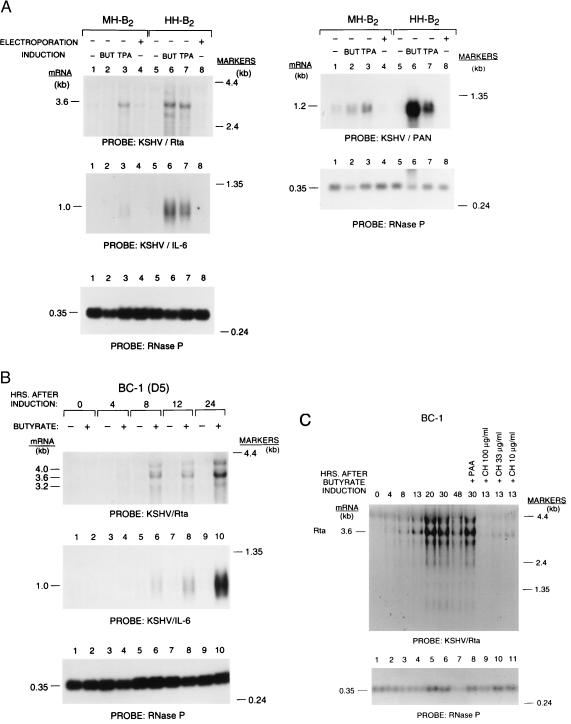
Expression of KSHV/Rta, PAN RNA, and KSHV/IL-6. (A) Chemical induction of KSHV/Rta and KSHV/IL-6 and PAN RNA in two EBV-negative cell lines derived from primary pleural effusion lymphoma. Cells were untreated or treated with TPA or N-butyrate (BUT) or electrophorated without DNA. Twenty-four hours after treatment RNA was prepared and analyzed with probes specific for KSHV Rta, IL-6, and PAN RNA. Each lane contains the RNA equivalent from 2 × 10⁶ cells. (B) Kinetics of expression following lytic cycle induction. BC-1 clone D5 cells were treated with N-butyrate; at the indicated intervals after treatment RNA was prepared and analyzed by Northern blotting. The probes were specific for the second exon of KSHV/Rta, for KSHV/IL6, and for the H1 RNA of RNase P (20). (C) Resistance of the 3.6-kb KSHV/Rta mRNA to the action of cyclohexamide. RNA harvested at intervals after addition of butyrate was analyzed by Northern blotting by using a probe from ORF 50. Aliquots of cells were treated with different amounts of cyclohexamide (CH) and harvested 13 h after induction (lanes 9–11). Another aliquot of cells was treated with phosphonoacetic acid (PAA) and harvested 30 h after induction.
Figure 3
Figure 3
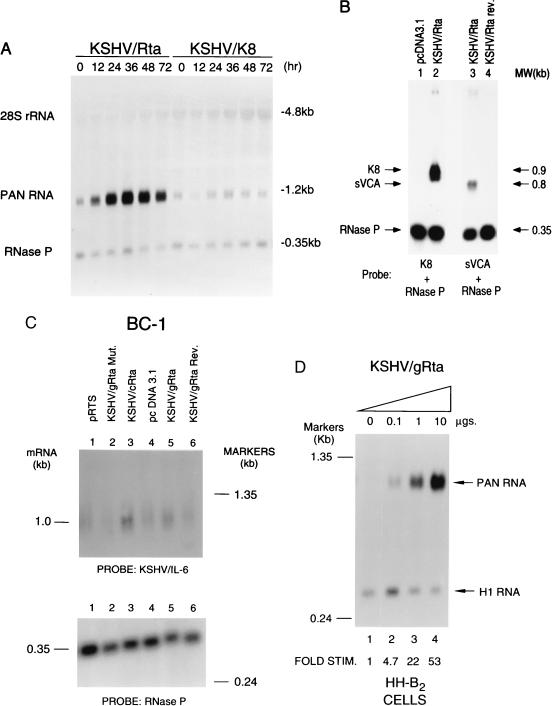
Activation of KSHV lytic cycle genes by KSHV/Rta. (A) KSHV/Rta stimulates expression of PAN RNA. Replicate aliquots of 2.5 × 10⁷ BC-1 cells were transfected with 10 μg of KSHV/genomic Rta or KSHV/K8 (8, 10, 12). RNA prepared at the times indicated after transfection was analyzed by Northern blotting by using probes specific for PAN RNA and the H1 component of RNase P. (B) KSHV/Rta stimulates expression of KSHV/K8 and KSHV/sVCA (ORF 65). The analysis of KSHV/K8 was carried out in BC-1 cells; RNA was harvested 48 h after transfection. The analysis of KSHV/sVCA was carried out in BCBL-1 cells; the RNA was prepared 96 h after transfection. (C) KSHV/Rta cDNA activates expression of viral IL-6. BC-1 cells were transfected with plasmids containing KSHV/Rta in the genomic configuration (g), in the cDNA configuration (c), in the genomic configuration in the reverse orientation (rev), or in the genomic configuration with a stop codon mutation (mut). The expression plasmids pRTS and pcDNA3.1 were used as negative controls. RNA prepared 24 h after transfection was analyzed by Northern blotting with probes specific for viral IL-6, PAN RNA and RNase P. (D) Response of PAN RNA expression following transfection of different amounts of KSHV/gRta expression plasmid into HH-B2 cells.
Figure 4
Figure 4
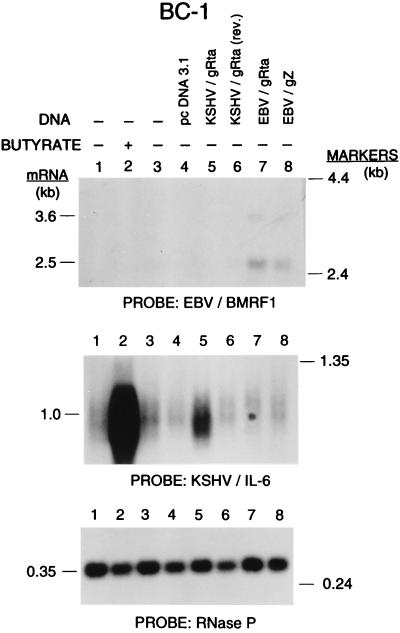
Specificity of reactivation of two gamma-herpesviruses, KSHV and EBV, in dually infected primary effusion lymphoma cells. BC-1 cells were transfected with KSHV/Rta or EBV/Rta or EBV/Z. RNAs prepared 24 h after transfection were analyzed for transcripts of KSHV/IL-6 and EBV/BMRF1.

References

    1. Chang Y, Cesarman E, Pessin M S, Lee F, Culpepper J, Knowles D M, Moore P S. Science. 1994;266:1865–1869. - PubMed
    1. Cesarman E, Chang Y, Moore P S, Said J W, Knowles D M. N Engl J Med. 1995;332:1186–1191. - PubMed
    1. Cesarman E, Moore P S, Rao P H, Inghirami G, Knowles D M, Chang Y. Blood. 1995;86:2708–2714. - PubMed
    1. Renne R, Zhong W, Herndier B, McGrath M, Abbey N, Kedes D, Ganem D. Nat Med. 1996;2:342–346. - PubMed
    1. Moore P S, Gao S J, Dominguez G, Cesarman E, Lungu O, Knowles D M, Garber R, Pellett P E, McGeoch D J, Chang Y. J Virol. 1996;70:549–558. - PMC - PubMed

Publication types

Associated data