. 1998 Sep 1;95(18):10914-9.
doi: 10.1073/pnas.95.18.10914.

Isoform-specific effects of human apolipoprotein E on brain function revealed in ApoE knockout mice: increased susceptibility of females

Affiliations

Isoform-specific effects of human apolipoprotein E on brain function revealed in ApoE knockout mice: increased susceptibility of females

J Raber et al. Proc Natl Acad Sci U S A. .

Abstract

Apolipoprotein E (apoE) mediates the redistribution of lipids among cells and is expressed at highest levels in brain and liver. Human apoE exists in three major isoforms encoded by distinct alleles (epsilon2, epsilon3, and epsilon4). Compared with APOE epsilon2 and epsilon3, APOE epsilon4 increases the risk of cognitive impairments, lowers the age of onset of Alzheimer's disease (AD), and decreases the response to AD treatments. Besides age, inheritance of the APOE epsilon4 allele is the most important known risk factor for the development of sporadic AD, the most common form of this illness. Although numerous hypotheses have been advanced, it remains unclear how APOE epsilon4 might affect cognition and increase AD risk. To assess the effects of distinct human apoE isoforms on the brain, we have used the neuron-specific enolase (NSE) promoter to express human apoE3 or apoE4 at similar levels in neurons of transgenic mice lacking endogenous mouse apoE. Compared with NSE-apoE3 mice and wild-type controls, NSE-apoE4 mice showed impairments in learning a water maze task and in vertical exploratory behavior that increased with age and were seen primarily in females. These findings demonstrate that human apoE isoforms have differential effects on brain function in vivo and that the susceptibility to apoE4-induced deficits is critically influenced by age and gender. These results could be pertinent to cognitive impairments observed in human APOE epsilon4 carriers. NSE-apoE mice and similar models may facilitate the preclinical assessment of treatments for apoE-related cognitive deficits.


Figures
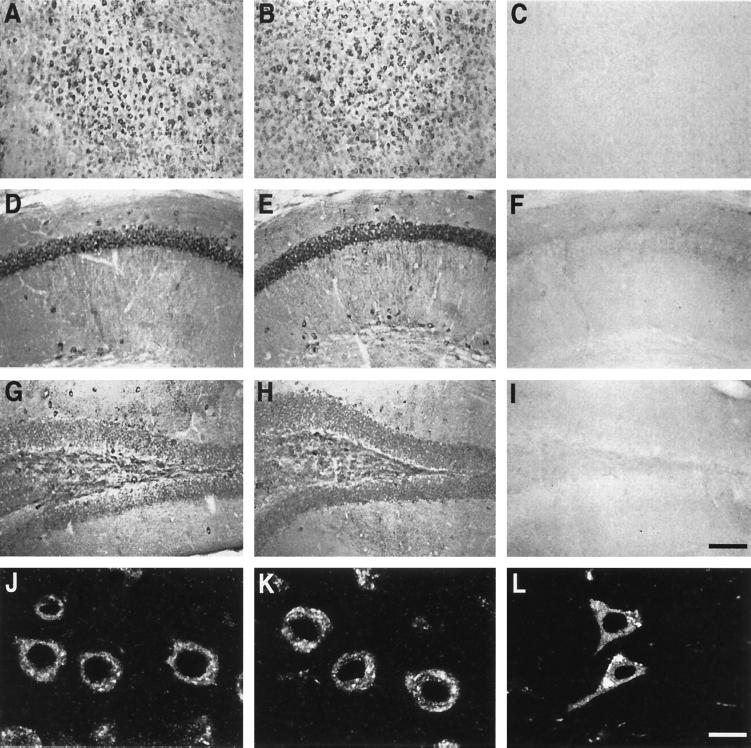
Figure 1
Figure 1
Immunocytochemical detection of human apoE in neurons of NSE-apoE3 and NSE-apoE4 mice and a human with AD. (A–I) Immunoperoxidase staining for human apoE revealed widespread neuronal labeling, including neocortex (A–C), hippocampal CA1 region (D–F), and dentate gyrus (G–I), in NSE-apoE3 (A, D, and G) and NSE-apoE4 (B, E, and H) mice. No apoE labeling was seen in corresponding brain regions of a knockout control lacking NSE-apoE transgenes (C, F, and I). (J–L) Immunofluorescence staining for human apoE strongly labeled neocortical neurons in NSE-apoE3 (J) and NSE-apoE4 (H) mice, and in a human AD case (APOE ɛ34) (L). (Bars: AI, 160 μm; JL, 10 μm.)
Figure 2
Figure 2
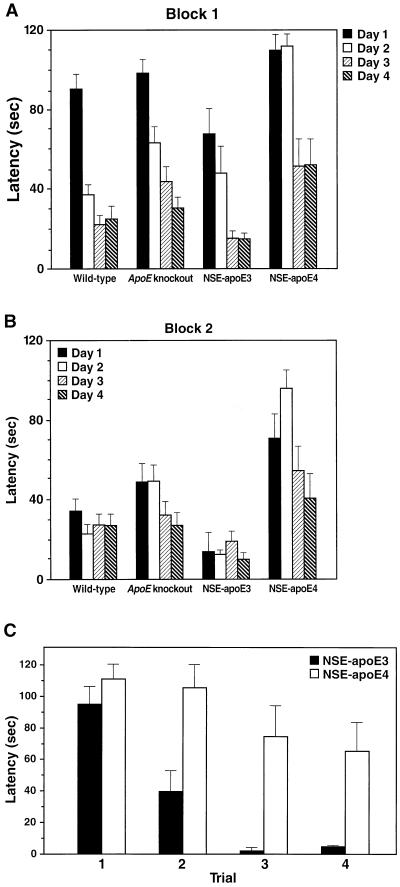
Differential effects of human apoE3 and apoE4 on water maze performance in 6-month-old female mice. The time required to locate a hidden platform submerged in a pool of water (latency) was compared among wild-type (n = 16), knockout (n = 16), NSE-apoE3 (n = 6), and NSE-apoE4 (n = 8) mice. Mice were tested on 4 consecutive days in two sessions (blocks) per day with a 2-h interval between blocks. The average latency recorded for each mouse in two successive trials per block was used to calculate group means ± SEM. Mice that failed to locate the platform were assigned a latency value of 120 sec. For block 1 (A), repeated-measures ANOVA revealed highly significant differences in day-to-day learning capacities among genotypes (P = 0.001), specifically between NSE-apoE4 and NSE-apoE3 (P = 0.0001), NSE-apoE4 and wild-type (P = 0.0001), and knockout and wild-type (P = 0.02) mice. Comparison of genotypes on individual days by Tukey–Kramer posthoc test revealed significant differences between NSE-apoE4 and NSE-apoE3 on day 1 (P < 0.05) and between NSE-apoE4 and all other genotypes on day 2 (P < 0.01). For block 2 (B), differences in day-to-day learning capacities among genotypes were even more significant (P = 0.0008 by repeated-measures ANOVA), specifically between NSE-apoE4 and NSE-apoE3 (P = 0.0002), NSE-apoE4 and wild-type (P = 0.0006), and NSE-apoE4 and knockout (P = 0.018) mice. Comparison of genotypes on individual days by Tukey–Kramer posthoc test revealed that NSE-apoE4 differed significantly from NSE-apoE3 (P < 0.01) and wild-type (P < 0.05) mice on day 1 and from all other genotypes on day 2 (P < 0.01). There were also significant differences in learning curves on day 1 (C). In contrast to NSE-apoE3 mice, NSE-apoE4 mice did not improve significantly in their ability to locate the platform over the different trials on day 1, even though the platform was kept in the same location. Differences among groups similar to those described above for latencies were also observed for path lengths (data not shown).
Figure 3
Figure 3
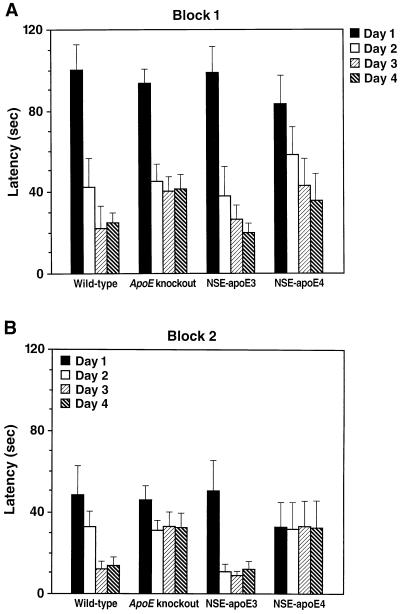
Water maze performance of young mice is independent of cerebral apoE expression. Three-month-old female wild-type (n = 6), knockout (n = 19), NSE-apoE3 (n = 5), and NSE-apoE4 (n = 7) mice were compared in the water maze as described in Fig. 2. In block 1 (A), mice of all genotypes learned the task without significant differences identified among groups by repeated-measures ANOVA. In block 2 (B), significant day-to-day improvements were seen only in wild-type (p = 0.008) and NSE-apoE3 (p = 0.001) mice, but not in knockout or NSE-apoE4 mice. However, the differences in learning curves among groups in block 2 were not significant by repeated-measures ANOVA. The average swim speeds among groups of mice did not differ significantly, and the four groups showed similar performance in locating the visible platform on day 5 (data not shown).
Figure 4
Figure 4
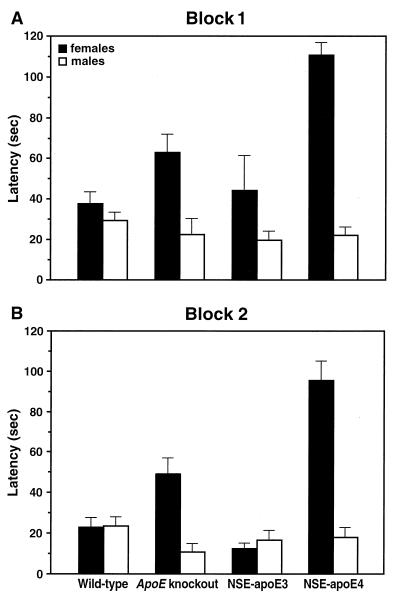
Gender dependence of apoE effects on water maze performance in 6-month-old mice. Wild-type (21 males, 16 females), knockout (14 males, 16 females), NSE-apoE3 (14 males, 6 females), and NSE-apoE4 (13 males, 8 females) mice were compared in the water maze as described in Fig. 2. Data represent results obtained in block 1 (A) and block 2 (B) on the second day of testing. For each of these blocks, two-factor ANOVA revealed highly significant effects of genotype and gender (P = 0.0001) as well as a highly significant interaction between the effects of genotype and gender (P = 0.0001). Significant differences between males and females were identified only in knockout and NSE-apoE4 mice (P = 0.0001) but not in wild-type or NSE-apoE3 mice. Average swim speeds and ability to locate a visible platform on day 5 did not differ significantly between age-matched male and female mice (data not shown).
Figure 5
Figure 5
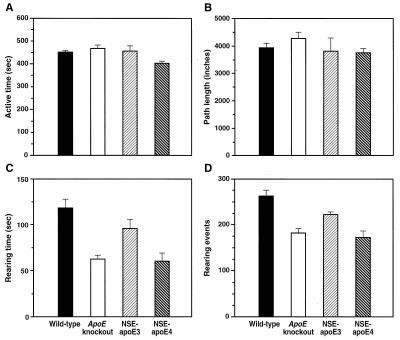
Effects of cerebral apoE expression on exploratory behavior. Active times (A), path lengths (B), as well as time (C) and frequency (D) of rearing were compared among 6-month-old female wild-type (n = 14), knockout (n = 16), NSE-apoE3 (n = 6), and NSE-apoE4 (n = 8) mice during open field activity. Bar graphs represent results (means ± SEM) obtained during the second of three 10-min observation periods. NSE-apoE4 mice showed mildly reduced active times (A), which differed significantly only from those observed in wild-type mice (P < 0.05 by Dunnett’s but insignificant by Tukey–Kramer posthoc test) and knockout mice (P < 0.05 by Tukey–Kramer posthoc test). ANOVA revealed no significant differences in pathlengths (B) among the four genotypes. Compared with wild-type controls, knockout mice and NSE-apoE4 mice showed significant reductions in frequency (C) and time (D) of rearing (P < 0.01 by Tukey-Kramer posthoc test), whereas NSE-apoE3 mice did not (Tukey–Kramer or Dunnett’s posthoc tests).

References

    1. Mahley R W. Science. 1988;240:622–630. - PubMed
    1. Strittmatter W J, Roses A D. Annu Rev Neurosci. 1996;19:53–77. - PubMed
    1. Weisgraber K H, Mahley R W. FASEB J. 1996;10:1485–1494. - PubMed
    1. Tang M X, Maestre G, Tsai W Y, Liu X H, Feng L, Chung W Y, Chun M, Schofield P, Stern Y, Tycko B, Mayeux R. Ann NY Acad Sci. 1996;802:6–15. - PubMed
    1. Arendt T, Schindler C, Brückner M K, Eschrich K, Bigl V, Zedlick D, Marcova L. J Neurosci. 1997;17:516–529. - PMC - PubMed

Publication types

Substances