. 1998 Sep;64(9):3313-9.
doi: 10.1128/AEM.64.9.3313-3319.1998.

Identification and characterization of Leuconostoc carnosum, associated with production and spoilage of vacuum-packaged, sliced, cooked ham

Affiliations

Identification and characterization of Leuconostoc carnosum, associated with production and spoilage of vacuum-packaged, sliced, cooked ham

K J Björkroth et al. Appl Environ Microbiol. 1998 Sep.

Abstract

Leuconostoc carnosum was shown to be the specific spoilage organism in vacuum-packaged, sliced, cooked ham showing spoilage during 3 weeks of shelf life. Identification of the specific spoilage organism was done by use of phenotypic data and ClaI, EcoRI, and HindIII reference strain ribopatterns. One hundred L. carnosum isolates associated with the production and spoilage of the ham were further characterized by pulsed-field gel electrophoresis (PFGE), together with some meat-associated Leuconostoc species: L. citreum, L. gelidum, L. mesenteroides subsp. dextranicum, and L. mesenteroides subsp. mesenteroides. ApaI and SmaI digests divided the industrial L. carnosum strains into 25 different PFGE types, ApaI and SmaI types being consistent. Only one specific PFGE type was associated with the spoiled packages. This type also was detected in air and raw-meat mass samples. The spoilage strain did not produce bacteriocins. Only seven isolates belonging to three different PFGE types produced bacteriocins. Similarity analysis of the industrial L. carnosum strains revealed a homogeneous cluster which could be divided into eight subclusters consisting of strains having at most three-fragment differences. The L. carnosum cluster was clearly distinguished from the other meat-associated leuconostoc clusters, with the exception of the L. carnosum type strain. Ribotyping can be very helpful in the identification of L. carnosum, but its discriminatory power is too weak for strain characterization. PFGE provides good discrimination for studies dealing with the properties of homogeneous L. carnosum strains.


Figures
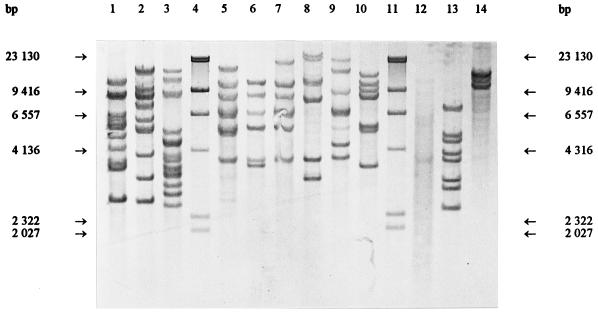
FIG. 1
FIG. 1
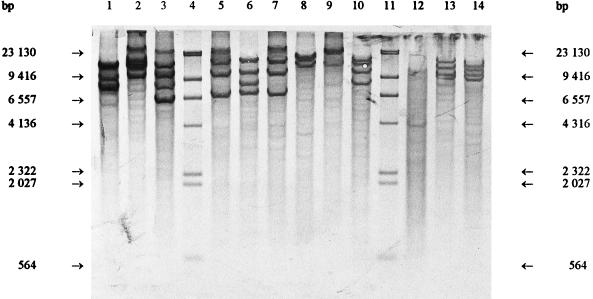
ClaI ribopatterns. Lanes 4 and 11, phage lambda DNA cleaved with HindIII as a fragment size marker; lane 1, Weissella viridescens ATCC 12706T; lane 2, Weissella halotolerans ATCC 35410T; lane 3, Weissella paramesenteroides DSM 20288T; lane 5, Leuconostoc mesenteroides subsp. mesenteroides DSM 20343T; lane 6, Leuconostoc mesenteroides subsp. cremoris CCUG 21965T; lane 7, Leuconostoc mesenteroides subsp. dextranicum DSM 20484T; lane 8, Leuconostoc pseudomesenteroides DSM 20193T; lane 9, Leuconostoc carnosum NCFB 2776T; lane 10, Leuconostoc gelidum NCFB 2775T; lane 12, Leuconostoc lactis CCUG 30064T; lane 13, Leuconostoc fallax CCUG 30061T; lane 14, Leuconostoc citreum (Leuconostoc amelibiosum) D1.
FIG. 2
FIG. 2
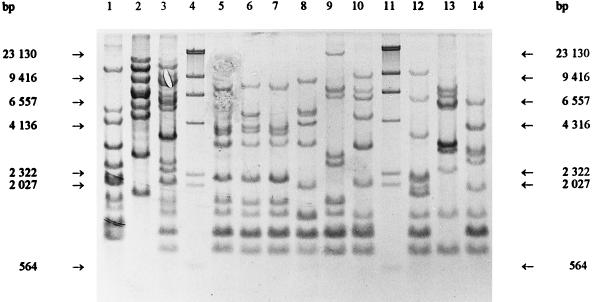
EcoRI ribopatterns. Lanes 4 and 11, phage lambda DNA cleaved with HindIII as a fragment size marker; lane 1, Weissella viridescens ATCC 12706T; lane 2, Weissella halotolerans ATCC 35410T; lane 3, Weissella paramesenteroides DSM 20288T; lane 5, Leuconostoc mesenteroides subsp. mesenteroides DSM 20343T; lane 6, Leuconostoc mesenteroides subsp. cremoris CCUG 21965T; lane 7, Leuconostoc mesenteroides subsp. dextranicum DSM 20484T; lane 8, Leuconostoc pseudomesenteroides DSM 20193T; lane 9, Leuconostoc carnosum NCFB 2776T; lane 10, Leuconostoc gelidum NCFB 2775T; lane 12, Leuconostoc lactis CCUG 30064T; lane 13, Leuconostoc fallax CCUG 30061T; lane 14, Leuconostoc citreum (Leuconostoc amelibiosum) D1.
FIG. 3
FIG. 3
HindIII ribopatterns. Lanes 4 and 11, phage lambda DNA cleaved with HindIII as a fragment size marker; lane 1, Weissella viridescens ATCC 12706T; lane 2, Weissella halotolerans ATCC 35410T; lane 3, Weissella paramesenteroides DSM 20288T; lane 5, Leuconostoc mesenteroides subsp. mesenteroides DSM 20343T; lane 6, Leuconostoc mesenteroides subsp. cremoris CCUG 21965T; lane 7, Leuconostoc mesenteroides subsp. dextranicum DSM 20484T; lane 8, Leuconostoc pseudomesenteroides DSM 20193T; lane 9, Leuconostoc carnosum NCFB 2776T; lane 10, Leuconostoc gelidum NCFB 2775T; lane 12, Leuconostoc lactis CCUG 30064T; lane 13, Leuconostoc fallax CCUG 30061T; lane 14, Leuconostoc citreum (Leuconostoc amelibiosum) D1.
FIG. 4
FIG. 4
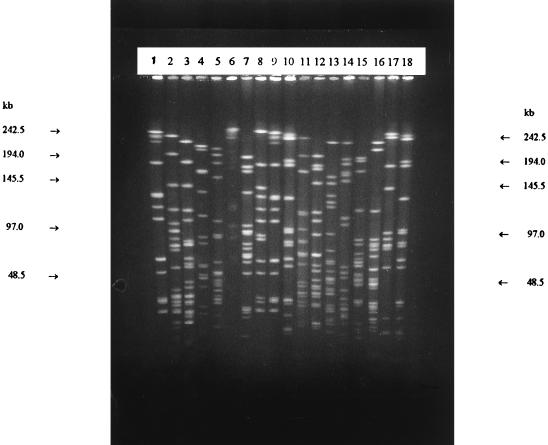
SmaI (lanes 1 to 9) and ApaI (lanes 10 to 18) ribopatterns. Lanes 1, 9, 10, and 18, Leuconostoc carnosum NCFB 2776T; lanes 2 and 11, Leuconostoc mesenteroides subsp. mesenteroides DSM 20343T; lanes 3 and 12, Leuconostoc mesenteroides subsp. dextranicum DSM 20484T; lanes 4 and 13, Leuconostoc pseudomesenteroides DSM 20193T; lanes 5 and 14, Weissella paramesenteroides DSM 20288T; lanes 6 and 15, Leuconostoc gelidum NCFB 2775T; lanes 7 and 16, Leuconostoc citreum (Leuconostoc amelibiosum) D1; lanes 8 and 17, Leuconostoc carnosum V-8a.
FIG. 5
FIG. 5
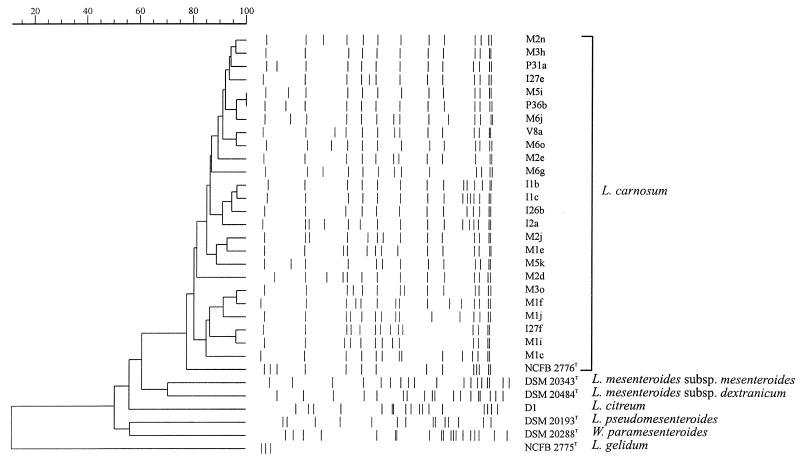
Dendrogram based on SmaI ribopatterns. The similarity between all pairs was expressed by Dice coefficient correlation, and the unweighted pair-group method with arithmetic averages was used for the construction of the dendrogram.

References

    1. Allen J R, Foster E M. Spoilage of vacuum-packed sliced processed meats during refrigerated storage. Food Res. 1960;25:19–25.
    1. Alm F, Erichsen I, Molin N. The effect of vacuum packaging on some sliced processed meat products as judged by organoleptic and bacteriological analysis. Food Technol. 1961;15:199–203.
    1. Becker B, Holzapfel W H, von Holy A. Effect of pH and the bacteriocin carnocin 54 on growth and cell morphology of two Leuconostoc strains. Lett Appl Microbiol. 1994;19:126–128.
    1. Björkroth J, Korkeala H. Evaluation of Lactobacillus sake contamination in vacuum packaged sliced cooked meat products by ribotyping. J Food Prot. 1996;59:398–401. - PubMed
    1. Björkroth J, Korkeala H. rRNA gene restriction patterns as a characterization tool for Lactobacillus sake strains producing ropy slime. Int J Food Microbiol. 1996;30:293–302. - PubMed

LinkOut - more resources