doi: 10.1128/CDLI.5.5.740-743.1998.
Neutrophil chemiluminescence during phagocytosis is inhibited by abnormally elevated levels of acetoacetate: implications for diabetic susceptibility to infections
Affiliations
- PMID: 9729546
- PMCID: PMC95650
- DOI: 10.1128/CDLI.5.5.740-743.1998
Item in Clipboard
Neutrophil chemiluminescence during phagocytosis is inhibited by abnormally elevated levels of acetoacetate: implications for diabetic susceptibility to infections
Clin Diagn Lab Immunol.
1998 Sep.
Abstract
Human neutrophils by a chemiluminescence assay exhibit diminished phagocytic activity in the presence of abnormally high levels of the serum metabolite acetoacetate. These findings, along with our previous evidence demonstrating myeloperoxidase inhibition by acetoacetate, implicate metabolic ketosis in the inhibition of neutrophil microbicidal activity and thus in increased susceptibility to infections.
Figures

Chemiluminescence from neutrophils engaged in phagocytic activity. Neutrophils at equivalent concentrations were exposed to Zymosan A particles containing luminol (ZAP) in the presence and absence of 2.8 mM acetoacetate. As shown, normal neutrophil phagocytic activity was accompanied by a high level of chemiluminescence, which was nearly abolished in the presence of acetoacetate.

Inhibition of neutrophil phagocytic activity as demonstrated by diminished chemiluminescence in the presence of increasing levels of acetoacetate. Chemiluminescence of ZAP-treated neutrophils in the presence of acetoacetate levels representing normal serum range (28 μM to 0.28 mM) was monitored. As shown, neutrophils exposed to acetoacetate concentrations within the normal serum range were actively phagocytic, albeit as the acetoacetate level reached a concentration representing the upper limit of normal, chemiluminescence declined. As the acetoacetate concentration was increased above normal serum range, a greater lag period in attaining peak chemiluminescence and diminished levels of chemiluminescence were observed.

Effect of acetoacetate on chemiluminescence from PMA-stimulated neutrophils. Chemiluminescence was measured from PMA-stimulated neutrophils alone as well as those exposed to 2.8 mM acetoacetate, the highest level of acetoacetate evaluated in this study. As shown, there was no evident effect of acetoacetate on chemiluminescence from PMA-stimulated neutrophils.
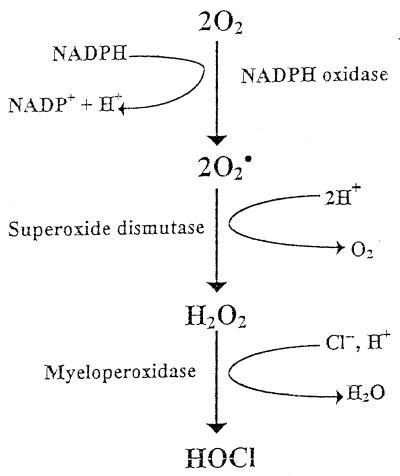
The phagocytic process, in which perturbation of the polymorphonuclear membrane results in a respiratory burst, activating membrane-bound NADPH oxidase to yield O2−. Superoxide dismutase catalyzes the rapid generation of H2O2, at whose expense MPO catalyzes oxidation of Cl− to yield HOCl.
References
-
- Harrison J E, Saeed F A. Acetoacetate is an electron donor to myeloperoxidase and a promoter of myeloperoxidase-catalyzed fatty acid peroxidation. Biochem Med. 1981;26:339–355. - PubMed
-
- Harrison J E, Saeed F A. ACS Annual Meeting Abstracts. 1981. Acetoacetate: an electron donor and halogen acceptor for neutrophil myeloperoxidase and a promoter of fatty acid peroxidation. - PubMed
-
- Harrison J E, Saeed F A. Radical acetoacetate oxidation by myeloperoxidase, lactoperoxidase, prostaglandin synthetase, and prostacyclin synthetase: implications for atherosclerosis. Biochem Med. 1983;29:149–163. - PubMed
-
- Harrison J E, Schultz J. Studies on the chlorinating mechanism of myeloperoxidase. J Biol Chem. 1976;251:1371–1374. - PubMed
MeSH terms
Substances
LinkOut - more resources
Full Text Sources
Medical
Research Materials