Review
. 1998 Sep;62(3):684-94.
doi: 10.1128/MMBR.62.3.684-694.1998.

Role of PKA in the timing of developmental events in Dictyostelium cells

Affiliations
Review

Role of PKA in the timing of developmental events in Dictyostelium cells

W F Loomis. Microbiol Mol Biol Rev. 1998 Sep.

Abstract

The cyclic AMP (cAMP)-dependent protein kinase, PKA, is dispensable for growth of Dictyostelium cells but plays a variety of crucial roles in development. The catalytic subunit of PKA is inhibited when associated with its regulatory subunit but is activated when cAMP binds to the regulatory subunit. Deletion of pkaR or overexpression of the gene encoding the catalytic subunit, pkaC, results in constitutive activity. Development is independent of cAMP in strains carrying these genetic alterations and proceeds rapidly to the formation of both spores and stalk cells. However, morphogenesis is aberrant in these mutants. In the wild type, PKA activity functions in a circuit that can spontaneously generate pulses of cAMP necessary for long-range aggregation. It is also essential for transcriptional activation of both prespore and prestalk genes during the slug stage. During culmination, PKA functions in both prespore and prestalk cells to regulate the relative timing of terminal differentiation. A positive feedback loop results in the rapid release of a signal peptide, SDF-2, when prestalk cells are exposed to low levels of SDF-2. The signal transduction pathway that mediates the response to SDF-2 in both prestalk and prespore cells involves the two-component system of DhkA and RegA. When the cAMP phosphodiesterase RegA is inhibited, cAMP accumulates and activates PKA, leading to vacuolation of stalk cells and encapsulation of spores. These studies indicate that multiple inputs regulate PKA activity to control the relative timing of differentiations in Dictyostelium.


Figures
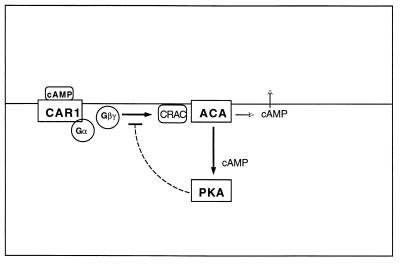
FIG. 1
FIG. 1
Control of activity. adenylyl cyclase (ACA) ACA is activated when extracellular cAMP binds to the serpentine receptor CAR1. Ligand-bound CAR1 facilitates exchange of GTP for GDP on the Gα subunit of trimeric G protein that results in release of the Gβγ subunits. In conjunction with the cytosolic regulator of ACA, CRAC, Gβγ stimulates ACA such that it catalyzes the formation of cAMP from ATP. Some of the newly made cAMP is secreted, while the remainder is free to interact with the regulatory subunit of PKA, thereby activating PKA. PKA activity then indirectly inhibits ACA activation. Since activation of PKA depends on accumulation of cAMP, it occurs somewhat after ACA is activated. The difference between the time of activation of ACA and that of PKA determines the length of the period during which cAMP is synthesized.
FIG. 2
FIG. 2
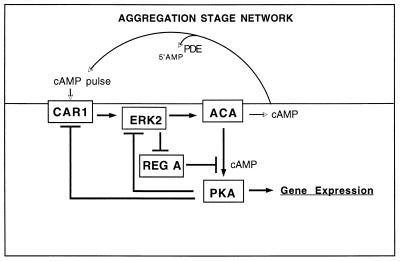
Signal relay stage network. Activation of CAR1 by extracellular cAMP results in a brief period during which adenylyl cyclase is active as described in the legend to Fig. 1. Either directly or indirectly, CAR1 also activates the MAP kinase, ERK2, when it binds extracellular cAMP. ERK2 inhibits the cAMP phosphodiesterase RegA while cAMP is accumulating in the cell. After PKA is activated by the cAMP produced by adenylyl cyclase, it inhibits ERK2. When RegA is no longer inhibited by ERK2, it can reduce the level of cAMP such that the regulatory subunit of PKA can associate with the catalytic subunit and inhibit it. cAMP secreted into the extracellular space is degraded by an extracellular phosphodiesterase, but some may survive to bind to CAR1. During the period when PKA is active, it can lead to an increase in the expression of genes such as acaA.
FIG. 3
FIG. 3
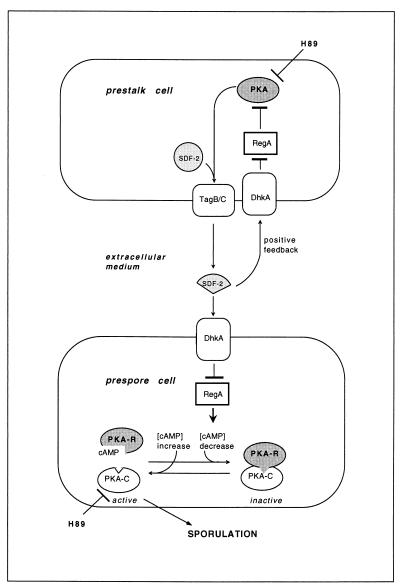
Signal transduction during culmination. Genetic studies suggest that the prestalk-specific membrane complex TagB/C is essential for release of the signal that triggers encapsulation of prespore cells and that the signal is recognized by the extracellular domain of the histidine kinase DhkA. DhkA can then inhibit the cAMP phosphodiesterase RegA that had been regulating PKA activity by facilitating the reversible interaction of the regulatory and catalytic subunits. The resulting increase in PKA activity leads to rapid encapsulation of prespore cells and stimulates SDF-2 release from prestalk cells. H89, the specific inhibitor of PKA activity, blocks the ability of prestalk cells to respond to SDF-2 by releasing more SDF-2 and blocks the ability of prespore cells to respond to SDF-2 by sporulating.
FIG. 4
FIG. 4
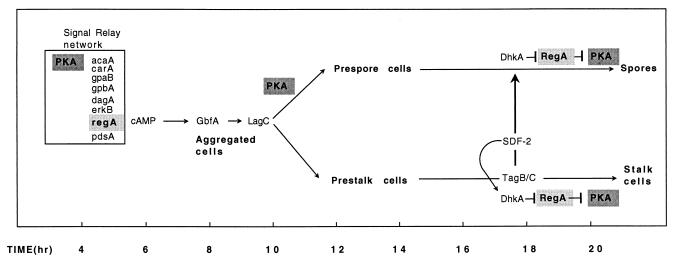
Multiple roles for RegA and PKA during development. The signal relay network is presented in Fig. 1 and 2. When aggregated cells are exposed to high levels of cAMP, genes dependent on the DNA-binding protein GBF are activated and cell type divergence proceeds. PKA is essential for prespore-specific gene expression and may also be involved in modulating prestalk genes. PKA activity during this stage of development is likely to be a function of RegA activity and the relative rates of transcription of pkaC and pkaR. During culmination pkaC is expressed at high levels in prespore cells, perhaps as a response to SDF-1. The autocrine circuit that results in rapid release of SDF-2 from prestalk cells exposes prespore cells to this sporulation inducer. The signal is transduced to PKA activity via the two-component system of DhkA and RegA.

References

    1. Abe K, Yanagisawa K. A new class of rapid developing mutants in Dictyostelium discoideum: implications for cyclic AMP metabolism and cell differentiation. Dev Biol. 1983;95:200–210. - PubMed
    1. Abel T, Nguyen P V, Barad M, Deuel T A, Kandel E R, Bourtchouladze R. Genetic demonstration of a role for PKA in the late phase of LTP and in hippocampus-based long-term memory. Cell. 1997;88:615–626. - PubMed
    1. Alcantara F, Monk M. Signal propagation during aggregation in the slime mould Dictyostelium discoideum. J Gen Microbiol. 1974;85:321–334. - PubMed
    1. Alex L, Simon M. Protein histidine kinases and signal transduction in prokaryotes and eukaryotes. Trends Genet. 1994;10:133–138. - PubMed
    1. Anjard C, Pinaud S, Kay R R, Reymond C D. Overexpression of DdPK2 protein kinase causes rapid development and affects the intracellular cAMP pathway of Dictyostelium discoideum. Development. 1992;115:785–790. - PubMed

Publication types

MeSH terms

Substances