. 1998 Sep 1;12(17):2698-710.
doi: 10.1101/gad.12.17.2698.

CLB5 and CLB6 are required for premeiotic DNA replication and activation of the meiotic S/M checkpoint

Affiliations

CLB5 and CLB6 are required for premeiotic DNA replication and activation of the meiotic S/M checkpoint

D Stuart et al. Genes Dev. .

Abstract

Initiation of DNA replication during the mitotic cell cycle requires the activation of a cyclin-dependent protein kinase (CDK). The B-type cyclins Clb5 and Clb6 are the primary activators of the S phase function of the budding yeast CDK Cdc28. However, in mitotically growing cells this role can be fulfilled by the other B-type cyclins Clb1-Clb4. We report here that cells undergoing meiotic development also require Clb dependent CDK activity for DNA replication. Diploid clb5/clb5 clb6/clb6 mutants are unable to perform premeiotic DNA replication. Despite this defect, the mutant cells progress into the meiotic program and undergo lethal segregation of unreplicated DNA suggesting that they fail to activate a checkpoint that restrains meiotic M phase until DNA replication is complete. We have found that a DNA replication checkpoint dependent on the ATM homolog MEC1 operates in wild-type cells during meiosis and can be invoked in response to inhibition of DNA synthesis. Although cells that lack clb5 and clb6 are unable to activate the meiotic DNA replication checkpoint, they do possess an intact DNA damage checkpoint which can restrain chromosome segregation in the face of DNA damage. We conclude that CLB5 and CLB6 are essential for premeiotic DNA replication and, consequently, for activation of a meiotic DNA replication checkpoint.


Figures
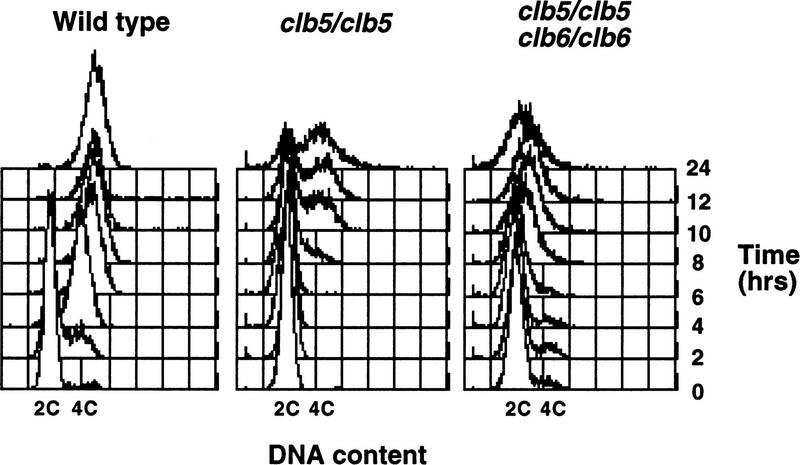
Figure 1
Figure 1
CLB5 and CLB6 are required for efficient premeiotic DNA replication. Synchronous populations of wild-type, clb5/clb5, and clb5/clb5 clb6/clb6 strains were isolated by centrifugal elutriation and induced to sporulate. Samples of each culture were collected every 2 hr and DNA content of the populations was monitored by flow cytometry of propidium iodide-stained cells. The position of 2C and 4C DNA contents is indicated at the bottom of each plot.
Figure 2
Figure 2
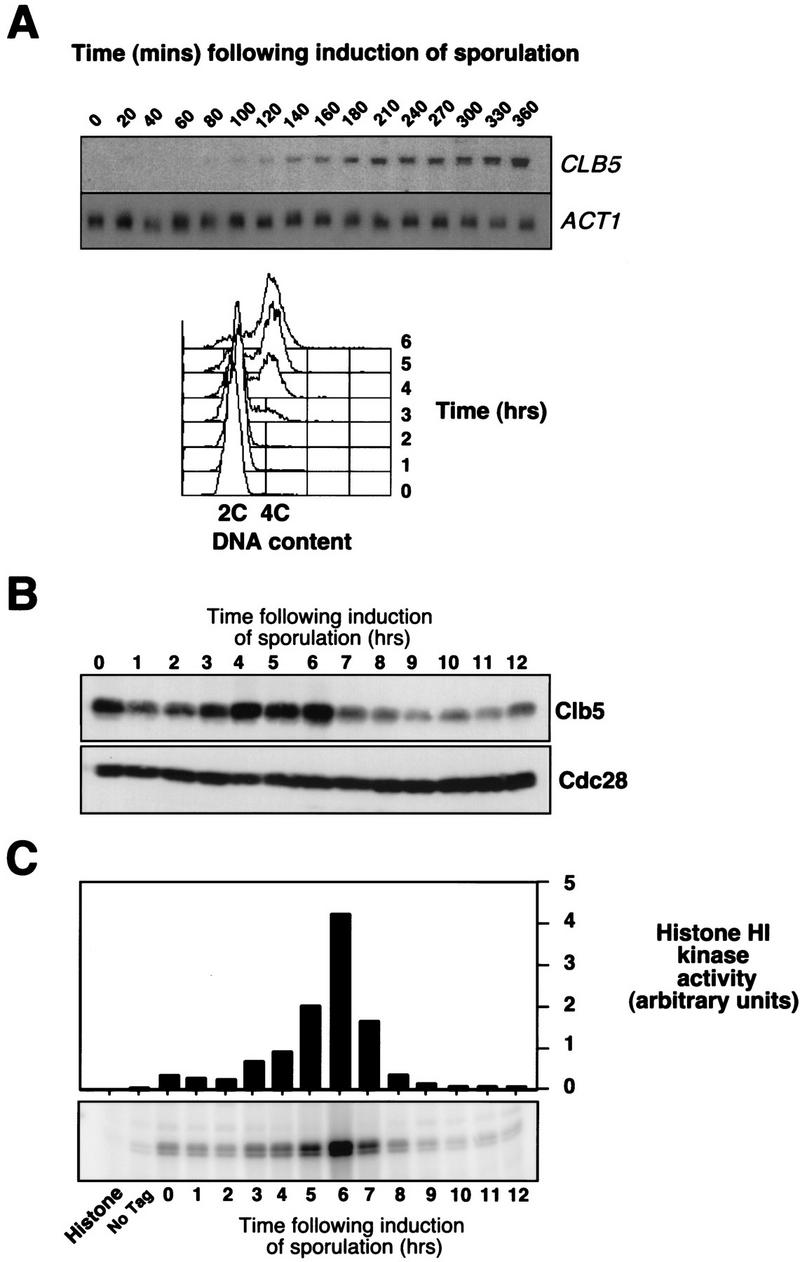
CLB5 RNA, protein, and associated kinase accumulate prior to and throughout meiotic S phase. (A) Synchronous population of G1 cells, isolated by centrifugal elutriation was induced to sporulate and samples collected at the indicated times were analyzed by Northern blotting for the abundance of CLB5 and ACT1 transcripts (top), or for DNA content by FACS (bottom). (B) Western blot analysis of Clb5 protein abundance in a culture grown to late log phase and then induced to sporulate at time 0. The Western blot was probed with 12CA5 anti HA antibody to detect Clb5HA and with anti-Cdc28 antibody as a control for loading. (C) Kinase activity associated with Clb5 was analyzed by immunoprecipitation with anti-HA antibody from samples of CLB5HA/CLB5HA diploids that had been induced to sporulate. Immune complexes were extensively washed and then assayed for kinase activity with histone H1 as a substrate.
Figure 3
Figure 3
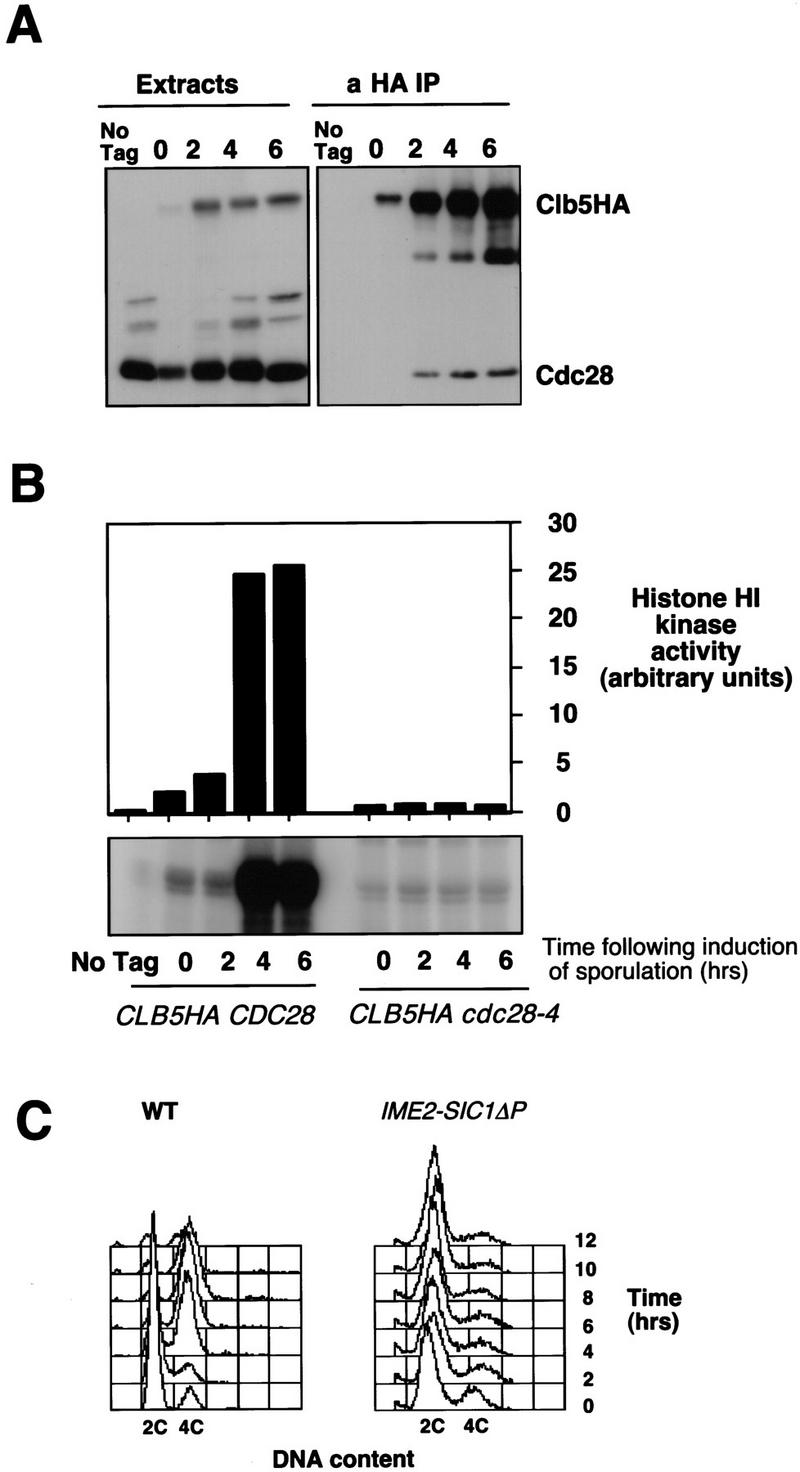
Histone HI kinase activity associated with Clb5 during sporulation is Cdc28 dependent. (A) Whole cell extract (50 μg) or anti-HA immunoprecipitates (from 1 mg of total protein) from either wild-type diploid cells (No Tag) or CLB5HA/CLB5HA diploids were separated by gel electrophoresis and probed for Clb5HA and Cdc28. (B) Histone H1 kinase activity associated with Clb5HA immune complexes prepared from diploid strains expressing wild-type Cdc28 (CLB5HA CDC28), a temperature-sensitive Cdc28-4 (CLB5HA cdc28-4), or a wild-type Cdc28 with untagged CLB5 (No Tag). Strains were grown and induced to sporulate at the permissive temperature of 28°C and kinase activity was assayed at 25°C. (C) DNA content over a time course of sporulation of wild-type diploids and diploids that express a stabilized version of the Clb/Cdc28 CDK inhibitor SIC1 (SIC1ΔP) under the regulation of the meiosis specific IME2 promoter.
Figure 4
Figure 4
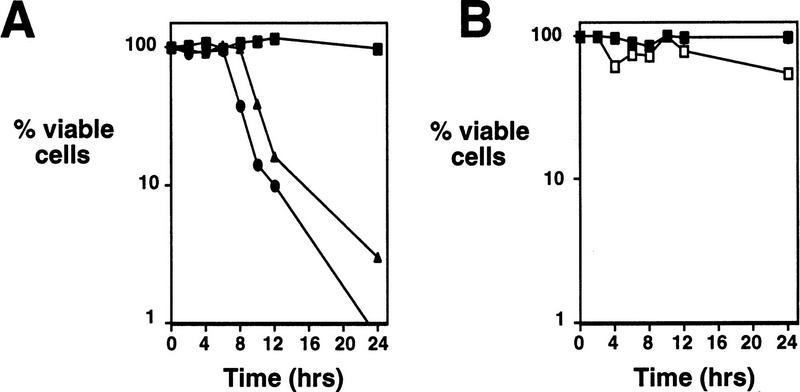
clb5 and clb5 clb6 mutant diploids rapidly lose viability when induced to sporulate. (A) Synchronous population of wild-type (█) clb5/clb5 (▴) or clb5/clb5 clb6/clb6 (•) cells were isolated by centrifugal elutriation and induced to sporulate. The viability of cells during the timecourse was determined by their ability to return to mitotic growth when plated onto rich growth medium at the times indicated. Values represent the average number of colonies derived from two independent samples. (B) Viability of wild-type diploid cells induced to sporulate in the absence of HU (█) or in the presence of 100 mm HU (□). All of the values represent the average number of colonies from two independent samples.
Figure 5
Figure 5
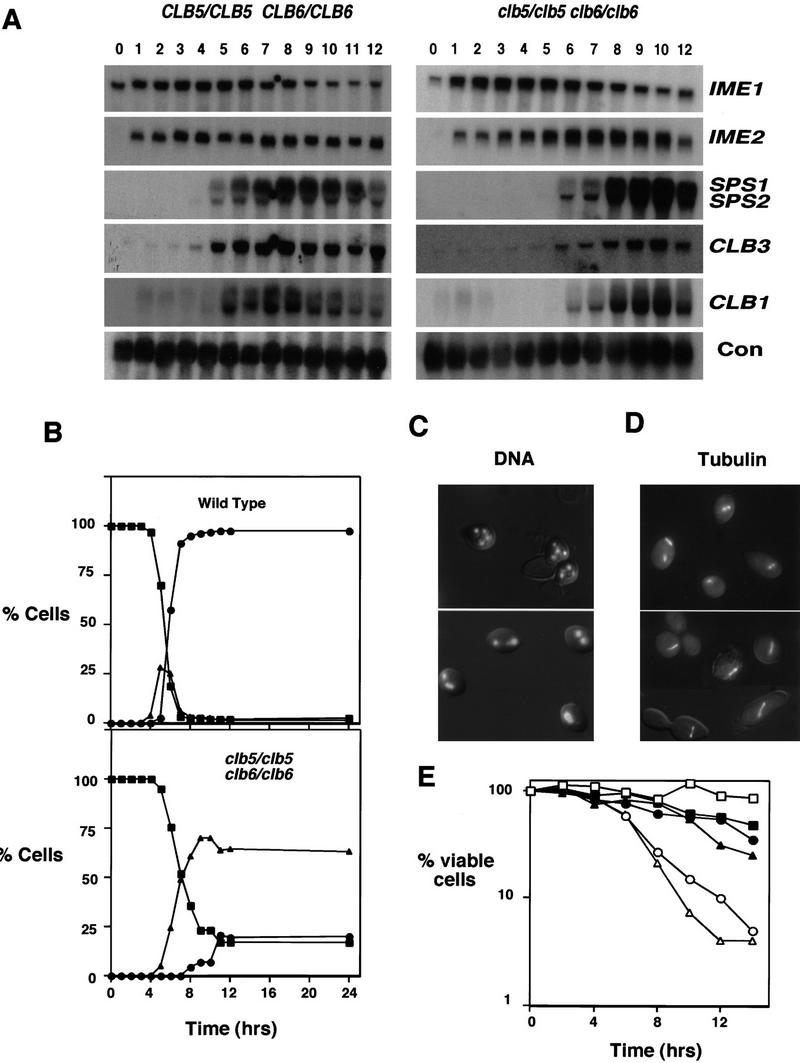
clb5/clb5 clb6/clb6 mutants attempt to progress through meiotic development despite being unable to replicate DNA. (A) Northern blots made with RNA samples from sporulating wild-type diploids (left) or clb5/clb5 clb6/clb6 mutants (right) were sequentially hybridized with probes recognizing RNA transcripts from the early (IME1 and IME2) and middle (SPS1 and SPS2) sporulation genes and the B-type cyclins, CLB1 and CLB3. The constitutively expressed gene C4/2 was used as a loading control (Su and Mitchell 1993). (B) Chromatin segregation in wild-type diploids (top) or clb5/clb5 clb6/clb6 mutants (bottom) following induction of sporulation. The proportion of cells having either one (█), two (▴), or more than two (•) masses of divided chromatin was determined by fluorescence microscopic examination of DAPI-stained cells following induction of sporulation in synchronized populations. (C) Chromatin masses in a representative group of cells from the 8-hr time point of B. Chromatin was visualized by propidium iodide fluorescence and is overlaid on a DIC image of the same cells. The wild-type cells (top) have undergone MI and MII, whereas most of the clb5/clb5 clb6/clb6 mutants (bottom) have apparently undergone a single meiotic division. (D) Meiotic spindles visualized by GFP–tubulin fluorescence in wild-type (top) and clb5/clb5 clb6/clb6 (bottom) 6 hr following the induc-tion of sporulation. The fluorescence image is overlaid on a DIC image of the same cells. (E) Lethal meiosis of clb5/clb5 clb6/clb6 mutants is partially rescued by inhibiting spindle formation. Viability in synchronized populations of wild-type (□,█), clb5/clb5 (○,•) or clb5/clb5 clb6/clb6 (▵,▴) mutant cells treated (solid symbols) with nocodazole (20 μ/ml)/benomyl (30 μg/ml) or left untreated (open symbols) following induction of sporulation.The percent of viable cells was determined by their ability to return to mitotic growth when removed from sporulation conditions and plated onto rich growth medium lacking any inhibitors. Values represent the average number of colonies derived from two independent samples.
Figure 6
Figure 6
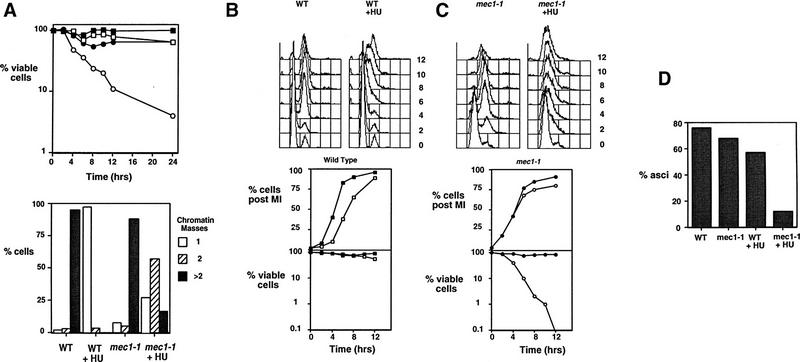
A DNA replication checkpoint dependent on MEC1 operates during meiotic development. (A) (Top) Viability of wild-type diploid cells (□,█) or mec1-1/mec1-1 mutants (○,•) that were either untreated (solid symbols) or treated with 100 mm HU (open symbols) following induction of sporulation. Viability was assessed by removing samples of each culture at the indicated time and plating onto rich growth medium lacking HU. (Bottom) Percent of wild-type or mec1-1/mec1-1 cells that display one, two, or more than two separated chromatin masses following 12 hr of sporulation in the presence or absence of 100 mm HU. (B) (Top) DNA content of wild-type diploids induced to sporulate in the presence of 2.5 mm HU, a subarresting concentration, at the indicated times following induction of sporulation determined by FACS analysis. (Bottom) Segregation of chromatin, determined by DAPI staining and cell viability as measured by ability to return to growth in wild-type diploids during sporulation in the absence (█) or in the presence (□) of 2.5 mm HU. (C) (Top) DNA content of mec1-1/mec1-1 diploids induced to sporulate in the presence of 2.5 mm HU, a subarresting concentration as determined by FACS analysis. (Bottom) Segregation of chromatin and cell viability of mec1-1/mec1-1 diploid cells during sporulation in the absence (•) or presence (○) of 2.5 mm HU. (D) Percent of wild-type or mec1-1/mec1-1 diploid cells forming asci after being sporulated for 24 hr in the presence or absence of 2.5 mm HU.
Figure 7
Figure 7
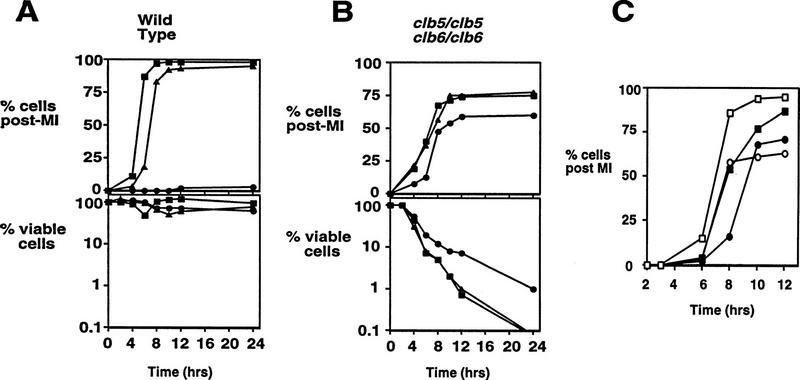
clb5/clb5 clb6/clb6 mutants are unable to delay chromosome segregation in response to HU, but can delay in response to DNA damage. Wild-type (A) or clb5/clb5 clb6/clb6 (B) diploids were induced to sporulate in the absence of HU (█), or with 2.5 mm HU (▴), or 100 mm HU (•). Samples obtained at the indicated intervals were stained with DAPI to determine when chromosome segregation occurred (top, A,B), or were diluted and plated to determine viability (bottom, A,B). (C) Wild-type (□,█) or clb5/clb5 clb6/clb6 (○,•) diploids were induced to sporulate at 30°C and after 2 hr were subjected to either mock irradiation (open symbols) or γ irradiation with 200 gy (solid symbols). Following treatment, cultures were returned to 30°C and samples withdrawn at the indicated times and stained with DAPI to monitor chromosome segregation.

References

    1. Budd ME, Wittrup KD, Bailey JE, Campbell JL. DNA polymerase I is required for premeiotic DNA replication and sporulation but not for X-ray repair in Saccharomyces cerevisiae. Mol Cell Biol. 1989;9:365–376. - PMC - PubMed
    1. Chu S, Herskowitz I. Gametogenesis in yeast is regulated by a transcriptional cascade dependent on Ndt80. Mol Cell. 1998;1:685–696. - PubMed
    1. Collins I, Newlon CS. Chromosomal DNA replication initiates at the same origins in meiosis and mitosis. Mol Cell Biol. 1994;14:3524–3534. - PMC - PubMed
    1. Dahmann C, Futcher B. Specialization of B-type cyclins for mitosis or meiosis in S. cerevisiae. Genetics. 1995;140:957–963. - PMC - PubMed
    1. Diffley JFX, Cocker JH, Dowell SJ, Rowley A. Two steps in the assembly of complexes at yeast replication origins in vivo. Cell. 1994;78:303–316. - PubMed

Publication types

MeSH terms