. 1998 Sep;118(1):149-58.
doi: 10.1104/pp.118.1.149.

Chilling delays circadian pattern of sucrose phosphate synthase and nitrate reductase activity in tomato

Affiliations

Chilling delays circadian pattern of sucrose phosphate synthase and nitrate reductase activity in tomato

TL Jones et al. Plant Physiol. 1998 Sep.

Abstract

Overnight low-temperature exposure inhibits photosynthesis in chilling-sensitive species such as tomato (Lycopersicon esculentum) and cucumber by as much as 60%. In an earlier study we showed that one intriguing effect of low temperature on chilling-sensitive plants is to stall the endogenous rhythm controlling transcription of certain nuclear-encoded genes, causing the synthesis of the corresponding transcripts and proteins to be mistimed when the plant is rewarmed. Here we show that the circadian rhythm controlling the activity of sucrose phosphate synthase (SPS) and nitrate reductase (NR), key control points of carbon and nitrogen metabolism in plant cells, is delayed in tomato by chilling treatments. Using specific protein kinase and phosphatase inhibitors, we further demonstrate that the chilling-induced delay in the circadian control of SPS and NR activity is associated with the activity of critical protein phosphatases. The sensitivity of the pattern of SPS activity to specific inhibitors of transcription and translation indicates that there is a chilling-induced delay in SPS phosphorylation status that is caused by an effect of low temperature on the expression of a gene coding for a phosphoprotein phosphatase, perhaps the SPS phosphatase. In contrast, the chilling-induced delay in NR activity does not appear to arise from effects on NR phosphorylation status, but rather from direct effects on NR expression. It is likely that the mistiming in the regulation of SPS and NR, and perhaps other key metabolic enzymes under circadian regulation, underlies the chilling sensitivity of photosynthesis in these plant species.


Figures
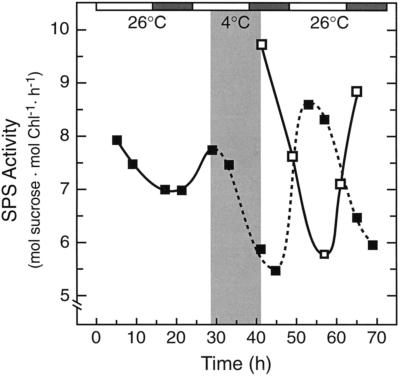
Figure 1
Figure 1
Low-temperature treatment delays the circadian rhythm controlling SPS activity. Plants were transferred to constant low-light (50 μmol quanta m−2 s−1) and temperature (26°C) conditions. The light and dark bars above the figure represent day and subjective night periods, respectively. A low-temperature treatment (4°C), represented by the shaded area in the main body of the figure, was imposed for 12 h, between h = 29 and h = 41. After rewarming, samples were taken to determine the effect of low temperature on the circadian rhythm in SPS activity. Comparison of the reference circadian rhythm (▪) and the postchilling oscillation (□) demonstrates that the 12-h low-temperature treatment delayed the oscillation in SPS activity by 12 h. Each point represents the mean of two samples, and the experiment was repeated several times with consistent results. Chl, Chlorophyll.
Figure 2
Figure 2
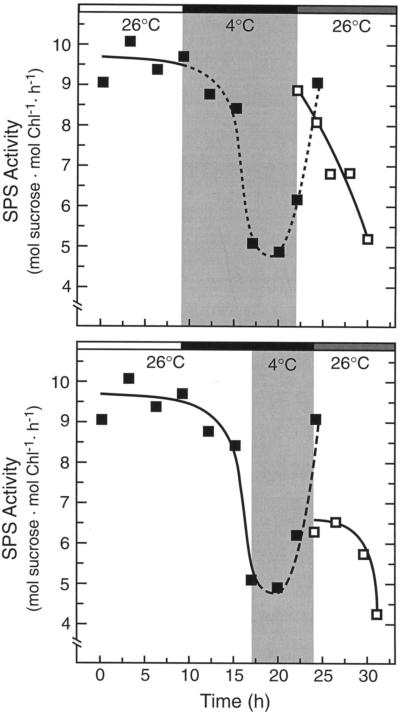
The effect of dark chilling treatments initiated at different times in the diurnal cycle on SPS activity in tomato. The white bar above the figure represents the light cycle, the black bar represents the dark cycle, and the gray bar represents the continuation of darkness during the normal light cycle (i.e. subjective day). Top, The dark chilling treatment was initiated during the light cycle at h = 9 and plants were rewarmed at h = 22. Data points were normalized to the diurnal SPS activity profile at h = 24. Bottom, The dark chilling treatment (4°C) was initiated during the night at h = 17, plants were rewarmed (26°C) at h = 24, and samples were then taken in the dark after rewarming (□). Data were normalized to the diurnal activity profile at h = 22. In both experiments, the low-temperature treatment resulted in the maintenance of the prechill SPS activity, showing that low-temperature treatment delayed the normal rhythm in SPS activity. Chl, Chlorophyll.
Figure 3
Figure 3
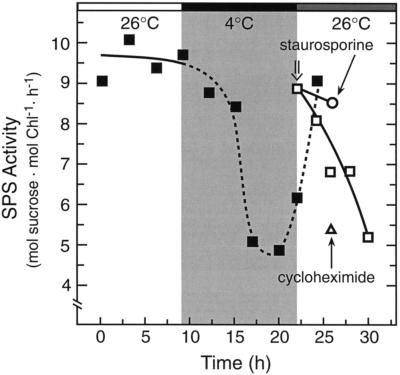
Inhibitor studies show that SPS maintains the prechilling phosphorylation state after chilling. Light/dark cycles are represented by the shaded bars above the figure, as described in the legend to Fig. 2. A dark chill was imposed between h = 9 and h = 22, and immediately upon rewarming staurosporine (100 μm, ○) or cycloheximide (200 μg/mL, ▵) was applied to attached, abraded tomato leaves. The time of inhibitor application is indicated (⇓). After a 4-h dark incubation, samples were taken to determine SPS activity. The staurosporine treatment maintained SPS in the more active state, demonstrating that the prechilling, dephosphorylated form of SPS was maintained throughout the low-temperature treatment. Each point represents the mean of at least three samples, and the sd values were less than 15% of the mean values. Chl, Chlorophyll.
Figure 4
Figure 4
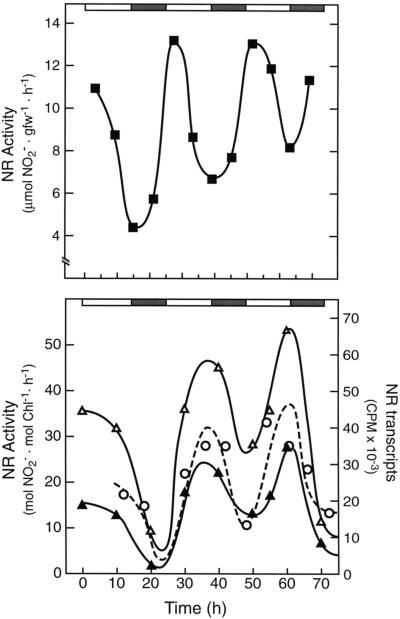
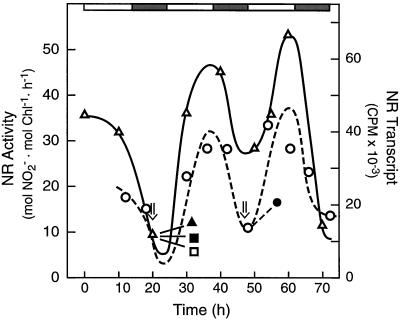
NR has a circadian pattern in transcript and protein levels, which is responsible for an endogenous rhythm in NR activity in tomato. The light and dark bars above the figure represent day and subjective night periods, respectively. Top, NR activity (▪) was assayed under in vivo conditions (see Methods) over a 3-d, constant light (450 μmol quanta m−2 s−1) and temperature (26°C) time course. The experiment was repeated twice, and the results shown are representative. gfw, Grams fresh weight. Bottom, NR activity was assayed under in vitro conditions in the absence (▵) and presence (▴) of Mg2+. The absence of Mg2+ prevents the Mg2+-dependent binding of 14-3-3-type inhibitor proteins to phospho-NR, thereby revealing changes in NR activity that are caused by changes in enzyme level (see text). Total leaf RNA was isolated from tomato leaves under constant-light circadian conditions and probed with a dCTP32-labeled tobacco nia-2 cDNA (○). The radioactivity was quantified on a phosphor imager. All experiments were repeated at least three times and representative results are shown. Chl, Chlorophyll.
Figure 5
Figure 5
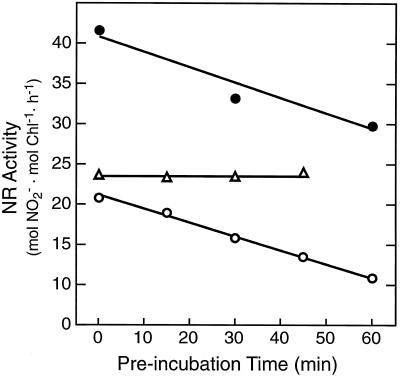
Continuous-light circadian samples do not show slow activation of NR in the presence of EDTA (i.e. in the absence of Mg2+). Leaf samples were taken at the peak (32 h, •) or trough (24 h, ○) of continuous-light circadian NR activity and after 20 h of dark adaptation (▵). The data plotted are the average of three separate experiments.
Figure 6
Figure 6
The circadian increase in NR activity (▵) is prevented by inhibitors of translation and transcription; the circadian increase in NR activity and transcript level is prevented by inhibitors of protein phosphatases. The light and dark bars above the figure represent day and subjective night periods, respectively. Tomato leaves were treated with okadaic acid (10 μm, ▴ and •), cordycepin (200 μg/mL, ▪), or cycloheximide (200 μg/mL, □) at the times indicated (⇓). NR activity was assayed under in vitro conditions. NR activity data are representative of at least four separate samples, and were normalized to the continuous-light circadian rhythm at h = 32. Total leaf RNA (○, •) was probed with a dCTP32-labeled tobacco nia-2 cDNA. NR transcript data are the average of two separate samples, and were normalized to the circadian rhythm at h = 55. Chl, Chlorophyll.
Figure 7
Figure 7
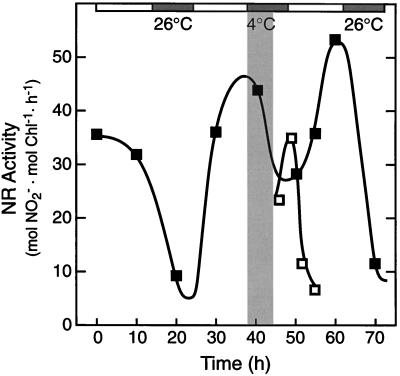
Low-temperature treatment delays the circadian rhythm controlling NR activity. The light and dark bars above the figure represent day and subjective night periods, respectively. A low-temperature treatment (4°C), represented by the shaded area in the main body of the figure, was imposed for 6 h, between h = 38 and h = 44. After rewarming, NR activity was assayed under in vitro conditions in the absence of Mg2+ (□). Comparison of the reference circadian rhythm (▪) and the postchilling oscillation (□) demonstrates that the 6-h low-temperature treatment delayed the oscillation in NR activity without Mg2+ (i.e. NR protein level). The experiment was repeated several times with consistent results. Chl, Chlorophyll.
Figure 8
Figure 8
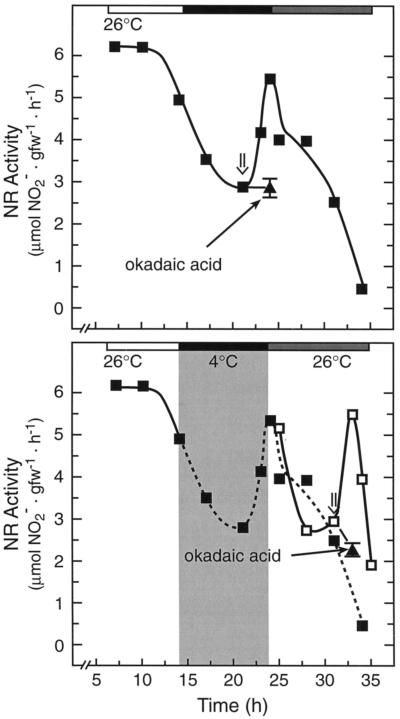
Low temperature delays the circadian control of the rise in in vivo NR activity that normally occurs before dawn. Top, For these experiments, plants grown under diurnal conditions (light/dark cycles are represented by the shaded bars above the figure, as described in the legend to Fig. 2) were given extended darkness in place of the normal dark-to-light transition at h = 24 (subjective day is represented by the gray bar). NR activity (▪) was assayed in the dark during the night and the following subjective day. Okadaic acid (10 μm, ▴) inhibited the circadian increase in NR activity. The experiment was repeated three times, and the profile shown is a representative result. Bottom, Plants were chilled at 4°C during the diurnal night cycle, between h = 14 and h = 24, and rewarmed in the dark. Samples were taken after rewarming (□) and demonstrate that the low-temperature treatment delayed the increase in NR activity by 10 h, indicating that the circadian clock stopped for the duration of the chill and resumed upon rewarming. During the dark recovery phase, okadaic acid (10 μm, ▴) was applied to attached tomato leaves (h = 32). Two hours later (h = 34), in vivo NR activity was assayed from the inhibitor-treated leaves and surfactant-treated controls. This experiment was repeated three times with consistent results. gfw, Grams fresh weight.

References

    1. Bachmann M, McMichael RW, Huber JL, Kaiser WM, Huber SC. Partial purification and characterization of a calcium-dependent protein kinase and an inhibitor protein required for inactivation of spinach leaf nitrate reductase. Plant Physiol. 1995;108:1083–1092. - PMC - PubMed
    1. Bachmann M, Shiraishi N, Campbell WH, Yoo BC, Harmon AC, Huber SC. Identification of Ser-543 as the major regulatory phosphorylation site in spinach leaf nitrate reductase. Plant Cell. 1996;8:127–131. - PMC - PubMed
    1. Baker NR, East TM, Long SP. Chilling damage to photosynthesis in young Zea mays. II. Photochemical function of thylakoids in vivo. J Exp Bot. 1983;34:189–197.
    1. Bringloe DH, Dyer TA, Gray JC. Developmental, circadian and light regulation of wheat ferredoxin gene expression. Plant Mol Biol. 1995;27:293–306. - PubMed
    1. Carter PJ, Nimmo HG, Fewson CA, Wilkins MB. Circadian rhythms in the activity of a plant protein kinase. EMBO J. 1991;10:2063–2068. - PMC - PubMed

LinkOut - more resources