. 1998 Oct;72(10):7909-15.
doi: 10.1128/JVI.72.10.7909-7915.1998.

The coxsackievirus-adenovirus receptor protein can function as a cellular attachment protein for adenovirus serotypes from subgroups A, C, D, E, and F

Affiliations

The coxsackievirus-adenovirus receptor protein can function as a cellular attachment protein for adenovirus serotypes from subgroups A, C, D, E, and F

P W Roelvink et al. J Virol. 1998 Oct.

Abstract

Attachment of an adenovirus (Ad) to a cell is mediated by the capsid fiber protein. To date, only the cellular fiber receptor for subgroup C serotypes 2 and 5, the so-called coxsackievirus-adenovirus receptor (CAR) protein, has been identified and cloned. Previous data suggested that the fiber of the subgroup D serotype Ad9 also recognizes CAR, since Ad9 and Ad2 fiber knobs cross-blocked each other's cellular binding. Recombinant fiber knobs and 3H-labeled Ad virions from serotypes representing all six subgroups (A to F) were used to determine whether the knobs cross-blocked the binding of virions from different subgroups. With the exception of subgroup B, all subgroup representatives cross-competed, suggesting that they use CAR as a cellular fiber receptor as well. This result was confirmed by showing that CAR, produced in a soluble recombinant form (sCAR), bound to nitrocellulose-immobilized virions from the different subgroups except subgroup B. Similar results were found for blotted fiber knob proteins. The subgroup F virus Ad41 has both short and long fibers, but only the long fiber bound sCAR. The sCAR protein blocked the attachment of all virus serotypes that bound CAR. Moreover, CHO cells expressing human CAR, in contrast to untransformed CHO cells, all specifically bound the sCAR-binding serotypes. We conclude therefore that Ad serotypes from subgroups A, C, D, E, and F all use CAR as a cellular fiber receptor.


Figures
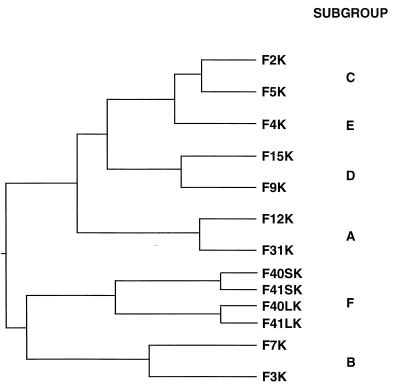
FIG. 1
FIG. 1
Phylogenetic tree of 13 fiber knob amino acid sequences. The sources of the sequences are identified in Materials and Methods. The sequences were aligned as described in the footnote to Table 1.
FIG. 2
FIG. 2
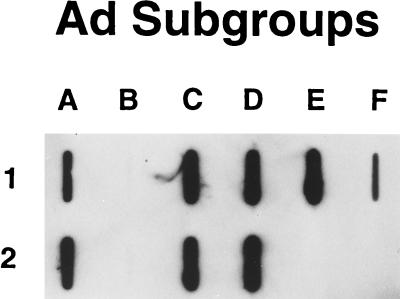
sCAR-virus slot blot. Approximately 2 × 10¹⁰ particles of each serotype were blotted onto nitrocellulose. The blot was blocked 5% milk in PBS and then incubated overnight with soluble CAR protein. Detection was performed as described in Materials and Methods. The lettering refers to the subgroup classification. The letter-and-number combination refers to the following serotypes: A1 and A2, Ad12 and Ad31; B1 and B2, Ad3 and Ad7; C1 and C2, Ad2 and Ad5; D1 and D2, Ad9 and Ad15; E1, Ad4; F1, Ad41.
FIG. 3
FIG. 3
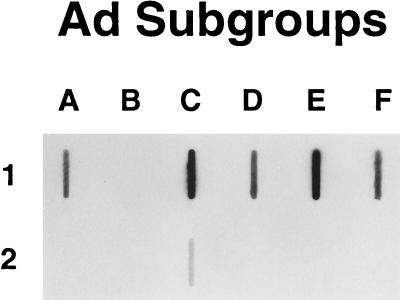
sCAR-fiber knob protein slot blot. Approximately 2 μg of each purified fiber knob protein was blotted onto a nitrocellulose. The blot was blocked and incubated overnight with sCAR protein. Detection was performed as described in Materials and Methods. The lettering refers to the subgroup classification. The letter-and-number combination refers to the following fiber knob proteins: A1, F12K; B1, F3K; C1 and C2, F2K and F5K; D1, F9K; E1, F4K; F1 and F2, F41LK and F41S-K.
FIG. 4
FIG. 4
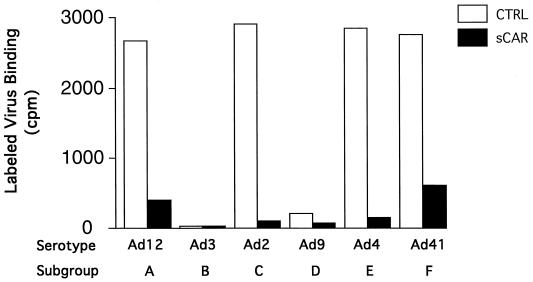
sCAR protein inhibits binding to Ramos cells. Equal specific activity input doses (9,000 cpm) of radiolabeled Ad serotypes were incubated with sCAR protein at 10 μg/ml for 30 min at RT. Next, the virus was added to 2 × 10⁶ Ramos cells and incubated in suspension for 1 h at RT. The cells were washed, the pellet was resuspended in 100 μl of PBS, and bound virus was determined by scintillation counting. The bars represent cpm bound (mean of three assays ± 5%). CTRL is control binding without sCAR preincubation.
FIG. 5
FIG. 5
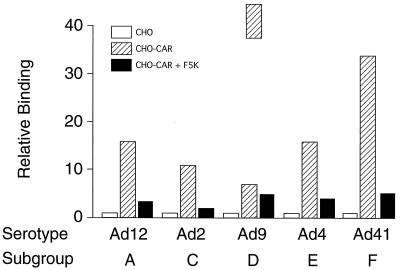
Qualitative analysis of Ad binding to CHO-CAR cells. Approximately 106 CHO-CAR cells, or CHO-CAR cells preincubated with F5K protein at 5 μg/ml, were incubated for 1 h at 4°C with radiolabeled Ad serotypes. The cells were washed, the pellet was resuspended in 100 μl of PBS, and bound virus was determined by scintillation counting. Open bars represent binding of the viruses to CHO cells standardized to 1 (mean of 3 assays ± 6%). Hatched bars represent binding to CHO-CAR cells (fold increase over binding to CHO). Solid bars represent binding to CHO-CAR cells after preincubation with F5K protein (fold increase over binding to CHO). The counts measured (in cpm) were as follows: Ad12, 323, 5,021, 865; Ad2, 944, 10,299, 1,500; Ad9, 50, 320, 210; Ad4, 293, 4,772, 1,135; Ad41, 255, 8,567, 1,158.
FIG. 6
FIG. 6
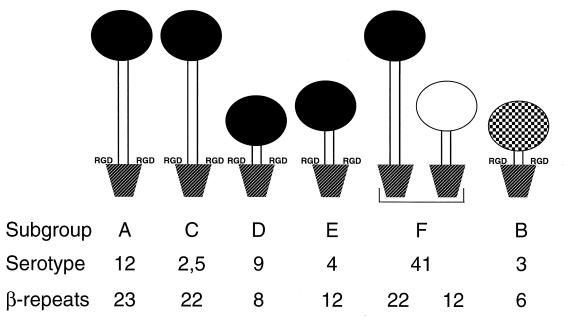
A model for Ad tropism based on fiber shaft length, fiber receptor recognition, and penton base receptor recognition. The serotypes from the five Ad subgroups that recognize CAR have different fiber shaft lengths and are complexed with the pentameric penton base that has RGD sequences, although penton base can occur without RGD sequences (Ad40 and Ad41). Fibers from subgroups A and C to F are able to recognize the CAR protein as a cellular fiber receptor. The number of β-repeats in the fiber shaft of those serotypes varies from 23 (Ad12) to 8 (Ad9). Once the number of β-repeats drops to 8, attachment is enhanced by direct interaction of the penton base RGD loops with the cellular αv-integrins. The cellular fiber receptors for fiber 41 short and fiber 3 remain unidentified.

References

    1. Ausubel F M, Brent R, Kingston R E, Moore D D, Seidman J G, Smith J A, Struhl K. Current protocols in molecular biology. New York, N.Y: Greene Publishing Associates/Wiley-Interscience; 1989.
    1. Bai M, Campisi L, Freimuth P. Vitronectin receptor antibodies inhibit infection of HeLa and A549 cells by adenovirus type 12 but not by adenovirus type 2. J Virol. 1994;68:5925–5932. - PMC - PubMed
    1. Bailey A, Mautner V. Phylogenetic relationships among adenovirus serotypes. Virology. 1994;205:438–452. - PubMed
    1. Bergelson J M, Cunningham J A, Droguett G, Kurt-Jones E A, Krithivas A, Hong J S, Horwitz M A, Crowell R L, Finberg R W. Isolation of a common receptor for Coxsackie B viruses and adenoviruses 2 and 5. Science. 1997;275:1320–1323. - PubMed
    1. Brough D E, Lizonova A, Hsu C, Kulesa V A, Kovesdi I. A gene transfer vector-cell line system for complete functional complementation of adenovirus early region E1 and E4. J Virol. 1996;70:6497–6501. - PMC - PubMed

Substances

LinkOut - more resources