. 1998 Oct;72(10):7978-84.
doi: 10.1128/JVI.72.10.7978-7984.1998.

The Epstein-Barr virus Rta protein activates lytic cycle genes and can disrupt latency in B lymphocytes

Affiliations

The Epstein-Barr virus Rta protein activates lytic cycle genes and can disrupt latency in B lymphocytes

T Ragoczy et al. J Virol. 1998 Oct.

Abstract

The transition of Epstein-Barr virus (EBV) from latency into the lytic cycle is associated with the expression of two immediate-early viral genes, BZLF1 and BRLF1. Overexpression of ZEBRA, the product of BZLF1, is sufficient to disrupt latency in B lymphocytes and epithelial cells by stimulating expression of lytic cycle genes, including BRLF1. The BRLF1 product Rta functions as a transcriptional activator in both B lymphocytes and epithelial cells. However, Rta has recently been reported to disrupt latency in an epithelial specific manner (S. Zalani, E. Holley-Guthrie, and S. Kenney, Proc. Natl. Acad. Sci. USA 93:9194-9199, 1996). Here we demonstrate that expression of Rta is also sufficient for disruption of latency in a permissive B-cell line. In HH514-16 cells, transfection of Rta leads to synthesis of ZEBRA, viral DNA replication, and late gene expression. However, Rta by itself is less potent than ZEBRA in the ability to activate most early and late lytic cycle genes. In light of previous work implicating ZEBRA in the activation of Rta, we suggest a cooperative model for EBV entry into the lytic cycle. Expression of either BZLF1 or BRLF1 triggers expression of the other immediate-early factor, and together these activators act individually or in synergy on downstream targets to activate the viral lytic cycle.


Figures

FIG. 1
FIG. 1
Activation of early and late viral genes following transfection of BRLF1 into B-cell lines. (A) Raji cells were untreated (lane 1) or were transfected with 5 μg of the indicated plasmids (lanes 2 to 7). Immunoblots prepared 72 h following transfection were probed sequentially with polyclonal rabbit antibody to Rta, with murine monoclonal antibody to EA-D, and with a human antibody to EBNA1. (B) HH514-16 cells were untreated (lane 1), chemically induced with TPA–n-butyrate (lane 2), or transfected with 10 μg of plasmid DNA (lanes 3 to 7). In lanes 4 and 6, the cells received 5 μg of activator and 5 μg of empty vector. In lanes 3 and 5, cells received only vector pBXG1 (lane 3) or pRTS (lane 5). In lane 7, both BZLF1 and BRLF1 were transfected. Immunoblots were probed sequentially with the indicated antisera. Anti-BZLF1 detects both the endogenous (top arrow) and transfected (bottom arrow) ZEBRA.
FIG. 2
FIG. 2
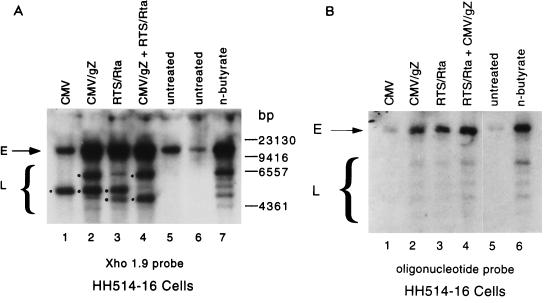
Activation of EBV DNA replication following transfection of BRLF1 into HH514-16 cells. Cells were transfected with 20 μg of total plasmid DNA containing vector alone (lane 1), vector plus genomic ZEBRA (lane 2), vector plus Rta (lane 3), or both activators (lane 4). Untreated cells (lane 5 and lane 6) or butyrate-treated cells (lane 7) were used as negative and positive controls. DNA digested with BamHI was analyzed by Southern blotting using either the Xho 1.9 probe (45) (A) or an oligonucleotide probe (B). Episomal EBV DNA (E) and input vector DNA (•) are indicated. L, linear DNA.
FIG. 3
FIG. 3
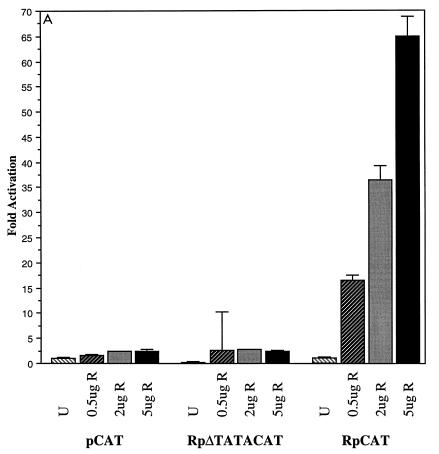
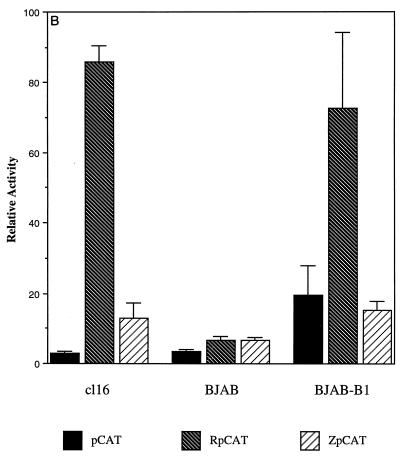
Comparison of transcriptional activation of CAT reporters containing Rp and Zp by Rta and ZEBRA. (A) Autostimulation of RpCAT by Rta. HH514-16 cells were transfected with 16 μg of total plasmid DNA with the indicated amount of activator, 10 μg of CAT reporter, and 1 μg of luciferase reporter. CAT and luciferase assays were performed 72 h following transfection. CAT activity was standardized for transfection efficiency by using the luciferase data. Fold activation is the ratio of CAT activity generated by a reporter in the presence of Rta (R) divided by the CAT activity in the presence of empty pRTS vector (U). The data for RpΔTATACAT are standardized together with those for RpCAT, where RpCAT transfected with empty vector equals 1. pCAT, reporter lacking any promoter or enhancer elements; RpΔTATACAT, 7-nt TATA box deletion in Rp. (B and C) Effects of different cell backgrounds on transcriptional activation of RpCAT and ZpCAT by Rta (B) and ZEBRA (C). For both panels B and C, fold activation for each cell line represents the CAT activity generated by the reporter pCAT, RpCAT, or ZpCAT in the presence of Rta or ZEBRA divided by the activity in the presence of empty vector. cl16, HH514-16.
FIG. 3
FIG. 3
Comparison of transcriptional activation of CAT reporters containing Rp and Zp by Rta and ZEBRA. (A) Autostimulation of RpCAT by Rta. HH514-16 cells were transfected with 16 μg of total plasmid DNA with the indicated amount of activator, 10 μg of CAT reporter, and 1 μg of luciferase reporter. CAT and luciferase assays were performed 72 h following transfection. CAT activity was standardized for transfection efficiency by using the luciferase data. Fold activation is the ratio of CAT activity generated by a reporter in the presence of Rta (R) divided by the CAT activity in the presence of empty pRTS vector (U). The data for RpΔTATACAT are standardized together with those for RpCAT, where RpCAT transfected with empty vector equals 1. pCAT, reporter lacking any promoter or enhancer elements; RpΔTATACAT, 7-nt TATA box deletion in Rp. (B and C) Effects of different cell backgrounds on transcriptional activation of RpCAT and ZpCAT by Rta (B) and ZEBRA (C). For both panels B and C, fold activation for each cell line represents the CAT activity generated by the reporter pCAT, RpCAT, or ZpCAT in the presence of Rta or ZEBRA divided by the activity in the presence of empty vector. cl16, HH514-16.
FIG. 3
FIG. 3
Comparison of transcriptional activation of CAT reporters containing Rp and Zp by Rta and ZEBRA. (A) Autostimulation of RpCAT by Rta. HH514-16 cells were transfected with 16 μg of total plasmid DNA with the indicated amount of activator, 10 μg of CAT reporter, and 1 μg of luciferase reporter. CAT and luciferase assays were performed 72 h following transfection. CAT activity was standardized for transfection efficiency by using the luciferase data. Fold activation is the ratio of CAT activity generated by a reporter in the presence of Rta (R) divided by the CAT activity in the presence of empty pRTS vector (U). The data for RpΔTATACAT are standardized together with those for RpCAT, where RpCAT transfected with empty vector equals 1. pCAT, reporter lacking any promoter or enhancer elements; RpΔTATACAT, 7-nt TATA box deletion in Rp. (B and C) Effects of different cell backgrounds on transcriptional activation of RpCAT and ZpCAT by Rta (B) and ZEBRA (C). For both panels B and C, fold activation for each cell line represents the CAT activity generated by the reporter pCAT, RpCAT, or ZpCAT in the presence of Rta or ZEBRA divided by the activity in the presence of empty vector. cl16, HH514-16.
FIG. 4
FIG. 4
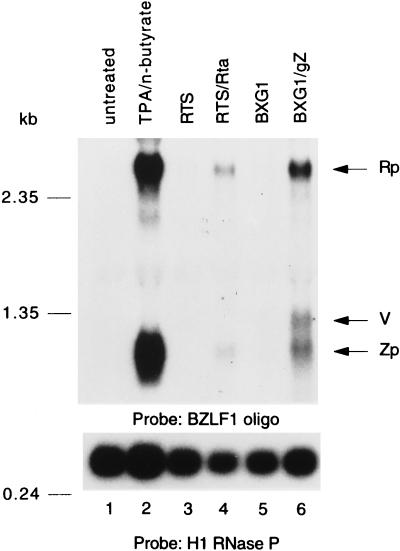
Activation of Rp- and Zp-driven transcripts from the latent EBV genome following transfection of Rta and ZEBRA. HH514-16 cells were untreated (lane 1), chemically induced (lane 2), or transfected with 5 μg of total plasmid DNA (5 μg of pRTS [lane 3] or pRTS/Rta [lane 4], 5 μg of pBXG1 [lane 5], or 4 μg of pBXG1 plus 1 μg of pBXG1/gZ [lane 6]). Total cell RNA prepared 28 h following transfection was analyzed by Northern blotting using a 33-nt oligonucleotide in BZLF1 as a probe. Transcripts initiating from Rp, Zp, and vector (V) are indicated.
FIG. 5
FIG. 5
Proposed model for disruption of latency in HH514-16 cells. The promoter regions of the BZLF1 and BRLF1 genes are illustrated. See Discussion for an explication of the model. H, repressive host factor (possibly histone); A, host cell activator; ZRE, ZEBRA response element; TRE, TPA response element, also known as ZII (16); Z, ZEBRA; R, Rta; X, a factor which mediates R activity on Rp and Zp.

References

    1. Baer R, Bankier A T, Biggin M D, Deininger P L, Farrell P J, Gibson T J, Hatful G, Hudson G S, Satchwell S C, Seguin C, Tuffnell P S, Barrell B G. DNA sequence and expression of the B95-8 Epstein-Barr virus genome. Nature. 1984;310:207–211. - PubMed
    1. Bartkiewicz M, Gold H, Altman S. Identification and characterization of an RNA molecule that copurifies with RNase P activity from HeLa cells. Genes Dev. 1989;3:488–499. - PubMed
    1. Bauer G, Hoefler P, zur Hausen H. Epstein-Barr virus induction by a serum factor. I. Induction and cooperation with additional inducers. Virology. 1982;121:184–194. - PubMed
    1. Bogedain C, Alliger P, Schwarzmann F, Marschall M, Wolf H, Jilg W. Different activation of Epstein-Barr virus immediate-early and early genes in Burkitt lymphoma cells and lymphoblastoid cell lines. J Virol. 1994;68:1200–1203. - PMC - PubMed
    1. Buisson M, Manet E, Trescol-Biemont M C, Gruffat H, Durand B, Sergeant A. The Epstein-Barr virus (EBV) early protein EB2 is a posttranscriptional activator expressed under the control of EBV transcription factors EB1 and R. J Virol. 1989;63:5276–5284. - PMC - PubMed

Publication types

LinkOut - more resources