. 1998 Oct;72(10):8214-9.
doi: 10.1128/JVI.72.10.8214-8219.1998.

The RNA polymerase of influenza virus, bound to the 5' end of virion RNA, acts in cis to polyadenylate mRNA

Affiliations

The RNA polymerase of influenza virus, bound to the 5' end of virion RNA, acts in cis to polyadenylate mRNA

L L Poon et al. J Virol. 1998 Oct.

Abstract

We previously demonstrated, by limited mutagenesis, that conserved sequence elements within the 5' end of influenza virus virion RNA (vRNA) are required for the polyadenylation of mRNA in vitro. To further characterize the nucleotide residues at the 5' end of vRNA which might be involved in polyadenylation, a complete set of short and long model vRNA-like templates with mutations at nucleotides 1' to 13' (prime notation denotes numbering from the 5' end) of vRNA were synthesized and transcribed in vitro. The products were assayed for mRNA production with both reverse transcription-PCR and [alpha-32P]ATP incorporation assays. Results from these independent assays showed that vRNA templates with point mutations at positions 2', 3', 7' to 9', and 11' to 13' synthesized polyadenylated transcripts inefficiently compared with those with mutations at positions 1', 4' to 6', and 10'. Positions 2', 3', 7' to 9', and 11' are known to be involved in RNA polymerase binding. Furthermore, residues at positions 11' to 13' are known to be involved in base pairing between the 3' and 5' ends of vRNA. These findings demonstrate that the RNA polymerase has to bind to the 5' end of the template vRNA, which must then interact with the 3' end of the same template for polyadenylation to occur. These results support a model in which a cis-acting RNA polymerase is required for the polyadenylation of influenza virus.


Figures
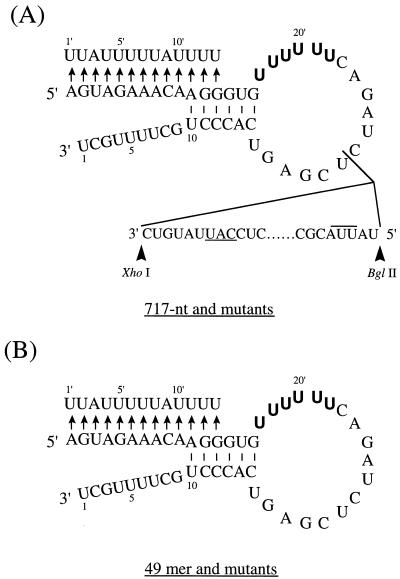
FIG. 1
FIG. 1
RNA templates used in in vitro influenza virus transcription reactions. The proposed base pairs in the RNA fork model (4, 5) are indicated by vertical lines. Prime notation denotes nucleotide numbering from the 5′ end to distinguish from 3′-end nucleotides (4). Point mutations from positions 1′ to 13′ are indicated above the sequences. The U6 track, the proposed poly(A) site, is in boldface type. (A) Sequence of the 717-nt template. Arrowheads indicate the XhoI and BglII sites in plasmid pBXPCAT1. Underlining and overlining indicate initiation and termination codons of the CAT gene, respectively. (B) Sequence of the 49-mer template.
FIG. 2
FIG. 2
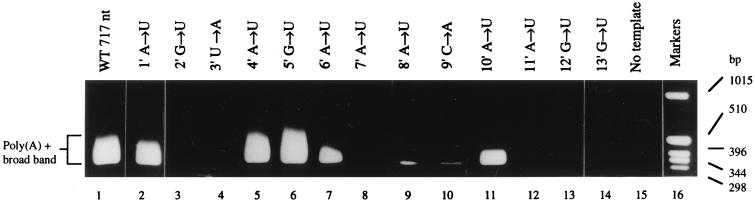
Effect of point mutations in the conserved sequence at the 5′ end of vRNA in the RT-PCR assay. The assay was carried out with a 5′ GC-clamped T20 primer and the 717-nt vRNA. The RT-PCR assay was performed with consistent results in at least three independent influenza virus transcription reactions for each mutant. Lane 1, wild-type (WT) 717-nt vRNA; lanes 2 to 14, points mutants; lane 15, no template; lane 16, DNA size markers.
FIG. 3
FIG. 3
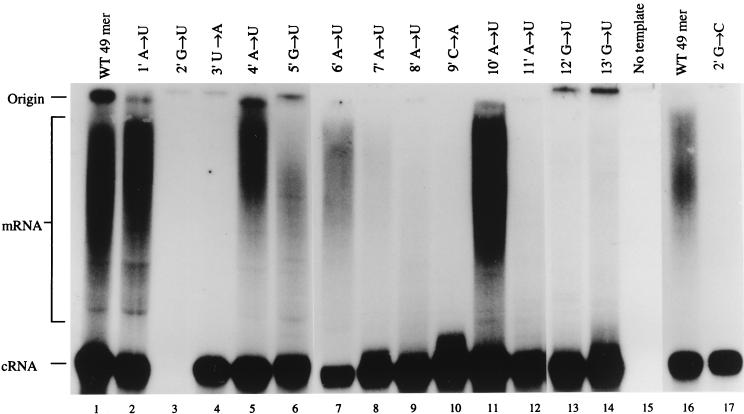
Effect of point mutations in the conserved sequence at the 5′ end of vRNA in the [α-32P]ATP incorporation assay. Except for the 2′ (G→U) vRNA mutant (lane 3), all vRNA templates were present in excess in the influenza virus transcription reactions. mRNA, cRNA, and the origin are indicated. The signal at the origin is thought to be due to nonspecific binding of radiolabel and/or transcription product from residual endogenous vRNA. Lanes 1 and 16, wild-type (WT) 49-mer; lanes 2 to 14, point mutants; lane 15, no template; lane 17, 2′ (G→C) mutant.
FIG. 4
FIG. 4
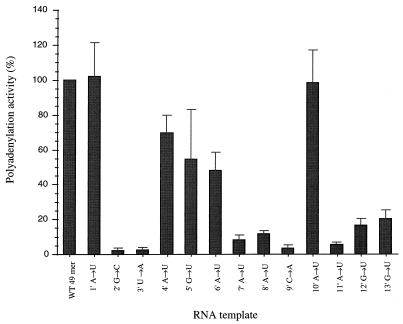
Quantitation of the effect of point mutations (1′ to 13′) in the 5′ end of the 49-mer vRNA-like template on polyadenylation activity assayed by the [α-32P]ATP incorporation assay. The mRNA products (high-molecular-weight smear; Fig. 3) from different vRNA templates were quantified by PhosphorImager analysis. Polyadenylation activities relative to that of the wild-type (WT) 49-mer (100%) are shown. The average and standard deviation for the mutants were derived from three or more independent assays. The point mutants used in the experiments are indicated. The activities at positions 4′, 5′, and 6′ were each statistically different from that of the wild type (P, <0.01).
FIG. 5
FIG. 5
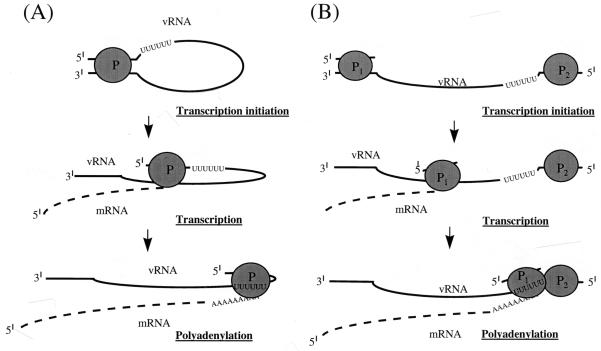
Two possible models for the mechanism by which a 5′-bound polymerase causes polyadenylation of influenza virus mRNA. (A) Transcription is initiated by a 5′-bound, cis-acting polymerase (P). Throughout transcription, the polymerase remains attached to the 5′ end of the template. As a result, the polymerase is unable to transcribe the site to which it is attached. Instead, polyadenylation of mRNA occurs by reiterative copying of the U5–7 track. (B) Transcription is initiated by a trans-acting polymerase (P1), which is bound to the 5′ end of a different vRNA template. When transcription is blocked by a 5′-bound polymerase (P2), the trans-acting polymerase (P1) starts polyadenylation by reiterative copying of the U5–7 track.

References

    1. Beaton A R, Krug R M. Transcription antitermination during influenza viral template RNA synthesis requires the nucleocapsid protein and the absence of a 5′ capped end. Proc Natl Acad Sci USA. 1986;83:6282–6286. - PMC - PubMed
    1. Cianci C, Tiley L, Krystal M. Differential activation of the influenza virus polymerase via template RNA binding. J Virol. 1995;69:3995–3999. - PMC - PubMed
    1. Desselberger U, Racaniello V R, Zazra J J, Palese P. The 3′ and 5′ terminal sequences of influenza A, B and C virus RNA segments are highly conserved and show partial inverted complementarity. Gene. 1980;8:315–328. - PubMed
    1. Fodor E, Pritlove D C, Brownlee G G. The influenza virus panhandle is involved in the initiation of transcription. J Virol. 1994;68:4092–4096. - PMC - PubMed
    1. Fodor E, Pritlove D C, Brownlee G G. Characterization of the RNA-fork model of the virion RNA in the initiation of transcription in influenza A virus. J Virol. 1995;69:4012–4019. - PMC - PubMed

Publication types

MeSH terms

LinkOut - more resources