Role of specific IgE, IgG and IgG4 antibodies to corn dust in exposed workers
- PMID: 9735662
- PMCID: PMC4531950
- DOI: 10.3904/kjim.1998.13.2.88
Role of specific IgE, IgG and IgG4 antibodies to corn dust in exposed workers
Abstract
Background and methods: To evaluate the role of specific antibodies to corn dust (CD) and their relationship to respiratory dysfunction, we detected serum specific IgE(slgE) and IgG4(slgG4) antibodies by ELISA in 42 employees working in the animal feed industry and 27 unexposed controls.
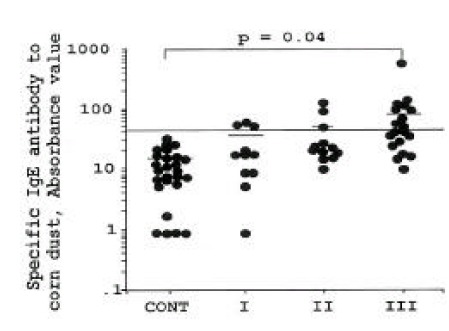
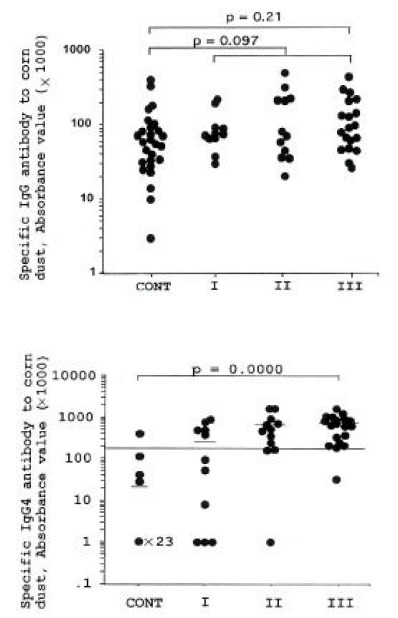
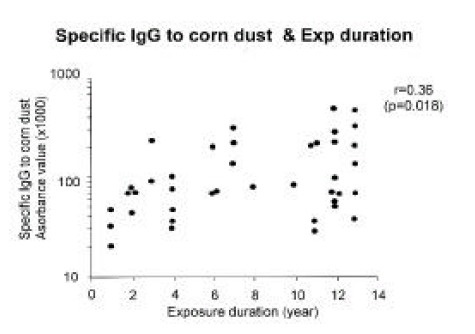
Results: Our survey revealed that 15 (34.9%) subjects had work-related respiratory dysfunction associated with or without nasal symptoms. Among these subjects, eight had airway hyper-responsiveness to methacholine. Significant differences were noted in slgE and slgG4 between exposed and unexposed groups (p = 0.04, p = 0.00 respectively), but no difference was noted in slgG (p = 0.1). Although there was no significant differences in the prevalence of specific IgE antibody between symptomatic (29%) and asymptomatic groups (19%, p = 0.55), the specific IgE levels were significantly higher in symptomatic workers than in asymptomatic workers (p = 0.03). Specific IgG antibody was detected in 1 (6%) symptomatic and 4 (15%) asymptomatic workers (p = 0.46). Specific IgG4 antibody was detected in 11 (73%) of symptomatic and 21 (78%) of asymptomatic workers (p = 0.90). The higher prevalence of slgG4 antibody was noted in workers with slgE antibody (p = 0.001). The correlation between slgG and exposure duration was significant (r = 0.36, p = 0.02). There was no association between the prevalence of slgE, slgG, and slgG4 to exposure intensity, smoking or atopic status.
Conclusion: These results suggested that the existence of slgG and slgG4 might represent a response to CD exposure, and that some unexposed subjects had slgG to CD. Specific IgE might play a role in the development of respiratory symptoms.
Figures
References
-
- Chan-Yeung M, Enarson DA, Kennedy SM. The impact of grain dust on respiratory health. Am Rev Respir Dis. 1992;145:476–87. - PubMed
-
- DoPico GA, Reddan W, Flaherty D, Tsiatis A, Peters ME, Rao R, Rankin J. Respiratory abnormalities among grain handlers: a clinical, physiologic, and immunologic study. Am Rev Respir Dis. 1977;115:915–27. - PubMed
-
- DoPico GA, Reddan W, Tsiatis A, Peters ME, Rankin J. Epidemiologic study of clinical and physiologic parameters in grain handlers of northern United States. Am Rev Respir Dis. 1984;130:759–65. - PubMed
-
- Huy T, De Schipper K, Chan-Yeung M, Kennedy SM. Grain dust and lung function. Dose-response relationships. Am Rev Respir Dis. 1991;144:1314–21. - PubMed
-
- Chan-Yeung M, Schulzer M, Maclean L, Dorken E, Tan F, Lam S, Enarson D, Grzybowski S. A follow-up study of the grain elevator workers in the port of Vancouver. Arch Env Health. 1980;36:75–81. - PubMed
Publication types
MeSH terms
Substances
LinkOut - more resources
Full Text Sources
Medical