


Radiation-induced p53 and p21WAF-1/CIP1 expression in the murine intestinal epithelium: apoptosis and cell cycle arrest
- PMID: 9736038
- PMCID: PMC1853021
- DOI: 10.1016/S0002-9440(10)65631-3
Radiation-induced p53 and p21WAF-1/CIP1 expression in the murine intestinal epithelium: apoptosis and cell cycle arrest
Abstract
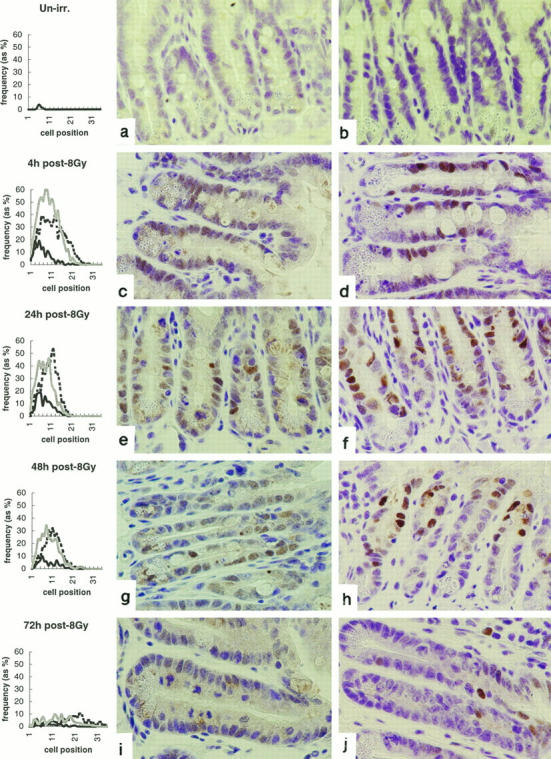
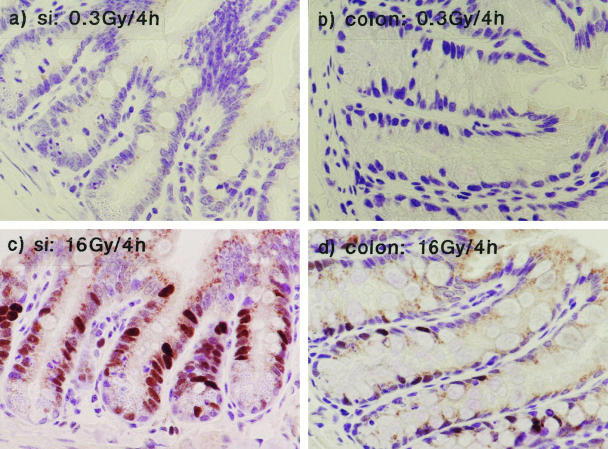
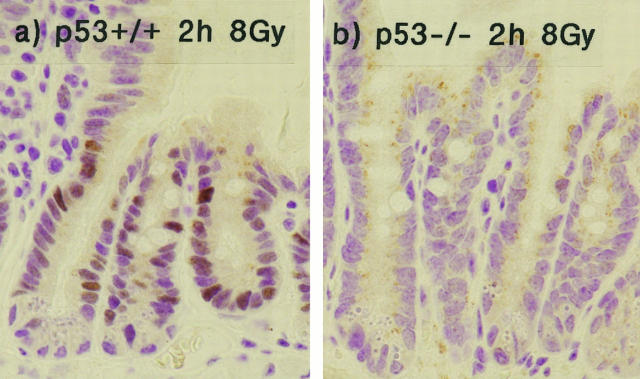
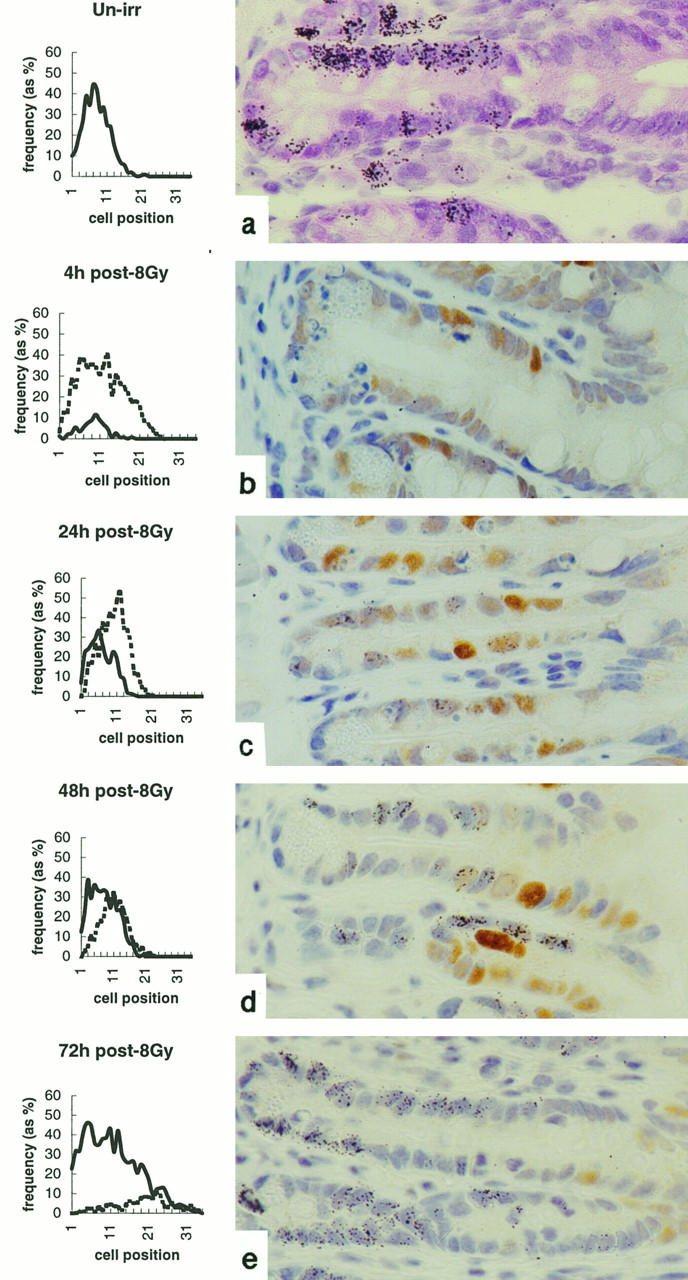
p53-dependent expression of p21WAF-1/CIP1 has been studied in murine intestinal epithelium after exposure to ionizing radiation. In un-irradiated small intestine, neither p53 nor p21WAF-1/CIP1 could be detected by immunohistochemistry. After irradiation (8 Gy), there was a time- and dose-dependent increase in the expression of both proteins. In the small bowel, the positional expression of p53 and p21WAF-1/CIP1 was similar but not coincident. Both proteins could be observed throughout the crypts with greatest frequency of expression over the first 15 cell positions, which includes the stem cell population (approximately positions 3 to 5) and the proliferating, transit cell population (approximately positions 5 to 15). p53-positive cells were primarily distributed toward the base of the crypt relative to p21WAF-1/CIP1. Subdivision of the p53-positive cell population revealed that the cells with strongest p53 immunoreactivity were positioned farther toward the base of the crypt, and their distribution was approximately coincident with the frequency distribution of apoptotic cells. Cells that were either weakly or moderately immunoreactive for p53 were located toward the middle of the crypt and were approximately coincident with the distribution of p21WAF-1/CIP1. The numbers of both p53- and p21WAF-1/CIP1-positive cells declined steadily with time, and by 6 days after irradiation there were very few immunoreactive cells to observe. Radiation-induced increase in p53 and p21WAF-1/CIP1 expression was not detected in mice homozygously null for p53. Expression of p21WAF-1/CIP1 and incorporation of tritiated thymidine were found to be mutually exclusive. In the large bowel, p21WAF-1/CIP1 and p53 expression were observed along the entire length of the colonic crypts after irradiation (8 Gy), and, unlike in the small intestine, this expression was not only maintained but increased over 72 hours. p21WAF-1/CIP1 immunoreactivity was detected in large intestine epithelium up to 6 days after irradiation. The differential expression of p21WAF-1/CIP1, observed between the large and small bowel and within the small intestinal crypts, is discussed.
Figures




References
-
- Jackson SP: The recognition of DNA damage. Curr Opin Genet Dev 1996, 6:19-25 - PubMed
-
- Kastan MB, Onyckwere O, Sidransky D, Vogelstein B, Craig RW: Participation of p53 protein in the cellular response to DNA damage. Cancer Res 1991, 51:6304-6311 - PubMed
-
- Kastan MB, Zhan Q, El-Deiry WS, Carrier F, Jacks T, Walsh WV, Plunkett BS, Vogelstein B, Fornace AJ, Jr: A mammalian cell cycle checkpoint pathway utilizing p53 and GADD45 is defective in ataxia telangiectasia. Cell 1992, 71:587-597 - PubMed
-
- Wood RD: DNA repair in eukaryotes. Annu Rev Biochem 1996, 65:135-167 - PubMed
-
- Reed JC: Double identity for proteins of the Bcl-2 family. Nature 1997, 387:773-776 - PubMed
Publication types
MeSH terms
Substances
LinkOut - more resources
Full Text Sources
Other Literature Sources
Research Materials
Miscellaneous
