In vitro inactivation of Chlamydia trachomatis by fatty acids and monoglycerides
- PMID: 9736551
- PMCID: PMC105821
- DOI: 10.1128/AAC.42.9.2290
In vitro inactivation of Chlamydia trachomatis by fatty acids and monoglycerides
Abstract
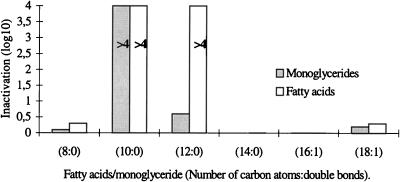
The antichlamydial effects of several fatty acids and monoglycerides were studied by incubating Chlamydia trachomatis bacteria with equal volumes of lipid solutions for 10 min and measuring the reduction in infectivity titer compared with that in a control solution without lipid. Caprylic acid (8:0), monocaprylin (8:0), monolaurin (12:0), myristic acid (14:0), palmitoleic acid (16:1), monopalmitolein (16:1), oleic acid (18:1), and monoolein (18:1) at concentrations of 20 mM (final concentration, 10 mM) had negligible effects on C. trachomatis. In contrast, lauric acid (12:0), capric acid (10:0), and monocaprin (10:0) caused a greater than 10,000-fold (>4-log10) reduction in the infectivity titer. When the fatty acids and monoglycerides were further compared at lower concentrations and with shorter exposure times, lauric acid was more active than capric acid and monocaprin was the most active, causing a greater than 100, 000-fold (>5-log10) inactivation of C. trachomatis at a concentration of 5 mM for 5 min. The high levels of activity of capric and lauric acids and particularly that of monocaprin are notable and suggest that these lipids have specific antichlamydial effects. The mode of action of monocaprin was further studied by removal of the lipid by centrifugation before inoculation of Chlamydia onto host cells and by electron microscopy. The results indicate that the bacteria are killed by the lipid, possibly by disrupting the membrane(s) of the elementary bodies. A 50% effective concentration of 30 microgram/ml was found by incubation of Chlamydia with monocaprin for 2 h. The rapid inactivation of large numbers of C. trachomatis organisms by monocaprin suggests that it may be useful as a microbicidal agent for the prevention of the sexual transmission of C. trachomatis.
Figures

References
-
- Centers for Disease Control and Prevention. Chlamydia trachomatis infection: policy guidelines for prevention and control. Morbid Mortal Weekly Rep. 1993;42:1–39. - PubMed
-
- Elias C J, Heise L L. Challenges for the development of female-controlled vaginal microbicides. AIDS. 1994;8:1–9. - PubMed
-
- Global Programme on AIDS, World Health Organization. An overview of selected curable sexually transmitted diseases. Geneva, Switzerland: World Health Organization; 1995.
-
- Isaacs C E, Litov R E, Thormar H. Antimicrobial activity of lipids added to human milk, infant formula, and bovine milk. Nutr Biochem. 1995;6:362–366. - PubMed
Publication types
MeSH terms
Substances
LinkOut - more resources
Full Text Sources
Other Literature Sources