


In vivo activities of amoxicillin and amoxicillin-clavulanate against Streptococcus pneumoniae: application to breakpoint determinations
- PMID: 9736566
- PMCID: PMC105836
- DOI: 10.1128/AAC.42.9.2375
In vivo activities of amoxicillin and amoxicillin-clavulanate against Streptococcus pneumoniae: application to breakpoint determinations
Abstract
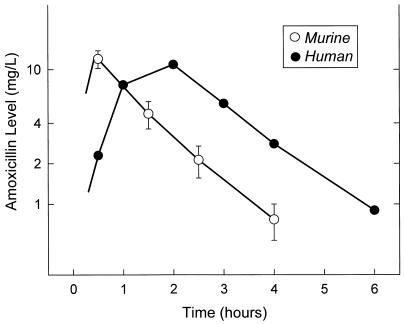
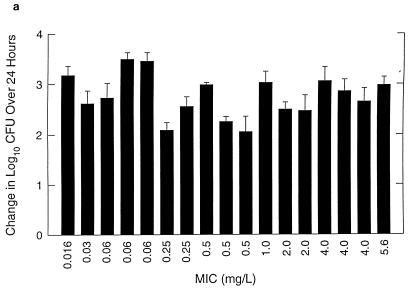
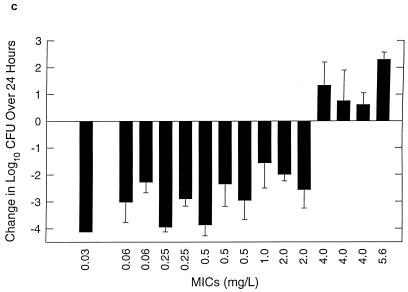
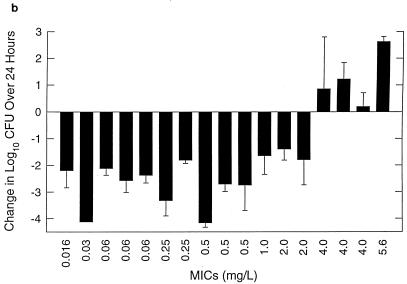
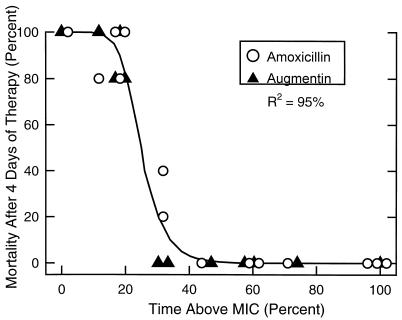
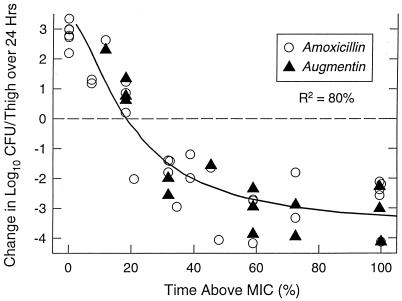
The in vivo activities of amoxicillin and amoxicillin-clavulanate against 17 strains of Streptococcus pneumoniae with penicillin MICs of 0.12-8.0 mg/liter were assessed in a cyclophosphamide-induced neutropenic murine thigh infection model. Renal impairment was produced by administration of uranyl nitrate to prolong the amoxicillin half-life in the mice from 21 to 65 min, simulating human pharmacokinetics. Two hours after thigh infection with 10(5) to 10(6) CFU, groups of mice were treated with 7 mg of amoxicillin per kg of body weight alone or combined with clavulanate (ratio, 4:1) every 8 h for 1 and 4 days. There was an excellent correlation between the MIC of amoxicillin (0.03 to 5.6 mg/liter) and (i) the change in log10 CFU/thigh at 24 h and (ii) survival after 4 days of therapy. Organisms for which MICs were 2 mg/liter or less were killed at 1.4 to 4.2 and 1.6 to 4.1 log10 CFU/thigh at 24 h by amoxicillin and amoxicillin-clavulanate, respectively. The four strains for which MICs were >4 mg/liter grew 0.2 to 2.6 and 0.6 to 2. 3 logs at 24 h despite therapy with amoxicillin and amoxicillin-clavulanate, respectively. Infection was uniformly fatal by 72 h in untreated mice. Amoxicillin therapy resulted in no mortality with organisms for which MICs were 1 mg/liter or less, 20 to 40% mortality with organisms for which MICs were 2 mg/liter, and 80 to 100% mortality with organisms for which MICs were 4.0-5.6 mg/liter. Lower and higher doses (0.5, 2, and 20 mg/kg) of amoxicillin were studied against organisms for which MICs were near the breakpoint. These studies demonstrate that a reduction of 1 log10 or greater in CFU/thigh at 24 h is consistently observed when amoxicillin levels exceed the MIC for 25 to 30% of the dosing interval. These studies would support amoxicillin (and amoxicillin-clavulanate) MIC breakpoints of 1 mg/liter for susceptible, 2 mg/liter for intermediate, and 4 mg/liter for resistant strains of S. pneumoniae.
Figures
References
-
- Abboud M F, Waisbren B A. Correlation between in vitro studies and response to antibiotic therapy in staphylococci bacteremia. Am J Med. 1959;104:226–233. - PubMed
-
- Asensi F, Perez-Tamarit D, Otero M C, et al. Imipenem-cilastin therapy in a child with meningitis caused by a multiply resistant pneumococcus. Pediatr Infect Dis J. 1989;163:895. - PubMed
-
- Barry B, Gehanno P, Bluman M, Boucot I. Program and abstracts of the 33rd Interscience Conference on Antimicrobial Agents and Chemotherapy. Washington, D.C: American Society for Microbiology; 1993. Clinical outcome of acute otitis media due to Streptococcus pneumoniae with decreased susceptibility to penicillin, abstr. 1373; p. 370.
-
- Block S, Hedrick J, Harrison C, et al. Program and abstracts of the 33rd Interscience Conference on Antimicrobial Agents and Chemotherapy. Washington, D.C: American Society for Microbiology; 1993. Penicillin-resistant S. pneumoniae in acute otitis media, abstr. 1046; p. 311.
-
- Craig, W. 1993. Relevance of animal models for clinical treatment. Eur. J. Clin. Microbiol. Infect. Dis. 12(Suppl. 1):55–57. - PubMed
Publication types
MeSH terms
Substances
LinkOut - more resources
Full Text Sources
Other Literature Sources
Medical
Molecular Biology Databases
