


doi: 10.1128/AAC.42.9.2425.
Prevalence and characterization of the mechanisms of macrolide, lincosamide, and streptogramin resistance in isolates of Streptococcus pneumoniae
Affiliations
- PMID: 9736575
- PMCID: PMC105845
- DOI: 10.1128/AAC.42.9.2425
Item in Clipboard
Prevalence and characterization of the mechanisms of macrolide, lincosamide, and streptogramin resistance in isolates of Streptococcus pneumoniae
Antimicrob Agents Chemother.
1998 Sep.
Abstract
Of a total of 147 erythromycin-resistant Streptococcus pneumoniae isolates, 64 (43.5%) were resistant to erythromycin, clindamycin, and streptogramin B (MLSB phenotype), 57 of which possessed the ermB gene. Eighty-two (55.8%) were resistant to erythromycin alone (M phenotype), 81 of which possessed the mefE gene. One was erythromycin and streptogramin B resistant but susceptible to clindamycin (MS phenotype) and possessed neither the erm gene nor the mefE gene.
Figures
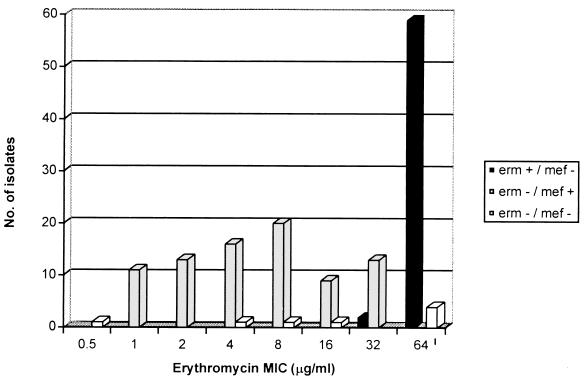
Distribution of mefE and erm genes according to the MIC of erythromycin.
References
-
- Ausubel F M, Brent R, Kingston R E, Moore D D, Seidman J G, Smith J A, Struhl K, editors. Current protocols in molecular biology, chapter 2, section 2.9.2. New York, N.Y: John Wiley & Sons, Inc.; 1997.
-
- Fernandez-Munoz R, Monro R E, Torres-Pinedo R, Vasquez D. Substrate- and antibiotic-binding sites at the peptidyl-transferase centre of Escherichia coli ribosomes. Studies on the chloramphenicol, lincomycin and erythromycin sites. Eur J Biochem. 1971;23:185–193. - PubMed
-
- National Committee for Clinical Laboratory Standards. Approved standards M2-A6 and M7-A4. National Committee for Clinical Laboratory Standards, Villanova, Pa. 1997. Methods for dilution antimicrobial susceptibility tests for bacteria that grow aerobically, 4th ed.
Publication types
MeSH terms
Substances
LinkOut - more resources
Full Text Sources
Other Literature Sources
Medical
