. 1998 Sep 15;95(19):11193-8.
doi: 10.1073/pnas.95.19.11193.

Mad2 transiently associates with an APC/p55Cdc complex during mitosis

Affiliations

Mad2 transiently associates with an APC/p55Cdc complex during mitosis

K Wassmann et al. Proc Natl Acad Sci U S A. .

Abstract

Activation of the mitotic checkpoint pathway in response to mitotic spindle damage in eukaryotic cells delays the exit from mitosis in an attempt to prevent chromosome missegregation. One component of this pathway, hsMad2, has been shown in mammalian cells to physically associate with components of a ubiquitin ligase activity (termed the anaphase promoting complex or APC) when the checkpoint is activated, thereby preventing the degradation of inhibitors of the mitotic exit machinery. In the present report, we demonstrate that the inhibitory association between Mad2 and the APC component Cdc27 also takes place transiently during the early stages of a normal mitosis and is lost before mitotic exit. We also show that Mad2 associates with the APC regulatory protein p55Cdc in mammalian cells as has been reported in yeast. In contrast, however, this complex is present only in nocodazole-arrested or early mitotic cells and is associated with the APC as a Mad2/p55Cdc/Cdc27 ternary complex. Evidence for a Mad2/Cdc27 complex that forms independent of p55Cdc also is presented. These results suggest a model for the regulation of the APC by Mad2 and may explain how the spindle assembly checkpoint apparatus controls the timing of mitosis under normal growth conditions.


Figures
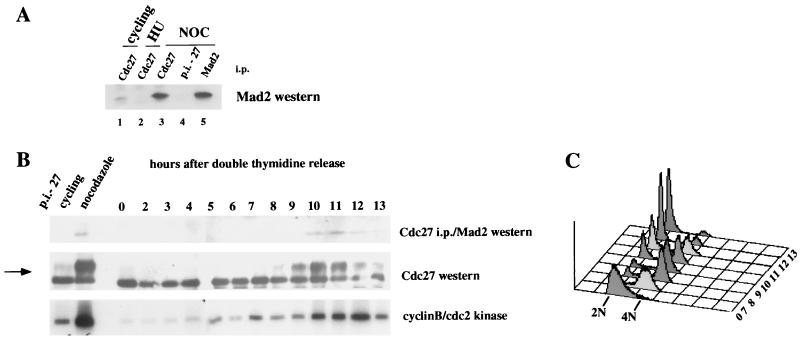
Figure 1
Figure 1
Mad2 transiently associates with Cdc27 during the cell cycle. (A) Mad2 is associated with Cdc27 in cycling cells. Extracts derived from cycling cells (lane 1), cells arrested with hydroxyurea (lane 2), or nocodazole (lane 3–5) were immunoprecipitated with the Cdc27 polyclonal antibody, and coimmunoprecipitating Mad2 protein was detected by Western blot analysis. Cdc27 preimmune serum was used as a negative control (lane 4), and the Mad2 polyclonal antiserum was used as a positive control (lane 5). Coimmunoprecipitations were done with 2 mg protein extract, and direct Mad2 immunoprecipitation was done with 100 μg protein extract (lane 5). (B) Association of Mad2 with Cdc27 is cell cycle-regulated. Cells were arrested in S phase by double-thymidine treatment and released. Protein extracts and nuclei (for FACS analysis) were prepared from samples taken at the indicated time points (in hours after the release). One milligram of protein extract was immunoprecipitated with Cdc27 antiserum followed by Western blot analysis of Mad2 (Top). Forty micrograms crude extract was used for the Cdc27 Western (Middle) and 150 μg for cyclin B/cdc2 kinase assays (Bottom). The arrow indicates the position of the phosphorylated forms of Cdc27. In all assays, extracts from cycling and nocodazole-arrested cells were included as indicated. For the coimmunoprecipitation assay, a Cdc27 preimmune control (p.i.-27) is shown. (C) FACS profile of the cell cycle release. The time points (in hours) are indicated.
Figure 2
Figure 2
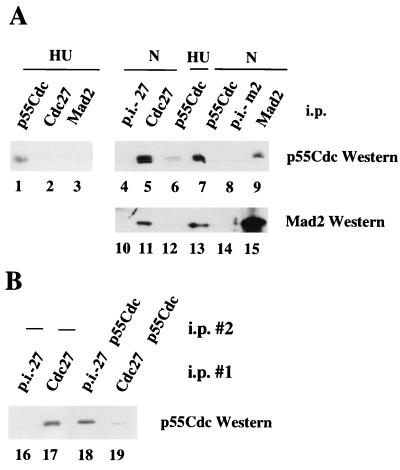
p55Cdc is associated with Mad2 and Cdc27 in nocodazole-arrested cells. Protein extracts (1.2 mg) derived from hydroxyurea-arrested cells (lanes 1–3 and 6) or nocodazole-arrested cells (lanes 4, 5, 7–9, 10, 11, and 13–15) were immunoprecipitated with the p55Cdc antibody (lanes 1, 6, 7, 12, and 13), with the Cdc27 antibody (lanes 2, 5, and 11), or the Mad2 antibody (lanes 3, 9, and 15). Preimmune controls were included (lanes 8 and 14, Mad2 preimmune serum, p.i.-m2; lanes 4 and 10, Cdc27 preimmune serum, p.i.-27). Western blots were probed with either the p55Cdc antibody (lanes 1–9) or the Mad2 antibody (lanes 10–15). (B) The majority of p55Cdc is found in association with Cdc27 in nocodazole-arrested cells. One milligram cell extract derived from nocodazole-arrested cells was immunodepleted with Cdc27 preimmune serum (lane 16) or with Cdc27 antiserum (lane 17). The supernatants of the first immunoprecipitation were split into two aliquots, and one aliquot was used for a second immunoprecipitation. Lanes 18, supernatant of lane 16, immunoprecipitated with p55Cdc antibody; lane 19, supernatant of lane 17, immunoprecipitated with p55Cdc antibody. All samples then were analyzed for p55Cdc by Western blotting. After immunodepletion with Cdc27 antiserum no Cdc27 protein was present in the supernatant (data not shown). Note that 1 mg protein extract was used for the first immunoprecipitation (lanes 16 and 17), and 500 μg protein extract was used for the second immunoprecipitation (lanes 18 and 19).
Figure 3
Figure 3
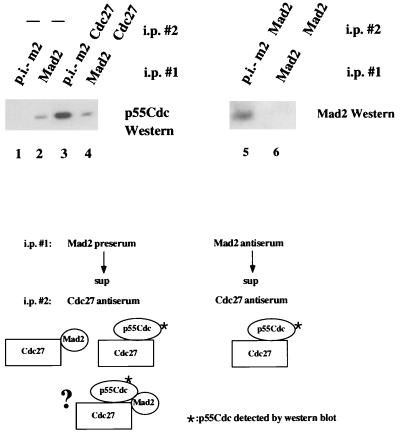
Evidence for a trimeric Cdc27/Mad2/p55Cdc complex. Protein extracts derived from nocodazole-arrested cells were used in the following assays. Lanes: 1, one-step immunoprecipitation with preimmune Mad2 antiserum (p.i.-m2); 2, one-step immunoprecipitation with the Mad2 antiserum; 3, immunodepletion with Mad2 preimmune serum followed by Cdc27 immunoprecipitation of the supernatant; 4, immunodepletion with the Mad2 antiserum followed by Cdc27 immunoprecipitation of the supernatant. After immunodepletion with Mad2 antiserum, no Mad2 protein was present in the supernatant of the immunoprecipitation (lane 5 and 6). All samples were then analyzed for p55Cdc by Western blotting. The schematic shows the species predicted to contain p55Cdc after precipitating with the preimmune Mad2 antiserum (Left) or the anti-Mad2 antiserum in the first immunoprecipitation assuming both dimeric p55Cdc/Cdc27 and trimeric p55Cdc/Cdc27/Mad2 complexes exist. The decrease in the p55Cdc signal observed when the Mad2 antiserum is used relative to the preimmune control is a measure of the amount of ternary complex present in the extract. Note that 3 mg of protein was used for coimmunoprecipitations and 300 μg was used for direct immunoprecipitations.
Figure 4
Figure 4
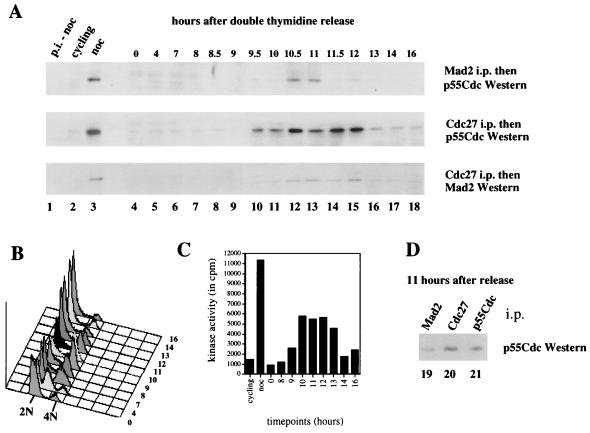
Association of p55Cdc with Mad2 and Cdc27 during a normal cell cycle. Cells were arrested by a double-thymidine block and released as described in Materials and Methods. Samples were taken at the indicated time points (lanes 4–18), and protein extracts and nuclei (for FACS analysis) were prepared. (A) Coimmunoprecipitations. Extracts from cycling (lane 2) and nocodazole-arrested cells (lanes 1 and 3) were included as controls. Immunoprecipitations were done with either Mad2 antibody or Cdc27 antibody. The Mad2 immunoprecipitates were analyzed for coprecipitating p55Cdc (Top) and the Cdc27 immunoprecipitates were analyzed for coimmunoprecipitating p55Cdc (Middle) and Mad2 (Bottom) by Western analysis. The appropriate preimmune control assays were performed on extracts derived from nocodazole-arrested cells (lane 1, p.i.-noc). FACS analysis (B) and cdc2/cyclin B kinase assays (C) were performed at the indicated time points. (D) p55Cdc associated with Mad2 (lane 19) and Cdc27 (lane 20) as well as total p55Cdc in the cells (lane 21) 11 hr postrelease are shown. Five hundred micrograms protein extract was used for each immunoprecipitation.
Figure 5
Figure 5
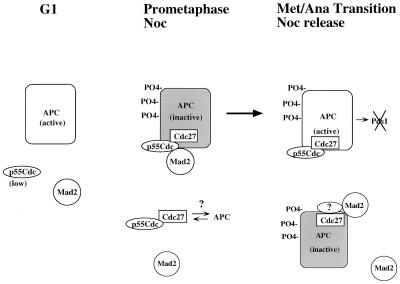
Model for the regulation of the APC by Mad2. In G1 cells, the APC is capable of degrading Pds1 and cyclin B independent of an associated p55Cdc. No Mad2/p55Cdc or APC/p55Cdc complexes are detected in this phase of the cell cycle. In prometaphase and/or after checkpoint activation with the mitotic spindle inhibitor nocodazole (NOC), Mad2 and p55Cdc are complexed with the APC that is inactivated by virtue of the presence of Mad2. Free p55Cdc/Cdc27 complexes may exist in this phase of the cell cycle but, we speculate, are not part of the APC. At the metaphase-to-anaphase transition (or after nocodazole release), the Mad2/p55Cdc interaction is lost before the loss of the p55Cdc/APC interaction, allowing the latter complex to ubiquitinate the anaphase inhibitor Pds1. Mad2/Cdc27/APC complexes may exist at this time but are lost before the degradation of cyclin B (see text for details).

References

    1. Kallio M, Weinstein J, Daum J R, Burke D J, Gorbsky G J. J Cell Biol. 1998;141:1393–1406. - PMC - PubMed
    1. Hoyt M A, Totis L, Roberts B T. Cell. 1991;66:507–517. - PubMed
    1. Weiss E, Winey M. J Cell Biol. 1996;132:111–123. - PMC - PubMed
    1. Hardwick K G, Murray A W. J Cell Biol. 1995;131:709–720. - PMC - PubMed
    1. Hardwick K G, Weiss E, Luca F C, Winey M, Murray A W. Science. 1996;273:953–956. - PubMed

Publication types

MeSH terms

LinkOut - more resources