


doi: 10.1128/JCM.36.10.3090-3093.1998.
Description of Gemella sanguinis sp. nov., isolated from human clinical specimens
Affiliations
- PMID: 9738079
- PMCID: PMC105123
- DOI: 10.1128/JCM.36.10.3090-3093.1998
Item in Clipboard
Description of Gemella sanguinis sp. nov., isolated from human clinical specimens
J Clin Microbiol.
1998 Oct.
Abstract
Six strains of a hitherto undescribed gram-positive, catalase-negative, facultatively anaerobic coccus isolated from human sources were characterized by phenotypic and molecular taxonomic methods. Comparative 16S rRNA gene sequencing studies demonstrated that the unknown strains were genealogically identical and constitute a new subline within the genus Gemella. The unknown bacterium was readily distinguished from Gemella haemolysans, Gemella bergeriae, and Gemella morbillorum by biochemical tests and electrophoretic analysis of whole-cell proteins. Based on phylogenetic and phenotypic evidence, it is proposed that the unknown bacterium be classified as Gemella sanguinis sp. nov. The type strain is CCUG 37820(T).
Figures
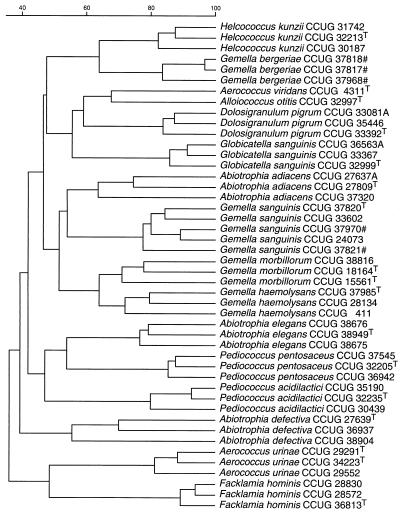
Similarity dendrogram based on whole-cell protein patterns of G. sanguinis sp. nov. and related species. Levels of correlation are expressed as percentages of similarity for convenience.
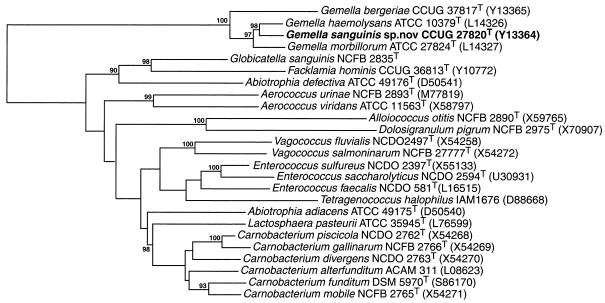
Unrooted tree showing the phylogenetic relationships of G. sanguinis sp. nov. and some other low-G+C-content gram-positive bacteria. The tree constructed by the neighbor-joining method was based on a comparison of approximately 1,320 nucleotides.
References
-
- Berger U. The genus Gemella. In: Balows A, Trüper H G, Dworkin M, Harder W, Schleifer K-H, editors. The prokaryotes. 2nd ed. New York, N.Y: Springer-Verlag; 1992. pp. 1643–1653.
-
- Eggelmeier F, Petit P, Dijkmans B A C. Total knee arthroplasty infection due to Gemella haemolysans. Br J Rheumatol. 1992;31:67–69. - PubMed
Publication types
MeSH terms
Substances
Associated data
- Actions
LinkOut - more resources
Full Text Sources
Other Literature Sources
Molecular Biology Databases
