


Attenuation of ischemic liver injury by prostaglandin E1 analogue, misoprostol, and prostaglandin I2 analogue, OP-41483
- PMID: 9740185
- PMCID: PMC3022419
- DOI: 10.1016/s1072-7515(98)00179-3
Attenuation of ischemic liver injury by prostaglandin E1 analogue, misoprostol, and prostaglandin I2 analogue, OP-41483
Abstract
Background: Prostaglandin has been reported to have protective effects against liver injury. Use of this agent in clinical settings, however, is limited because of drug-related side effects. This study investigated whether misoprostol, prostaglandin E1 analogue, and OP-41483, prostaglandin I2 analogue, which have fewer adverse effects with a longer half-life, attenuate ischemic liver damage.
Study design: Thirty beagle dogs underwent 2 hours of hepatic vascular exclusion using venovenous bypass. Misoprostol was administered intravenously for 30 minutes before ischemia and for 3 hours after reperfusion. OP-41483 was administered intraportally for 30 minutes before ischemia (2 microg/kg/min) and for 3 hours after reperfusion (0.5 microg/kg/min). Animals were divided into five groups: untreated control group (n=10); high-dose misoprostol (total 100 microg/kg) group (MP-H, n=5); middle-dose misoprostol (50 microg/kg) group (MP-M, n=5); low-dose misoprostol (25 microg/kg) group (MP-L, n=5); and OP-41483 group (OP, n=5). Animal survival, hepatic tissue blood flow (HTBF), liver function, and histology were analyzed.
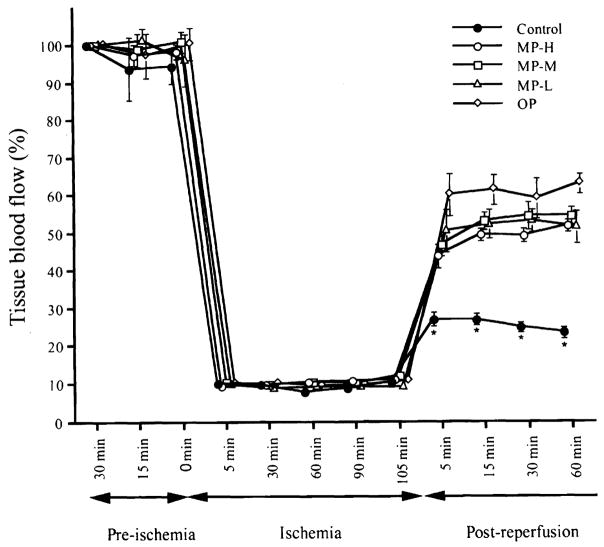
Results: Two-week animal survival rates were 30% in control, 60% in MP-H, 100% in MP-M, 80% in MP-L, and 100% in OP. The treatments with prostaglandin analogues improved HTBF, and attenuated liver enzyme release, adenine nucleotrides degradation, and histologic abnormalities. In contrast to the MP-H animals that exhibited unstable cardiovascular systems, the MP-M, MP-L, and OP animals experienced only transient hypotension.
Conclusions: These results indicate that misoprostol and OP-41483 prevent ischemic liver damage, although careful dose adjustment of misoprostol is required to obtain the best protection with minimal side effects.
Figures



References
-
- Stachira J, Tarnawski A, Ivey KJ, et al. Prostaglandin protection of carbon tetrachloride-induced liver cell necrosis in the rat. Gastroenterology. 1981;81:211–217. - PubMed
-
- Crafa F, Gugenheim J, Saint-Paul MC, et al. Protective effects of prostaglandin E1 on normothermic liver ischemia. Eur Surg Res. 1991;23:278–284. - PubMed
-
- Helling TS, Wogahn BM, Olson SA, et al. The effect of prostaglandin E1 on liver adenine nucleotides and cytoplasmic enzymes in porcine model of normothermic hepatic ischemia. Hepatology. 1995;22:1554–1559. - PubMed
-
- Sikujara O, Monden M, Toyoshima K, et al. Cytoprotective effect of prostaglandin I2 on ischemia-induced hepatic cell injury. Transplantation. 1983;36:238–243. - PubMed
-
- Steininger R, Muhlbacher F, Rauhs R, et al. Protective effect of PGI2 and diltiazem on liver ischemia and reperfusion in pigs. Transplant Proc. 1988;20:999–1002. - PubMed
Publication types
MeSH terms
Substances
Grants and funding
LinkOut - more resources
Full Text Sources
Medical
Miscellaneous