. 1998 Oct;18(10):6142-51.
doi: 10.1128/MCB.18.10.6142.

Circadian regulation of a Drosophila homolog of the mammalian Clock gene: PER and TIM function as positive regulators

Affiliations

Circadian regulation of a Drosophila homolog of the mammalian Clock gene: PER and TIM function as positive regulators

K Bae et al. Mol Cell Biol. 1998 Oct.

Abstract

The Clock gene plays an essential role in the manifestation of circadian rhythms (approximately 24 h) in mice and is a member of the basic helix-loop-helix (bHLH) PER-ARNT-SIM (PAS) superfamily of transcription factors. Here we report the characterization of a novel Drosophila bHLH-PAS protein that is highly homologous to mammalian CLOCK. (Similar findings were recently described by Allada et al. Cell 93:791-804, 1998, and Darlington et al., Science 280:1599-1603, 1998.) Transcripts from this putative Clock ortholog (designated dClock) undergo daily rhythms in abundance that are antiphase to the cycling observed for the RNA products from the Drosophila melanogaster circadian clock genes period (per) and timeless (tim). Furthermore, dClock RNA cycling is abolished and the levels are at trough values in the absence of either PER or TIM, suggesting that these two proteins can function as transcriptional activators, a possibility which is in stark contrast to their previously characterized role in transcriptional autoinhibition. Finally, the temporal regulation of dClock expression is quickly perturbed by shifts in light-dark cycles, indicating that this molecular rhythm is closely connected to the photic entrainment pathway. The isolation of a Drosophila homolog of Clock together with the recent discovery of mammalian homologs of per indicate that there is high structural conservation in the integral components underlying circadian oscillators in Drosophila and mammals. Nevertheless, because mammalian Clock mRNA is constitutively expressed, our findings are a further example of striking differences in the regulation of putative circadian clock orthologs in different species.


Figures
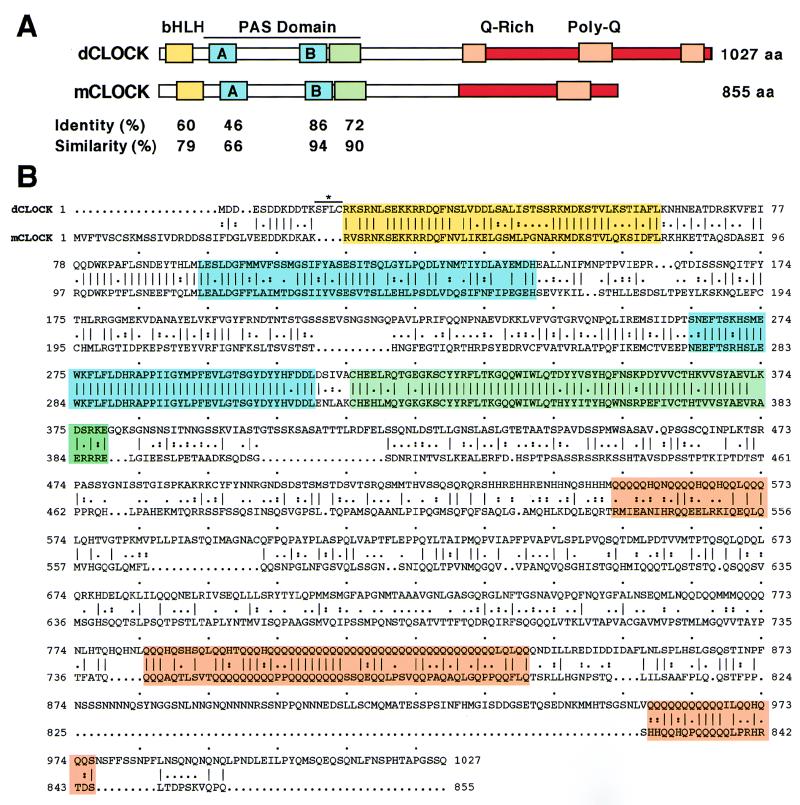
FIG. 1
FIG. 1
Comparison of the predicted protein sequences of dCLOCK and mCLOCK. (A) A schematic representation of dCLOCK and mCLOCK with homologous regions highlighted by different colors is shown. Yellow, amino-terminal region containing bHLH; blue, A and B repeats of PAS; green, region in PAS domain that is immediately carboxy terminal to PAS-B; orange, polyglutamine stretch; red, glutamine-rich region. The boundaries of the bHLH-PAS repeats, glutamine-rich region, and polyglutamine stretch were according to King et al. (23). The boundary of the region immediately carboxy terminal to the PAS-B repeat is based on Saez and Young (37). (B) Pairwise alignment of dCLOCK and mCLOCK amino acids was done with the Genetics Computer Group program GAP. Amino acid identity is indicated by a vertical line and similarity is indicated by dots. Overall, the amino acid sequences of dCLOCK and mCLOCK are 50% identical and 67% similar (data not shown). The mCLOCK sequence is from King et al. (23). A line above the four amino acids that differ between our sequence and that recently published by Darlington et al. (9) is shown.
FIG. 2
FIG. 2
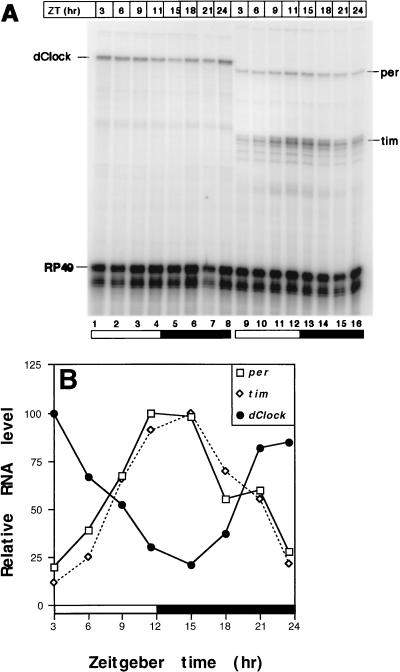
Daily cycling of dClock mRNA in heads from wild-type D. melanogaster. (A) Autoradiogram of dClock, per, tim, and RP49 transcripts in wild-type flies during a 12-h LD cycle. Levels of dClock, per, tim, and RP49 transcripts were determined by RNase protection assays (see Materials and Methods). (B) Quantitation of results shown in panel A. Time course of dClock, per, and tim transcript levels in wild-type flies during 12-h LD conditions. Peak levels for each mRNA were set to 100. Relative RNA level refers to ratio of dClock, per, or tim transcripts to RP49 RNA. Closed bar, darkness; open bar, light. Similar results were obtained in five independent experiments, and a representative example is shown.
FIG. 3
FIG. 3
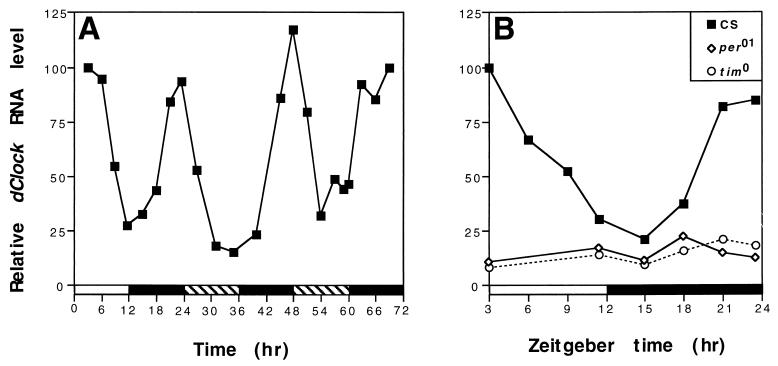
Circadian regulation of dClock mRNA cycling. (A) Levels of dClock mRNA in wild-type flies during the last 12-h LD cycle and the first 2 days in constant dark conditions. Peak levels of dClock mRNA at ZT3 were set to 100. Time refers to hours since last dark-to-light transition at ZT0. (B) PER and TIM are required for high-level expression of dClock. Levels of dClock mRNA in wild-type CS, per01, and tim0 flies during 12-h LD. Peak levels of dClock mRNA in wild-type flies was set to 100. Relative RNA levels refers to ratios of dClock to RP49 RNA. Closed bar, darkness; open bar, light; striped bar, subjective day. Each experiment was done at least three times with similar results, and representative examples are shown.
FIG. 4
FIG. 4
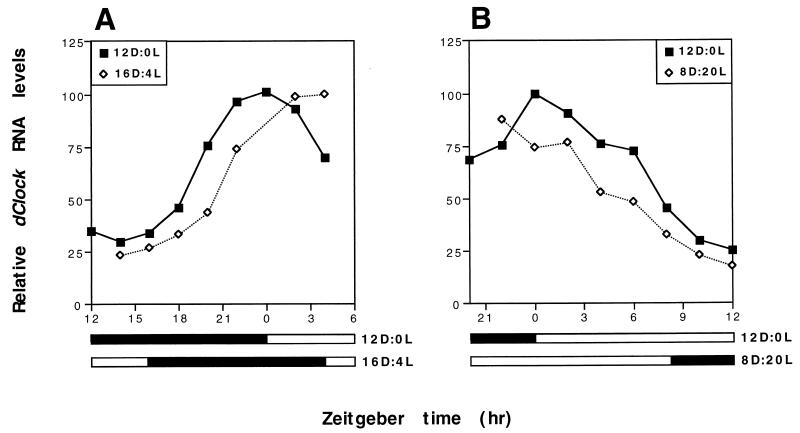
dClock RNA levels in flies exposed to shifts in the timing of a 12-h LD cycle. Four groups of wild-type D. melanogaster were entrained by a standard 12-h LD cycle for 3 days. Subsequently, two groups of flies were transferred from the original 12-h LD condition and treated with either a backward (A) or forward (B) shift of 4 h in the timing of the 12-h LD cycle; a group of flies maintained in standard 12-h LD conditions served as the control for each group of flies that was exposed to a 12-h LD shift (see Materials and Methods). (A) The 4-h backward shift was initiated by extending the light period for four extra hours (between ZT12 and ZT16) and beginning the dark period at ZT16 (16D:4L) relative to the original 12-h LD cycle (12D:0L). (B) The 4-h forward shift was initiated by beginning the light period 4 h earlier at ZT20 (8D:20L) relative to the original 12-h LD cycle (12D:0L). Peak levels of dClock mRNA under standard 12-h LD conditions were set to 100. Levels of dClock transcripts were determined by RNase protection assays. Relative RNA levels refers to ratios of dClock to RP49 RNA. Closed bar, darkness; open bar, light. The experiment was done twice with similar results, and one example is shown.
FIG. 5
FIG. 5
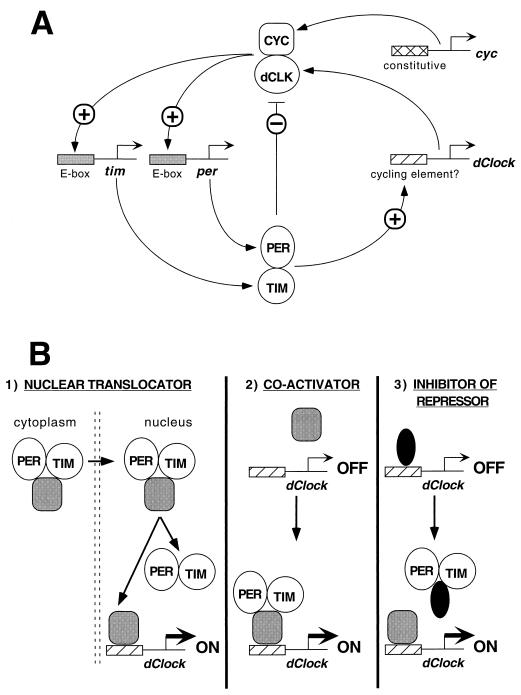
Model of how PER and TIM might regulate dClock expression and function in the transcriptional feedback loop. (A) dCLOCK (dCLK) and CYC interact to form a heterodimer that binds E-box elements on per and tim 5′ regulatory sequences leading to transcriptional activation (2, 9). Increases in the levels of per and tim transcripts are subsequently followed by a rise in the amounts of PER and TIM proteins (not shown). After attaining a critical intracellular concentration, PER and TIM interact to form a complex that enters the nucleus (8, 13, 25, 37, 54), where PER, TIM, and/or the PER-TIM complex (the latter case is shown) inhibit the transcriptional activity of dCLOCK-CYC (9). In addition, nucleus-localized PER, TIM and/or the PER-TIM complex stimulate the rhythmic expression of dClock. Unlike per, tim, and dClock, cyc is expressed constitutively (36). (B) Three examples of how PER and TIM might lead to the stimulation of dClock transcription. See Discussion for more details. Gray oval, hypothetical transcription complex that stimulates dClock expression; black oval, hypothetical transcription complex that inhibits dClock expression.

References

    1. Albrecht U, Sun Z S, Eichele G, Lee C C. A differential response of two putative mammalian circadian regulators, mper1 and mper2, to light. Cell. 1997;91:1055–1064. - PubMed
    1. Allada R, White N E, So W V, Hall J C, Rosbash M. A mutant Drosophila homolog of mammalian Clock disrupts circadian rhythms and transcription of period and timeless. Cell. 1998;93:791–804. - PubMed
    1. Aronson B D, Johnson K A, Loros J J, Dunlap J C. Negative feedback defining a circadian clock: autoregulation of the clock gene frequency. Science. 1994;263:1578–1584. - PubMed
    1. Citri Y, Colot H V, Jacquier A C, Yu Q, Hall J C, Baltimore D, Rosbash M. A family of unusually spliced biologically active transcripts encoded by a Drosophila clock gene. Nature. 1987;326:42–47. - PubMed
    1. Crews S T. Control of cell lineage-specific development and transcription by bHLH-PAS proteins. Genes Dev. 1998;12:607–620. - PubMed

Publication types

MeSH terms

Associated data