


Differential normalization of mucosal interleukin-8 and interleukin-6 activity after Helicobacter pylori eradication
- PMID: 9746573
- PMCID: PMC108584
- DOI: 10.1128/IAI.66.10.4742-4747.1998
Differential normalization of mucosal interleukin-8 and interleukin-6 activity after Helicobacter pylori eradication
Abstract
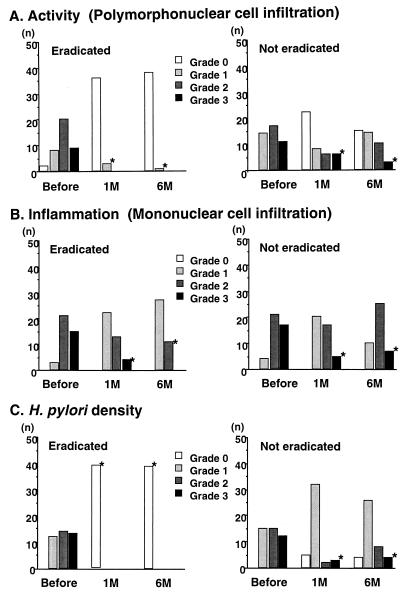
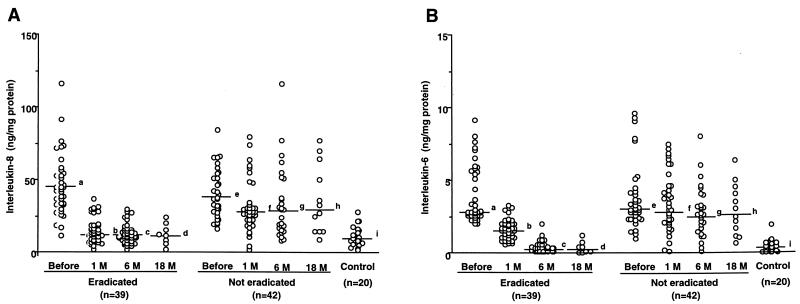
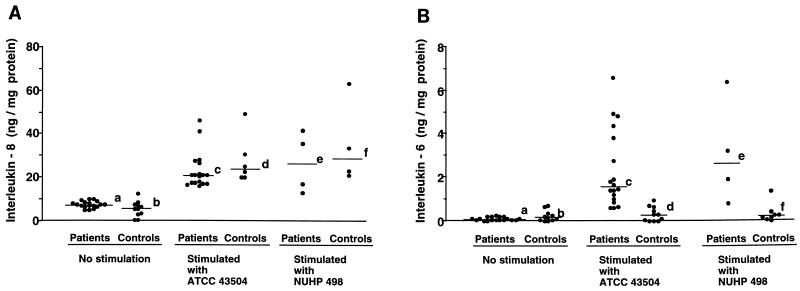
There is differential resolution of mucosal infiltration with neutrophils and mononuclear cells following successful Helicobacter pylori eradication. We investigated the effects of H. pylori eradication on mucosal interleukin-8 (IL-8) and IL-6 activity in relation to the resolution of H. pylori-associated gastritis. Eighty-one duodenal ulcer patients with H. pylori infection received dual- or triple-treatment eradication therapy, and mucosal biopsy specimens obtained at the initial and follow-up endoscopic examinations were cultured in vitro for 24 h. The levels of IL-8 and IL-6 were measured by enzyme-linked immunosorbent assays. In the 42 patients in whom H. pylori eradication failed, there was little change in the numbers of neutrophils and mononuclear cells infiltrating the mucosa and in IL-8 and IL-6 activity. In the 39 patients in whom H. pylori was eradicated, there was normalization both in the numbers of infiltrating neutrophils and in mucosal IL-8 activity, which was evident within 1 month following therapy. In contrast, there was a gradual resolution of mononuclear cell infiltration over a 6-month period, accompanied by a gradual normalization in IL-6 levels. Addition of H. pylori to cultures of mucosal tissues induced a significant increase in IL-8 activity in both uninfected control subjects and patients from whom H. pylori was eradicated. However, this introduction yielded a significant increase in IL-6 activity only in the latter group. This study indicates a dichotomy in the changes of mucosal IL-8 and IL-6 activity after H. pylori eradication. The rapid normalization of IL-8 after H. pylori eradication and the ability of H. pylori cells to stimulate IL-8 in control tissues indicate that IL-8 induction is a part of the innate (nonimmune) responses to this organism. In contrast, the results of experiments analyzing IL-6 activity in cultured mucosal tissues suggest that the gradual resolution of mucosal IL-6 activity and mononuclear infiltration after successful eradication observed in vivo may reflect gradually diminishing residual immune responses against H. pylori.
Figures
References
-
- Alam K, Schubert T T, Bologna S D, Ma C K. Increased density of Helicobacter pylori on antral biopsy is associated with severity of acute and chronic inflammation and likelihood of duodenal ulceration. Am J Gastroenterol. 1992;87:424–448. - PubMed
-
- Ando T, Kusugami K, Ohsuga M, Shinoda M, Sakakibara M, Saito H, Fukatsu A, Ichiyama S, Ohta M. Interleukin-8 activity correlates with histological severity in Helicobacter pylori-associated antral gastritis. Am J Gastroenterol. 1996;91:1150–1156. - PubMed
-
- Blaser M J. Hypotheses on the pathogenesis and natural history of Helicobacter pylori-induced inflammation. Gastroenterology. 1992;102:720–727. - PubMed
-
- Borody T, Andrews P, Mancuso N, Jankiewicz E, Brandl S. Helicobacter pylori reinfection 4 years post-eradication. Lancet. 1992;339:1295. - PubMed
-
- Coghlan J G, Gilligan D, Humphreys H, McKenna D, Dooley C, Sweeney E, Keane C, O’Morain C. Campylobacter pylori and recurrence of duodenal ulcers. Lancet. 1987;ii:1109–1111. - PubMed
Publication types
MeSH terms
Substances
LinkOut - more resources
Full Text Sources
Medical
