


Succinoglycan is required for initiation and elongation of infection threads during nodulation of alfalfa by Rhizobium meliloti
- PMID: 9748453
- PMCID: PMC107556
- DOI: 10.1128/JB.180.19.5183-5191.1998
Succinoglycan is required for initiation and elongation of infection threads during nodulation of alfalfa by Rhizobium meliloti
Abstract
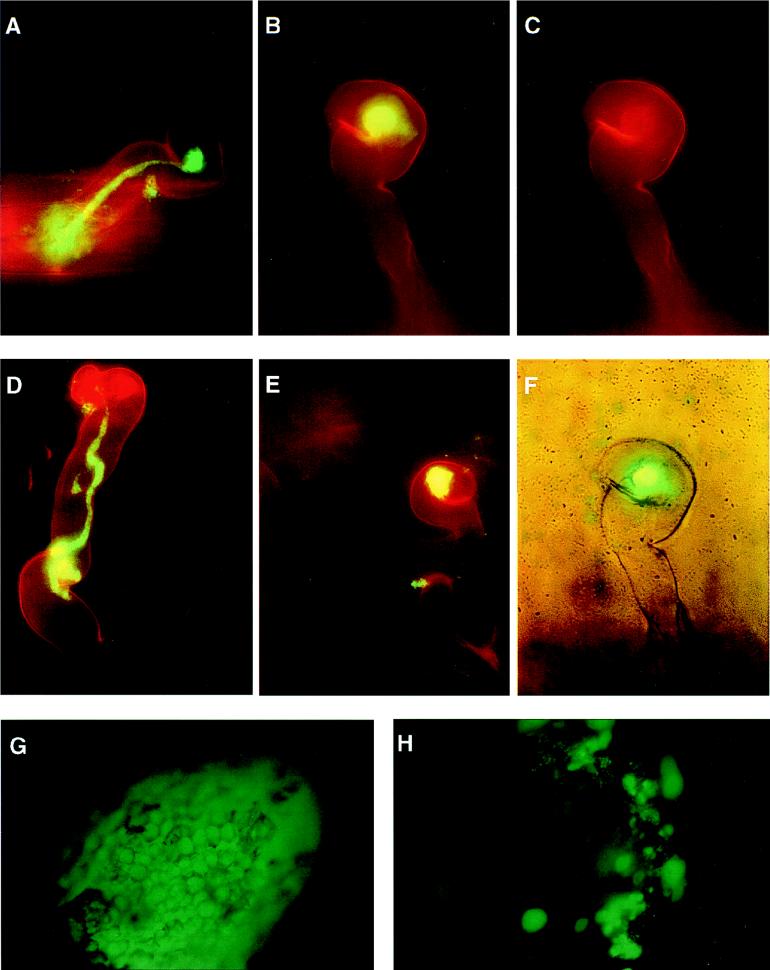
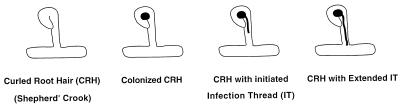
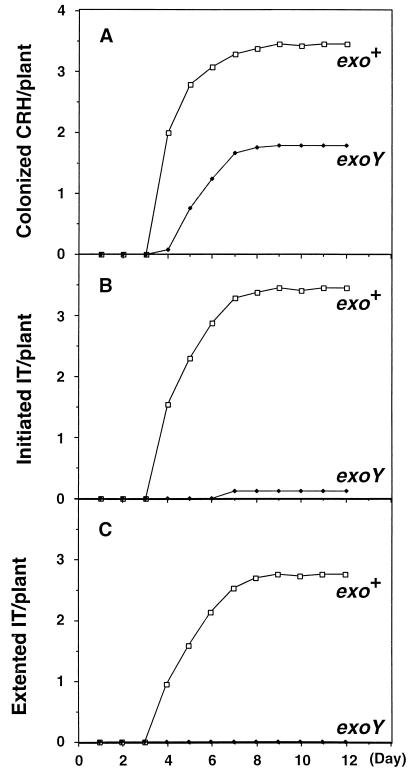
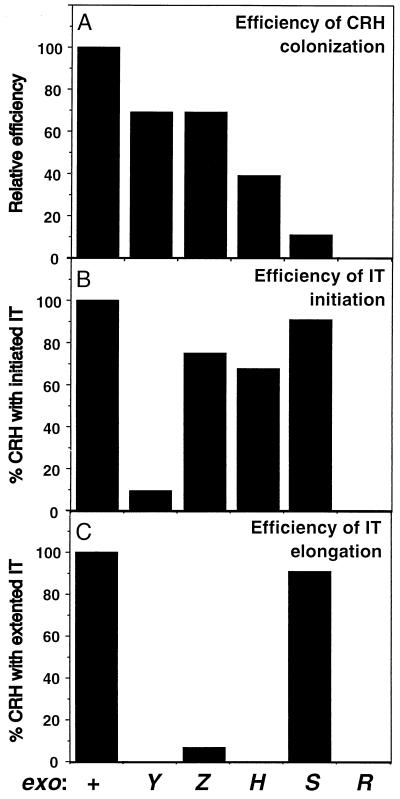
Rhizobium meliloti Rm1021 must be able to synthesize succinoglycan in order to invade successfully the nodules which it elicits on alfalfa and to establish an effective nitrogen-fixing symbiosis. Using R. meliloti cells that express green fluorescent protein (GFP), we have examined the nature of the symbiotic deficiency of exo mutants that are defective or altered in succinoglycan production. Our observations indicate that an exoY mutant, which does not produce succinoglycan, is symbiotically defective because it cannot initiate the formation of infection threads. An exoZ mutant, which produces succinoglycan without the acetyl modification, forms nitrogen-fixing nodules on plants, but it exhibits a reduced efficiency in the initiation and elongation of infection threads. An exoH mutant, which produces symbiotically nonfunctional high-molecular-weight succinoglycan that lacks the succinyl modification, cannot form extended infection threads. Infection threads initiate at a reduced rate and then abort before they reach the base of the root hairs. Overproduction of succinoglycan by the exoS96::Tn5 mutant does not reduce the efficiency of infection thread initiation and elongation, but it does significantly reduce the ability of this mutant to colonize the curled root hairs, which is the first step of the invasion process. The exoR95::Tn5 mutant, which overproduces succinoglycan to an even greater extent than the exoS96::Tn5 mutant, has completely lost its ability to colonize the curled root hairs. These new observations lead us to propose that succinoglycan is required for both the initiation and elongation of infection threads during nodule invasion and that excess production of succinoglycan interferes with the ability of the rhizobia to colonize curled root hairs.
Figures
References
-
- Aman P, McNeil M, Franzen L-E, Darvill A G, Albersheim P. Structural elucidation, using HPLC-MS and GLC-MS, of the acidic exopolysaccharide secreted by Rhizobium meliloti strain Rm1021. Carbohydr Res. 1981;95:263–282.
-
- Becker A, Kleickmann A, Keller M, Arnold W, Pühler A. Identification and analysis of the Rhizobium meliloti exoAMNOP genes involved in exopolysaccharide biosynthesis and mapping of promoters located on the exoHKLAMONP fragment. Mol Gen Genet. 1993;241:367–379. - PubMed
-
- Becker A, Kleickmann A, Küster H, Keller M, Arnold W, Pühler A. Analysis of the Rhizobium meliloti genes exoU, exoV, exoW, exoT, and exoI involved in exopolysaccharide biosynthesis and nodule invasion: exoU and exoW probably encode glucosyltransferases. Mol Plant-Microbe Interact. 1993;6:735–744. - PubMed
-
- Becker A, Küster H, Niehaus K, Pühler A. Extension of the Rhizobium meliloti succinoglycan biosynthesis gene cluster: identification of the exsA gene encoding an ABC transporter protein, and the exsB gene which probably codes for a regulator of succinoglycan biosynthesis. Mol Gen Genet. 1995;249:487–497. - PubMed
Publication types
MeSH terms
Substances
Grants and funding
LinkOut - more resources
Full Text Sources
Other Literature Sources
Molecular Biology Databases
