. 1998 Sep 29;95(20):11697-702.
doi: 10.1073/pnas.95.20.11697.

Distinct steady-state nuclear receptor coregulator complexes exist in vivo

Affiliations

Distinct steady-state nuclear receptor coregulator complexes exist in vivo

N J McKenna et al. Proc Natl Acad Sci U S A. .

Abstract

Transcriptional regulation by members of the nuclear hormone receptor superfamily is a modular process requiring the mediation of distinct subclasses of coregulators. These subclasses include members of the steroid receptor coactivator-1 (SRC-1) coactivator family, p300/CBP and their associated proteins, such as p300/CBP-associated factor, human homologs of SWI/SNF proteins such as BRG-1, and the less well-characterized E3 ubiquitin-protein ligases E6 papillomavirus protein-associated protein and receptor-potentiating factor-1. Because functional studies indicate that these coregulators may form higher order complexes, we analyzed steady-state complexes of different coregulator subclasses in vivo. T47D and HeLa cell lysates were subjected to biochemical fractionation and screened by immunoblotting using coregulator-specific antibodies. We show that different subclasses of nuclear receptor coregulators exhibit distinct fractionation profiles. Furthermore, evidence is provided that SRC-1 family members may exist in vivo in heteromultimeric forms with each other. In addition, we demonstrate that liganded PR is present in stable complexes containing SRC-1 and transcription intermediary factor 2 (TIF2) in vivo. Our results suggest that the assembly of large, modular transcriptional complexes by recruitment of distinct subclasses of preformed coregulator subcomplexes may be involved in transcriptional regulation by activated nuclear receptors.


Figures
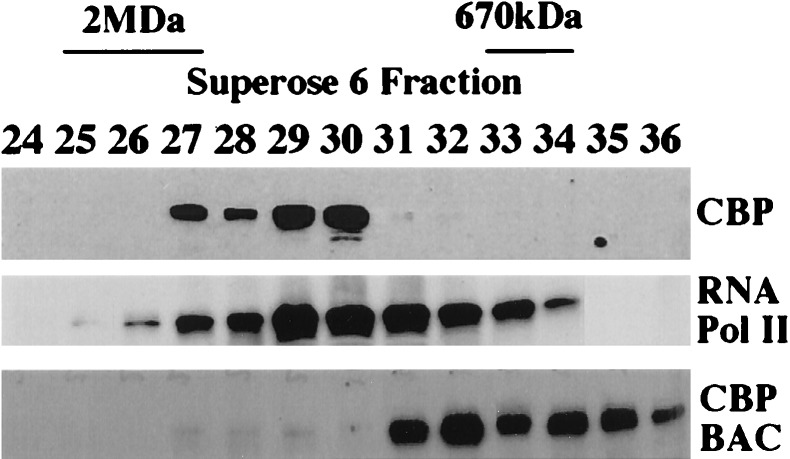
Figure 1
Figure 1
High molecular mass complexes contain CBP and RNA pol II. Fractionation of T47D lysate on a Superose 6 column was analyzed by immunoblot with CBP and RNA Pol II-specific antibodies (CBP and RNA pol II). Recombinant baculovirus-expressed CBP also was fractionated (CBP BAC). Indicated are elution peaks of molecular mass markers: mammalian SWI/SNF complex (≈2 MDa) and thyroglobulin (670 kDa). The void volume (4 MDa for globular proteins) was determined at fraction 20 by silver staining after fractionation of T47D cell lysate (data not shown).
Figure 2
Figure 2
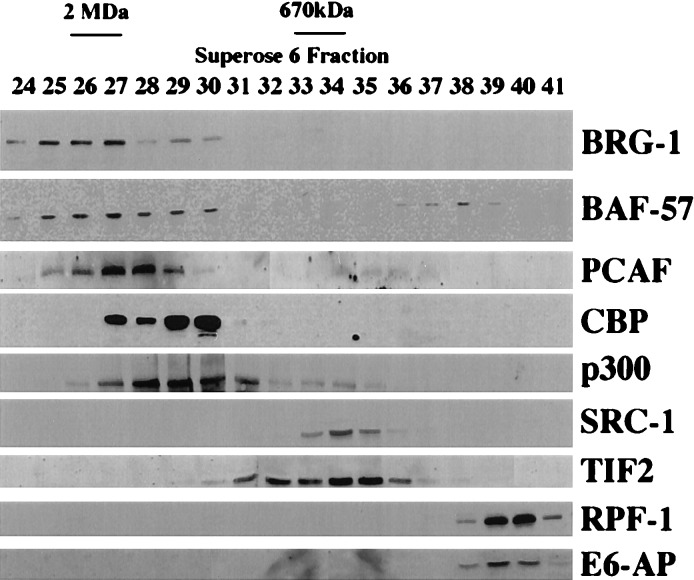
Distinct steady–state fractionation profiles of different subclasses of nuclear receptor coregulators. T47D or HeLa cell lysate was fractionated on a Superose 6 column and subjected to immunoblot analysis by using coregulator-specific antibodies as indicated. Elution peaks of molecular mass standards are indicated. The relatively sharp elution peaks of SRC-1 and CBP were reproducible. No difference in fractionation pattern was observed between different cell lines.
Figure 3
Figure 3
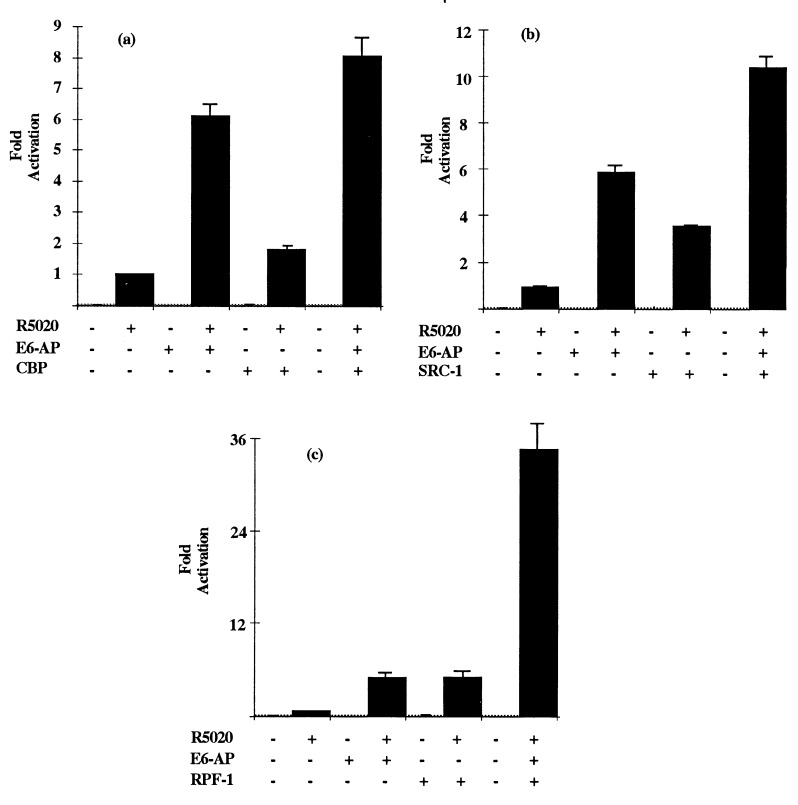
Synergistic enhancement of PR transactivation by E6-AP and RPF-1. HeLa cells were transiently transfected with 0.2 μg of PR-B expression plasmid and 1 μg of pPRE-E1b-Luc reporter in the presence and absence of 0.5 μg (total) of vectors expressing the indicated coactivators. The cells were treated with either vehicle only (−R5020) or 10nM R5020 (+). Data are expressed as the mean (± SD) of triplicate values.
Figure 4
Figure 4
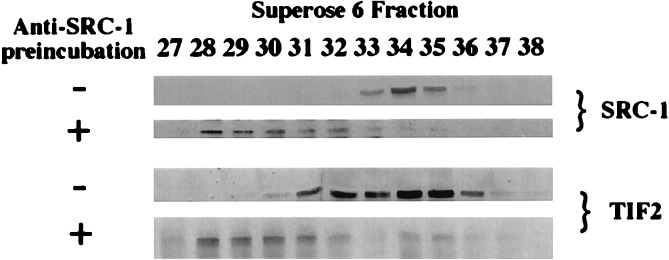
SRC-1 and TIF2 can form common complexes in vivo. SRC-1 complexes were collected by incubation with SRC-1 monoclonal antibody and polyclonal antimouse IgG and fractionated by gel filtration. Immunoblotting confirmed the shift of SRC-1 from its elution peak in the absence of preincubation with anti-SRC-1 antibody (−) to earlier fractions in the presence of anti-SRC-1 antibody (+). The relatively broad elution profile of shifted SRC-1 is most likely due to the heterogeneity of immune complexes formed in these fractions.
Figure 5
Figure 5
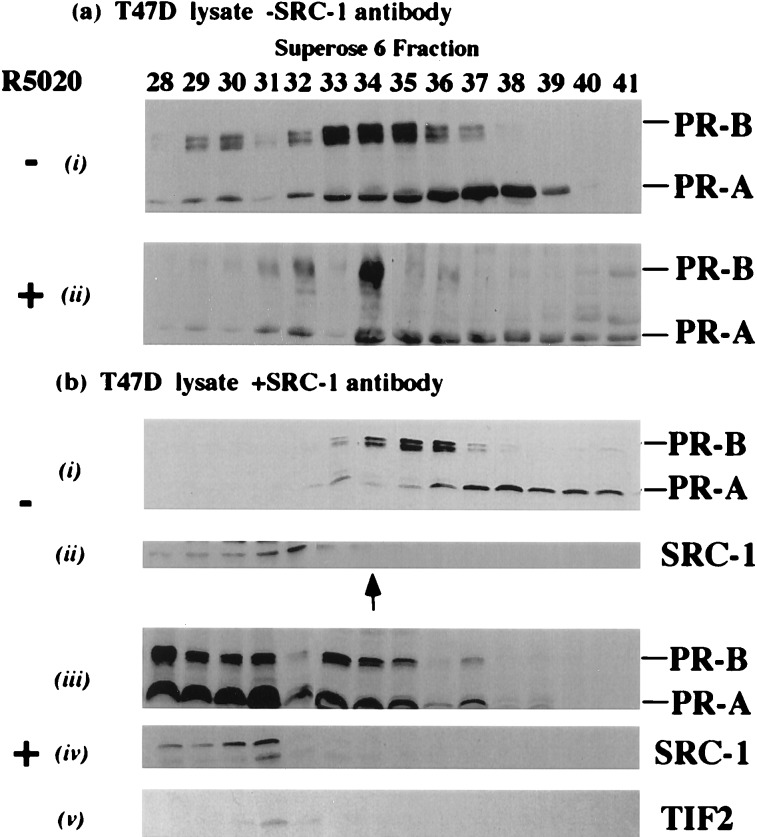
Liganded PR exists in stable complexes containing SRC-1 and TIF2 in vivo. (a) T47D cells were pretreated with vehicle (i) and with 1nM progesterone (ii) before fractionation and immunoblotting with PR antibody. (b) Cells were treated as above except lysate was incubated with anti-SRC-1 antibody, fractionated and immunoblotted for (i) PR, (ii) SRC-1, (iii) PR, (iv) SRC-1, and (v) TIF2. (The arrow indicates the peak of SRC-1 and TIF2 in the absence of preincubation with the SRC-1 antibody).
Figure 6
Figure 6
Mechanistic model for transcriptional activation by activated PR. The relative stability of the complexes between liganded PR and SRC-1/TIF2-containing subcomplexes suggests they may be important intermediates in PR transactivation. Interactions of SRC-1 with other subclasses of coregulators appear to be comparatively transient.

References

    1. Tsai M-J, O’Malley B W. Annu Rev Biochem. 1994;63:451–486. - PubMed
    1. Onate S A, Tsai S Y, Tsai M-J, O’Malley B W. Science. 1995;270:1354–1357. - PubMed
    1. Kamei Y, Xu L, Heinzel T, Torchia J, Kurokawa R, Gloss B, Lin S C, Heyman R A, Rose D W, Glass C K, et al. Cell. 1996;85:403–414. - PubMed
    1. Halachmi S, Marden E, Martin G, Mackay H, Abbondanza C, Brown M. Science. 1994;264:1455–1458. - PubMed
    1. Hong H, Kohli K, Trivedi A, Johnson D L, Stallcup M R. Proc Natl Acad Sci USA. 1996;93:4948–4952. - PMC - PubMed

Publication types

MeSH terms

Substances