. 1998 Sep 29;95(20):11739-44.
doi: 10.1073/pnas.95.20.11739.

Habitat structure determines competition intensity and invasion success in gecko lizards

Affiliations

Habitat structure determines competition intensity and invasion success in gecko lizards

K Petren et al. Proc Natl Acad Sci U S A. .

Abstract

Species diversity is correlated with structural complexity in many animal communities; however, experimental tests of the mechanisms underlying this important relationship are rare, especially in terrestrial communities. We manipulated physical features of the habitat of gecko lizards and measured the effect on exploitation competition for insects. Increasing both the dispersion of food resources and microhabitat topography dramatically reduced interspecific competition. Adding topographic structure reduced the advantages of the larger, faster, invasive species. Interindividual spacing decreased, but intraspecific agonistic interference increased in the more territorial, resident species. Human structural alterations of the environment facilitate invasion and competitive displacement in this system. Physical microhabitat structure can potentially affect species interactions through a variety of complex mechanisms.


Figures
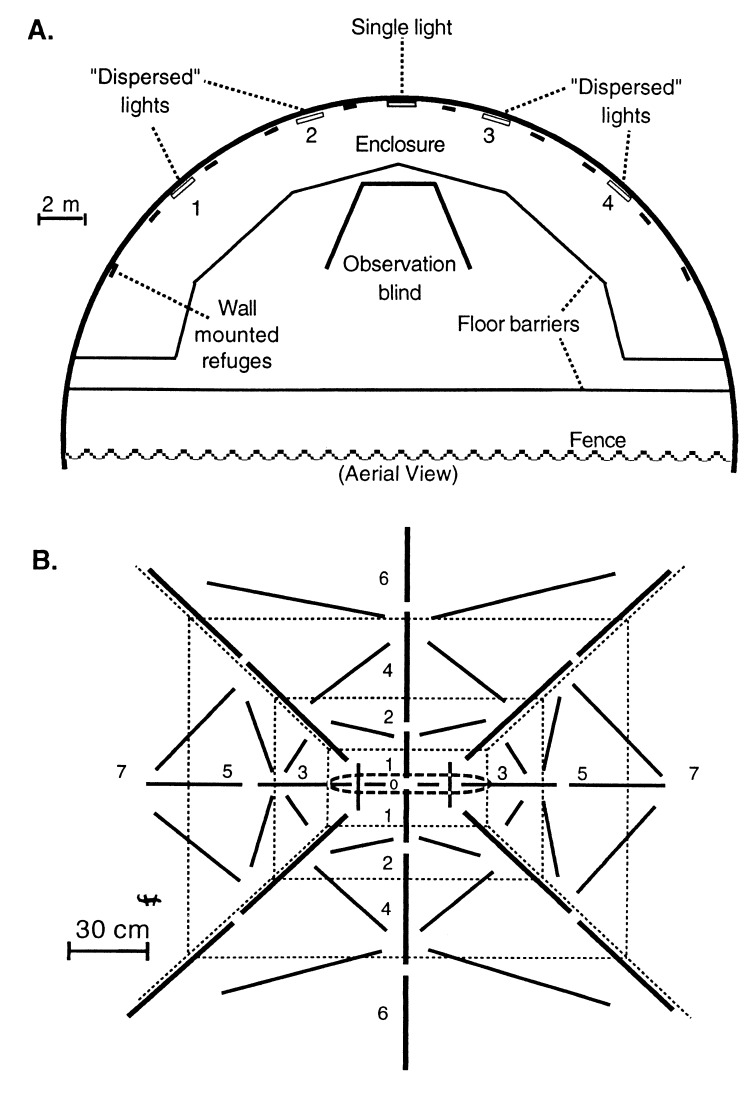
Figure 1
Figure 1
Experimental enclosures. (A) Top view. Experimental geckos were kept inside enclosures with Teflon barriers, although natural insects could pass freely through the large opening. Urban control treatments contained a single light affixed to the vertical wall 1.8 m from the floor. Dispersed insect treatments contained four lights, but only one light was on at any given time (for 8–10 min). (B) Topographic structure was enhanced in a third experimental treatment by affixing aluminum baffles to the wall near the light. Diagonal barriers (thick lines) were 10 cm high (from the wall), whereas all other barriers were 5 cm high. Geckos moved freely on and around barriers. Numbers denote regions used to mark gecko positions. Region 0 contained the light, and region 8 encompassed all parts of the enclosure that were not visible.
Figure 2
Figure 2
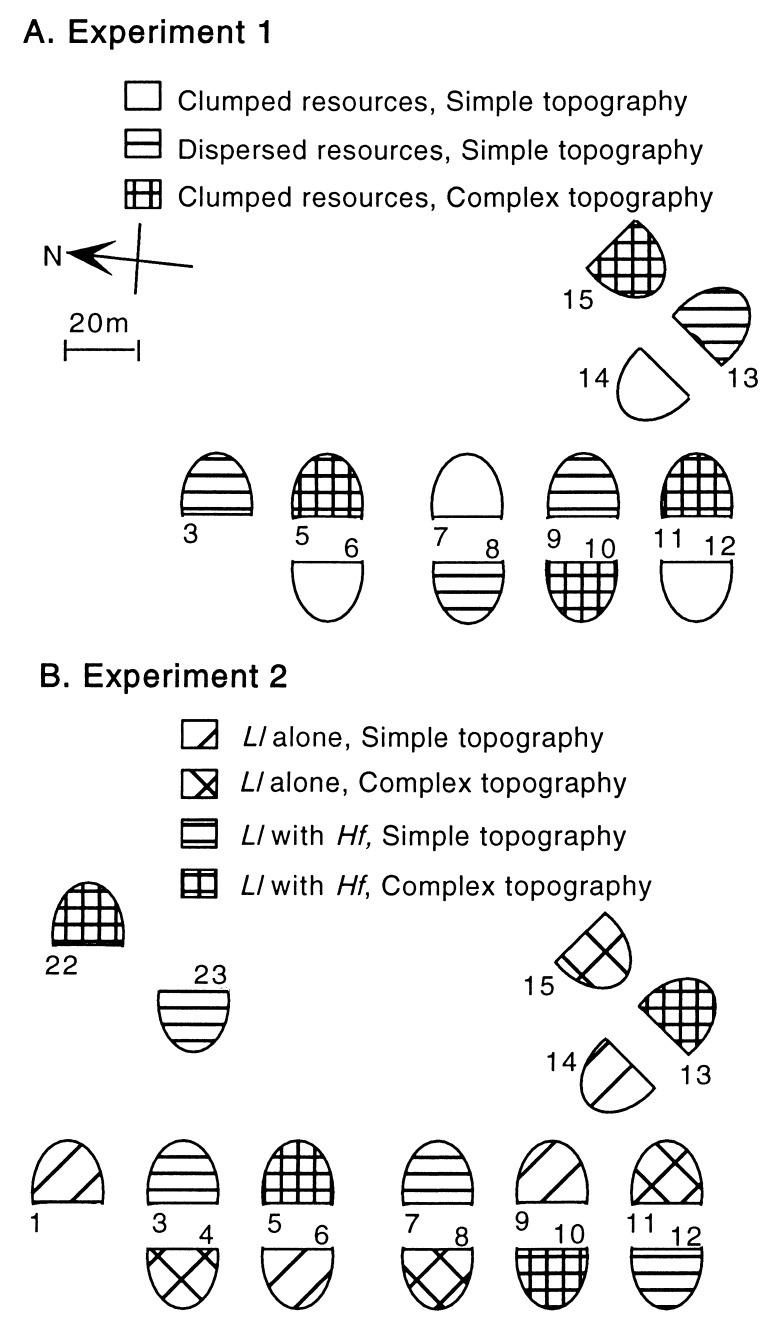
Treatments for each experiment were systematically assigned to balance for previously documented systematic patterns of insect abundance (25). (A) For experiment 1, each of three treatments had four replicate enclosures stocked with 20 geckos each (10 Ll and 10 Hf). (B) For experiment 2, two factors (inter- and intraspecific competitor) were crossed to produce four treatments, again with 4-fold replication stocked with 20 Ll or 10 Hf and 10 Ll.
Figure 3
Figure 3
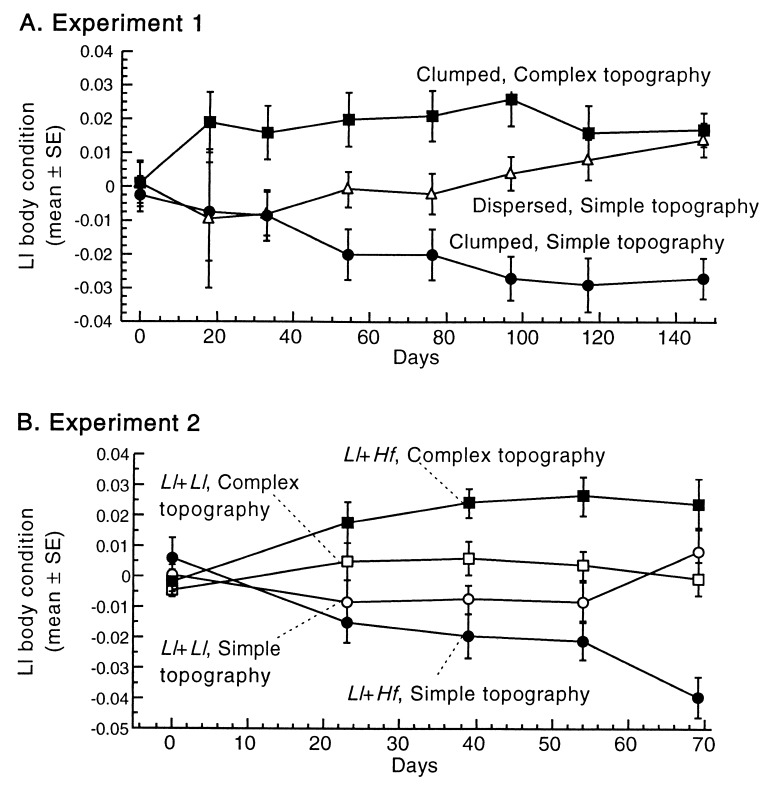
Increasing resource dispersion and topographic complexity nearly eliminated competition. (A) Ll body condition showed significant differences at every census after 30 days (ANOVA all P < 0.03), but geckos with topographic structure improved more rapidly than those with dispersed resources. At census 7, both treatments were significantly different from the “urban control” (ANOVA F = 26.5, P = 0.002; Fisher’s PLSD P < 0.001). (B) More complex topographical structure reduced interspecific competition more than intraspecific competition in Ll. The interaction of competitor type (intraspecific vs. interspecific) and topographic structure (simple/complex) was significant in the last two censuses (ANOVA structure F > 13.0, P < 0.01; competitor F < 2.0, P > 0.1; structure × competitor F = 7.7, P < 0.02). The relative magnitude of inter- and intraspecific competition was completely reversed by increasing topographic complexity.
Figure 4
Figure 4
(A) In experiment 1, the proportion of long (>20 cm) foraging attempts by Hf increased when insects were dispersed (ANOVA F = 4.8, P < 0.04; Fisher’s PLSD P < 0.02). Fewer long attempts were made by Ll when topography was complex (ANOVA F = 8.2, P < 0.01; Fisher’s PLSD P < 0.01). (B) In experiment 2, increased topographic structure caused Hf harvest rates at longer distances to decline (t = 2.8, P = 0.03), whereas Ll did not experience a decline (t = 1.2, P > 0.25). (C) In experiment 1, of those geckos that were foraging near the light, Hf showed little increased access to the light because of treatment effects (ANOVA F = 1.6, P > 0.25; regions shown in Fig. 1), whereas Ll were closer to lights in both dispersed and complex environments as compared with controls (ANOVA F = 8.5, P < 0.01; Fisher’s PLSD P < 0.03).
Figure 5
Figure 5
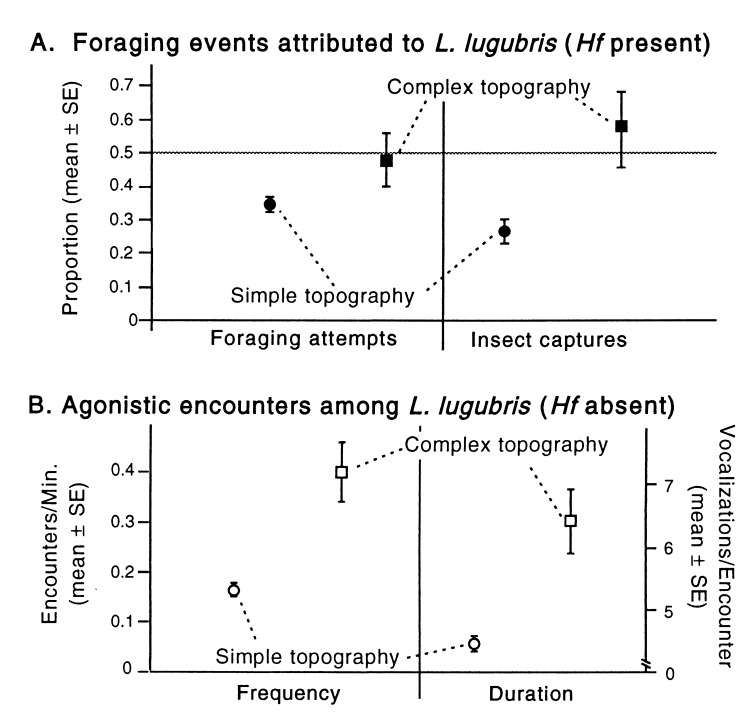
(A) Ll made more foraging attempts in the presence of Hf when topography was complex, but this difference was not significant (t = 1.6, P > 1.5). However, Ll obtained a significantly greater proportion of all insects captured (t = 2.5, P < 0.05). (B) The frequency and duration of agonistic encounters among Ll increased significantly when complex topographic structure was enhanced (experiment 2, treatments without Hf).

References

    1. McCoy E D, Bell S S. In: Habitat Structure: The Physical Arrangement of Objects in Space. Bell S S, McCoy E D, Mushinsky H R, editors. London: Chapman & Hall; 1991. pp. 3–27.
    1. MacArthur R H, MacArthur J W. Ecology. 1961;42:594–598.
    1. Sanders H L. Am Nat. 1968;102:243–282.
    1. Karr J R, Roth R R. Am Nat. 1971;105:423–435.
    1. Lawton J H. Annu Rev Entomol. 1983;28:23–39.

Publication types