


Evidence for interspecies gene transfer in the evolution of 2,4-dichlorophenoxyacetic acid degraders
- PMID: 9758850
- PMCID: PMC106609
- DOI: 10.1128/AEM.64.10.4089-4092.1998
Evidence for interspecies gene transfer in the evolution of 2,4-dichlorophenoxyacetic acid degraders
Abstract
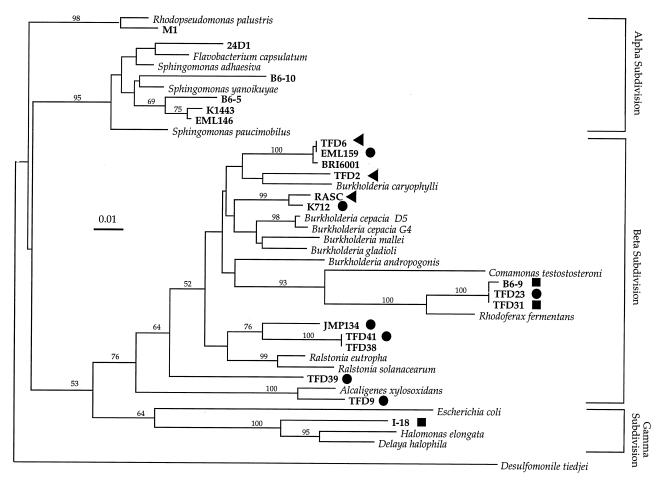
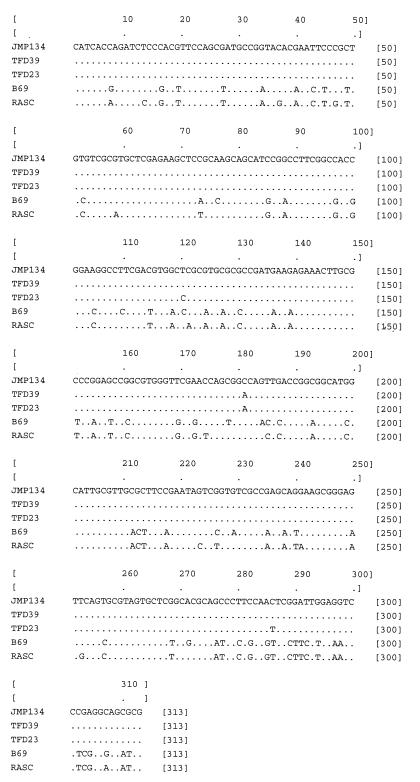
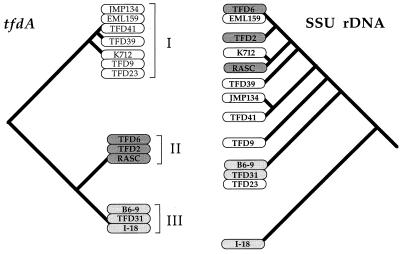
Small-subunit ribosomal DNA (SSU rDNA) from 20 phenotypically distinct strains of 2,4-dichlorophenoxyacetic acid (2,4-D)-degrading bacteria was partially sequenced, yielding 18 unique strains belonging to members of the alpha, beta, and gamma subgroups of the class Proteobacteria. To understand the origin of 2,4-D degradation in this diverse collection, the first gene in the 2,4-D pathway, tfdA, was sequenced. The sequences fell into three unique classes found in various members of the beta and gamma subgroups of Proteobacteria. None of the alpha-Proteobacteria yielded tfdA PCR products. A comparison of the dendrogram of the tfdA genes with that of the SSU rDNA genes demonstrated incongruency in phylogenies, and hence 2,4-D degradation must have originated from gene transfer between species. Only those strains with tfdA sequences highly similar to the tfdA sequence of strain JMP134 (tfdA class I) transferred all the 2,4-D genes and conferred the 2,4-D degradation phenotype to a Burkholderia cepacia recipient.
Figures
References
-
- Altschul S F, Gish W, Miller W, Myers E W, Lipman D J. Basic local alignment search tool. J Mol Biol. 1990;215:403–410. - PubMed
-
- Felsenstein J. Phylogenies from molecular sequences: inference and reliability. Annu Rev Genet. 1988;22:521–565. - PubMed
-
- Friedrich B, Meyer M, Schlegel H. Transfer and expression of the herbicide-degrading plasmid pJP4 in aerobic autotrophic bacteria. Arch Microbiol. 1983;134:92–97. - PubMed
Publication types
MeSH terms
Substances
LinkOut - more resources
Full Text Sources
Other Literature Sources
