


Representing thoughts, words, and things in the UMLS
- PMID: 9760390
- PMCID: PMC61323
- DOI: 10.1136/jamia.1998.0050421
Representing thoughts, words, and things in the UMLS
Abstract
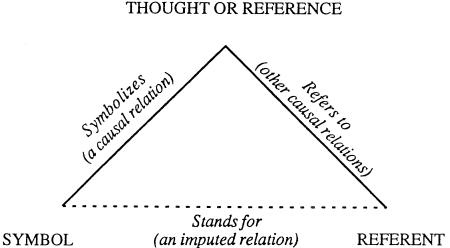
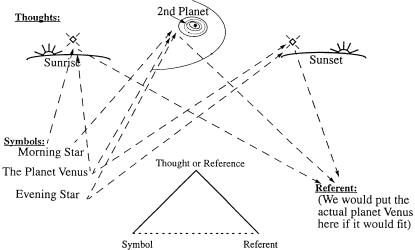
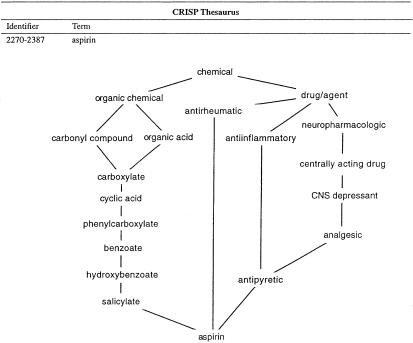
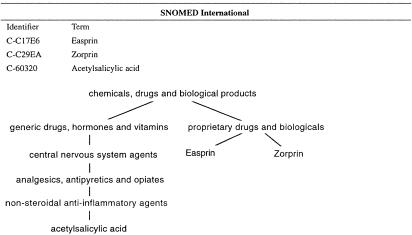
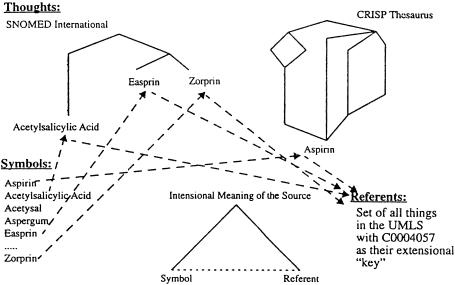
The authors describe a framework, based on the Ogden-Richards semiotic triangle, for understanding the relationship between the Unified Medical Language System (UMLS) and the source terminologies from which the UMLS derives its content. They pay particular attention to UMLS's Concept Unique Identifier (CUI) and the sense of "meaning" it represents as contrasted with the sense of "meaning" represented by the source terminologies. The CUI takes on emergent meaning through linkage to terms in different terminology systems. In some cases, a CUI's emergent meaning can differ significantly from the original sources' intended meanings of terms linked by that CUI. Identification of these different senses of meaning within the UMLS is consistent with historical themes of semantic interpretation of language. Examination of the UMLS within such a historical framework makes it possible to better understand the strengths and limitations of the UMLS approach for integrating disparate terminologic systems and to provide a model, or theoretic foundation, for evaluating the UMLS as a Possible World--that is, as a mathematical formalism that represents propositions about some perspective or interpretation of the physical world.
Figures
References
-
- Ogden CK, Richards IA. The Meaning of Meaning. 8th ed. Orlando, Fla.: Harcourt Brace Jovanovich, 1989. First edition published 1923.
-
- White NP. Plato on Knowledge and Reality. Indianapolis, Ind.: Hackett Publishing Co, 1976.
-
- Witt C. Substance and Essence in Aristotle: An Interpretation of Metaphysics VII-IX. Ithaca, NY: Cornell University Press, 1989.
Publication types
MeSH terms
Grants and funding
LinkOut - more resources
Full Text Sources
Other Literature Sources
