


Reduced striatal dopamine transporter density in abstinent methamphetamine and methcathinone users: evidence from positron emission tomography studies with [11C]WIN-35,428
- PMID: 9763484
- PMCID: PMC6792853
- DOI: 10.1523/JNEUROSCI.18-20-08417.1998
Reduced striatal dopamine transporter density in abstinent methamphetamine and methcathinone users: evidence from positron emission tomography studies with [11C]WIN-35,428
Abstract
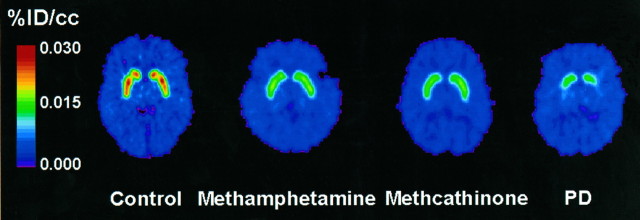
Methamphetamine and methcathinone are psychostimulant drugs with high potential for abuse. In animals, methamphetamine and related drugs are known to damage brain dopamine (DA) neurons, and this damage has recently been shown to be detectable in living nonhuman primates by means of positron emission tomography (PET) with [11C]WIN-35,428, a DA transporter (DAT) ligand. The present studies determined whether living humans with a history of methamphetamine or methcathinone abuse showed evidence of lasting decrements in brain DAT density. PET studies were performed in 10 control subjects, six abstinent methamphetamine users, four abstinent methcathinone users, and three patients with Parkinson's disease (PD). On average, subjects had abstained from amphetamine use for approximately 3 years. Before PET studies, all subjects underwent urine and blood toxicology screens to rule out recent drug use. Compared with controls, abstinent methamphetamine and methcathinone users had significant decreases in DAT density in the caudate nucleus (-23 and -24%, respectively) and putamen (-25 and -16%, respectively). Larger decreases in DAT density were evident in patients with PD (47 and 68% in caudate and putamen, respectively). Neither methamphetamine nor methcathinone users showed clinical signs of parkinsonism. Persistent reductions of DAT density in methamphetamine and methcathinone users are suggestive of loss of DAT or loss of DA terminals and raise the possibility that as these individuals age, they may be at increased risk for the development of parkinsonism or neuropsychiatric conditions in which brain DA neurons have been implicated.
Figures
References
-
- Bakhit C, Morgan MA, Peat MA, Gibb JW. Long-term effects of methamphetamine on the synthesis and metabolism of 5-hydroxytryptamine in various regions of the rat brain. Neuropharmacology. 1981;20:1135–1140. - PubMed
-
- Brill H, Hirose T. The rise and fall of a methamphetamine epidemic. Semin Psychiatry. 1969;1:179–213.
-
- Calkins RF, Aktan GB, Hussain KL. Methcathinone: the next illicit stimulant epidemic? J Psychoact Drugs. 1995;27:277–285. - PubMed
-
- Canfield DR, Spealman RD, Kaufman MJ, Madras BK. Autoradiographic localization of cocaine binding sites by [3H]CFT ([3H]WIN 35,428) in the monkey brain. Synapse. 1990;6:189–195. - PubMed
-
- Cerruti C, Pillotte N, Uhl G, Kuhar M. Reduction in dopamine transporter mRNA after cessation of repeated cocaine administration. Mol Brain Res. 1994;22:1–4. - PubMed
Publication types
MeSH terms
Substances
Grants and funding
LinkOut - more resources
Full Text Sources
Medical
Miscellaneous
