


Modification of activity-dependent increases of cerebral blood flow by excitatory synaptic activity and spikes in rat cerebellar cortex
- PMID: 9763643
- PMCID: PMC2231204
- DOI: 10.1111/j.1469-7793.1998.555be.x
Modification of activity-dependent increases of cerebral blood flow by excitatory synaptic activity and spikes in rat cerebellar cortex
Abstract
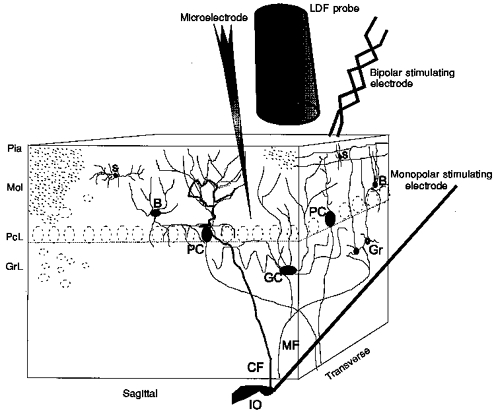
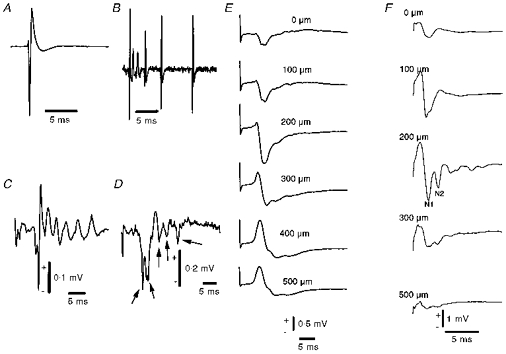
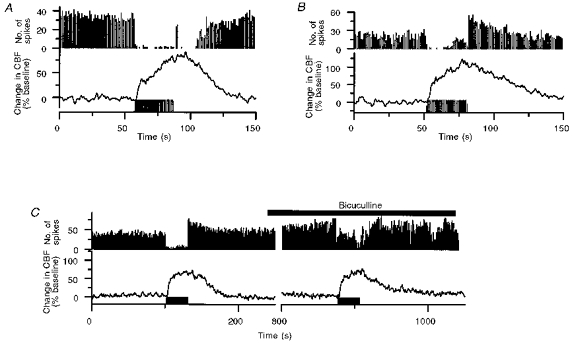
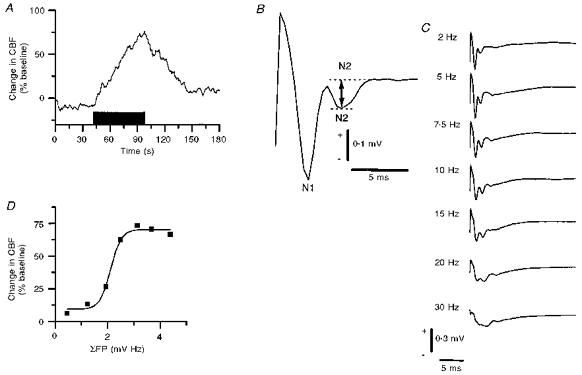
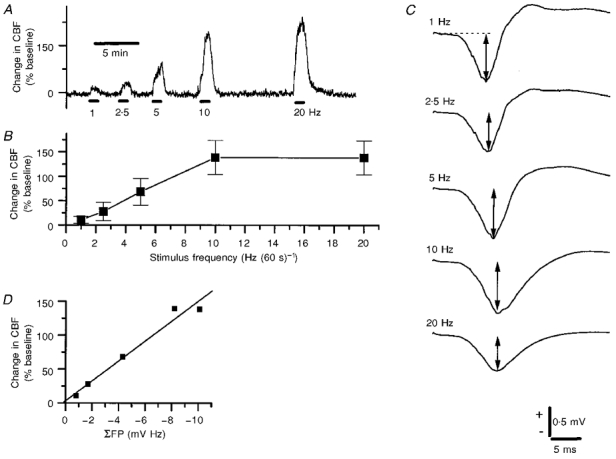
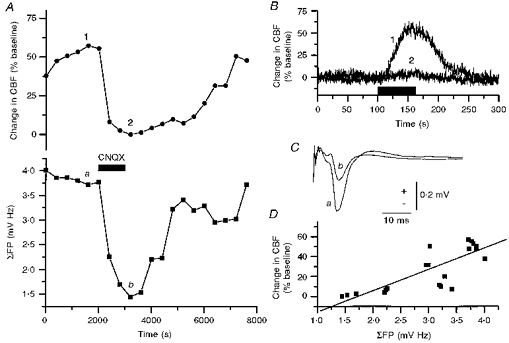
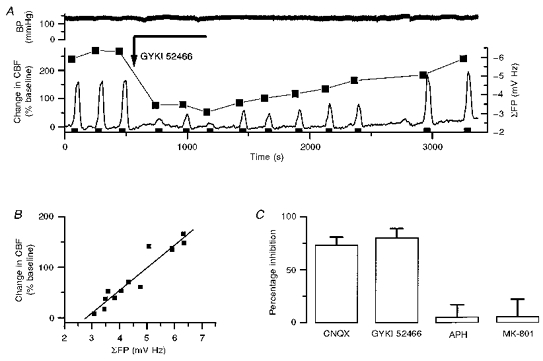
1. Mechanisms of activity-dependent increases in cerebral blood flow (CBF) were examined in rat cerebellar cortex using the laser Doppler flow technique and extracellular recordings of single unit activity and field potentials. 2. Stimulation of the monosynaptic climbing fibre system evoked long-lasting complex spikes in Purkinje cells, and extracellular field potentials with a characteristic profile that indicated contributions from both passive and active membrane mechanisms. The concomitant CBF increases were reproducible at fairly short intervals, and suggest that both synaptic activity and spikes may contribute to increased CBF. 3. Stimulation of the disynaptic parallel fibre system inhibited the spiking activity in Purkinje cells, while the postsynaptic activity increased as indicated by the simultaneously recorded field potential. Nevertheless, CBF always increased. The inhibition of spike firing activity was partly dependent on GABAergic transmission, but may also relate to the intrinsic membrane properties of Purkinje cells. 4. The CBF increases evoked by parallel or climbing fibre stimulation were highly correlated to the sum of neural activities, i.e. the negativity of field potentials multiplied by the stimulus frequency. This suggests a robust link between extracellular current flow and activity-dependent increases in CBF. 5. AMPA receptor blockade attenuated CBF increases and field potential amplitudes, while NMDA receptor antagonism did not. This is consistent with the idea that the CBF responses are of neuronal origin. 6. This study has shown that activity-dependent CBF increases evoked by stimulation of cerebellar parallel fibres are dependent on synaptic excitation, including excitation of inhibitory interneurones, whereas the net activity of Purkinje cells, the principal neurones of the cerebellar cortex, is unimportant for the vascular response. For the climbing fibre system, not only synaptic activity but also the generation of complex spikes from Purkinje cells contribute to the increases in CBF. The strong correlation between CBF and field potential amplitudes suggests that extracellular ion fluxes contribute to the coupling of brain activity to blood flow.
Figures
References
-
- Akgören N, Dalgaard P, Lauritzen M. Cerebral blood flow increases evoked by electrical stimulation of rat cerebellar cortex: relation to excitatory synaptic activity and nitric oxide synthesis. Brain Research. 1996;710:204–214. 10.1016/0006-8993(95)01354-7. - DOI - PubMed
-
- Akgören N, Mathiesen C, Rubin I, Lauritzen M. Laminar analysis of activity-dependent increases of CBF in rat cerebellar cortex: dependence on synaptic strength. American Journal of Physiology. 1997;273:H1166–1176. - PubMed
-
- Andersen P, Eccles JC, Voorhoeve PE. Postsynaptic inhibition of cerebellar Purkinje cells. Journal of Neurophysiology. 1965;27:1138–1153. - PubMed
-
- Azizi SA, Woodward DJ. Inferior olivary nuclear complex of the rat: Morphology and comments on the principles of organization within the olivocerebellar system. Journal of Comparative Neurology. 1987;263:467–484. - PubMed
Publication types
MeSH terms
Substances
LinkOut - more resources
Full Text Sources
