. 1998 Oct;114(1):78-86.
doi: 10.1046/j.1365-2249.1998.00689.x.

Differential production of IL-10 by T cells and monocytes of HIV-infected individuals: association of IL-10 production with CD28-mediated immune responsiveness

Affiliations

Differential production of IL-10 by T cells and monocytes of HIV-infected individuals: association of IL-10 production with CD28-mediated immune responsiveness

A Kumar et al. Clin Exp Immunol. 1998 Oct.

Abstract

Immune unresponsiveness in HIV-1 infection can result from impaired signals delivered by the costimulatory CD28-B7 pathway and the altered production of immunoregulatory cytokines, in particular IL-10, whose production is altered in HIV-1 infection. In this study we investigate IL-10 regulation in T cells and monocytes from HIV+ individuals, and its association with CD28-mediated T cell proliferation. IL-10 production as analysed in T cell- and monocyte-depleted peripheral blood mononuclear cells (PBMC), and by intracellular staining at the single-cell level, reveals a defect in IL-10 production by CD4+ and CD8+ T cells, whereas monocytes constitute the major IL-10-producing cell type. To investigate the impact of IL-10 on immune responsiveness, CD28-mediated proliferative responses in HIV+ individuals were correlated with PHA-induced IL-10 production. CD4+ T cells expressed CD28, yet exhibited markedly reduced CD28-mediated cell proliferation. This CD28-mediated CD4+ T cell proliferation was found to be inversely associated with the levels of PHA-induced IL-10 production and could be restored, at least in part, by anti-IL-10 antibodies. These results suggest that IL-10 production is differentially regulated in T cells and monocytes of HIV+ individuals, and that IL-10 may have a role in inducing immune unresponsiveness by modulating the CD28-B7 pathway.


Figures
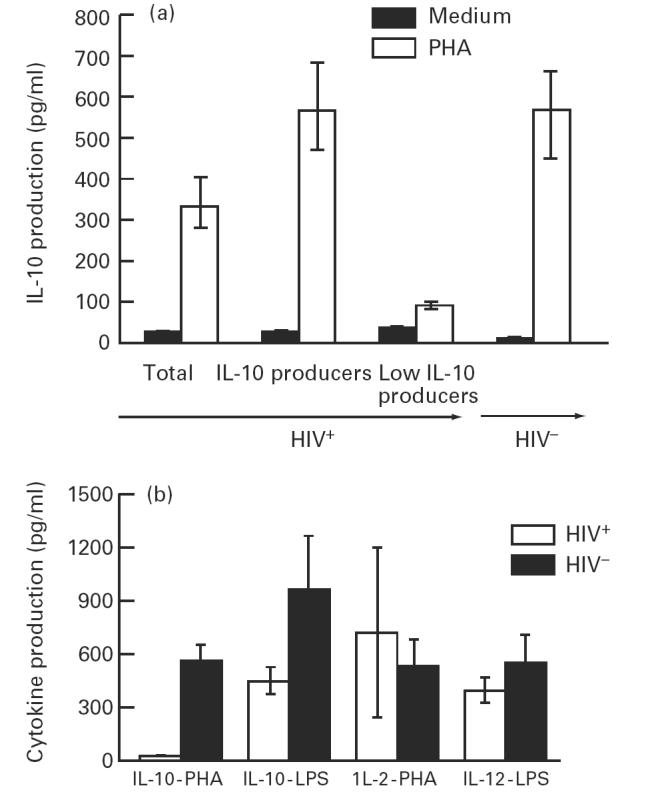
Fig. 1
Fig. 1
(a). Production of IL-10 by phytohaemagglutinin (PHA)-stimulated peripheral blood mononuclear cells (PBMC) from HIV+ and HIV individuals. PBMC from 37 HIV+ and 16 HIV individuals were cultured at a concentration of 2 × 10⁶/ml for 48 h with PHA (1:50 final dilution) and supernatants were collected and assayed for IL-10 production by ELISA. IL-10 levels are reported as pg/ml (mean ± s.e.m.). PBMC from HIV+ individuals were stratified into low IL-10 producers (IL-10 stimulation index (SI) < 4) and IL-10 producers (IL-10 SI > 4). (b) Production of IL-2, IL-10 and IL-12 by PBMC from HIV+ low IL-10 producers and HIV normal controls. PBMC from 15 HIV+ low IL-10 producers were stimulated with PHA and analysed for IL-10 (IL-10-PHA) and IL-2 production (IL-2-PHA). PBMC from these patients were also stimulated with lipopolysaccharide (LPS) (1 μg/ml) and analysed for IL-10 (IL-10-LPS) and IL-12 (IL-12-LPS) production. The levels of IL-2, IL-10, and IL-12 are reported as pg/ml (mean ± s.e.m.).
Fig. 2
Fig. 2
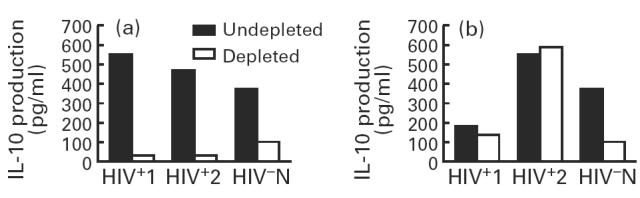
Effect of monocyte (a) and T cell (b) depletion from peripheral blood mononuclear cells (PBMC) of HIV+ and HIV individuals on IL-10 production following stimulation with phytohaemagglutinin (PHA). PBMC from six HIV+ and six HIV individuals were depleted of either T cells or monocytes by using anti-CD2 conjugated immunobeads and by l-leucine-methyl ester (L-LME) treatment, respectively. The depleted and undepleted PBMC were stimulated with PHA for 2 days and supernatants were analysed for IL-10 production by ELISA. The results from two representative HIV+ and one HIV individual are shown.
Fig. 3
Fig. 3
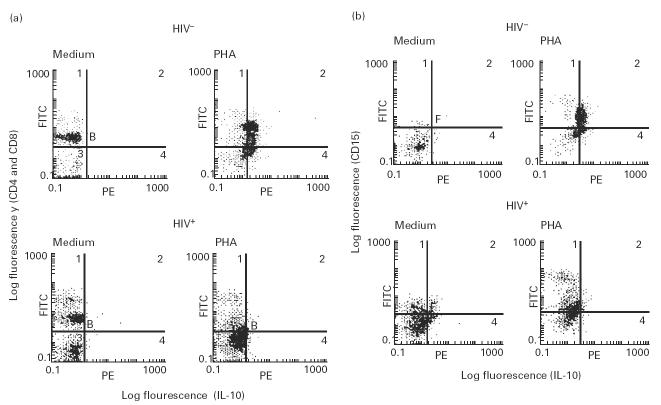
Analysis of IL-10 expression by T cells and monocytes of HIV+ and HIV individuals by intracellular staining. Peripheral blood mononuclear cells (PBMC) (2 × 10⁶ cells/ml) from six HIV+ and five HIV individuals were stimulated with phytohaemagglutinin (PHA) for 36 h and analysed for IL-10 production at the single-cell level by intracellular staining using three-colour flow cytometry as described in Materials and Methods. CD4+ and CD8+ T cells (stained with Quantum Red-labelled anti-CD4 and anti-CD8 antibodies) and CD15+ monocytes (stained with FITC-labelled anti-CD15 antibodies) were analysed for IL-10 expression (counter-stained with PE-labelled anti-IL-10 antibodies). Results of IL-10 expression by CD4+ and CD8+ T cells (a) and CD15+ monocytes (b) of one representative HIV+ and HIV individual are shown. Medium and PHA indicate unstimulated and PHA-stimulated cells, respectively. Unstimulated cells were also stained with isotype-matched antibody of irrelevant specificity and exhibited similar patterns of staining as for PHA-stimulated cells (data not shown).
Fig. 4
Fig. 4
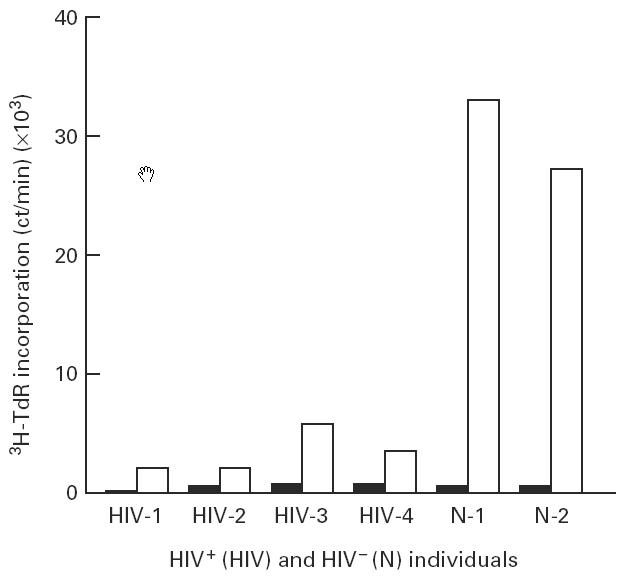
Proliferative response of CD4+ mononuclear cells (CD4+ T cells and monocytes) from peripheral blood mononuclear cells (PBMC) of HIV+ and HIV individuals in response to suboptimal concentrations of phytohaemagglutinin (PHA) and anti-CD28 antibodies. CD4+ cells from PBMC of four HIV+ (HIV-1 to HIV-4) and two HIV (N-1 and N-2) individuals were stimulated with a suboptimal concentration of PHA (1:200 final dilution) and anti-CD28 antibodies (1:100 final dilution) followed by measurement of cell proliferation by 3H-thymidine incorporation. ▪, Cells stimulated with a suboptimal concentration of PHA alone; □, cells stimulated with a suboptimal concentration of PHA and anti-CD28 antibodies.
Fig. 5
Fig. 5
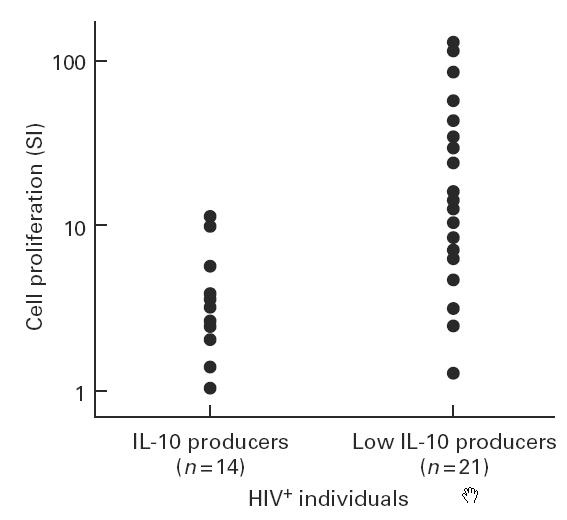
Correlation of IL-10 production by phytohaemagglutinin (PHA)-stimulated peripheral blood mononuclear cells (PBMC) from HIV+ low IL-10 producers and IL-10 producers with proliferative responses of CD4+ mononuclear cells to anti-CD28 antibodies and PHA. CD4+ mononuclear cells (2 × 10⁴/ml) from HIV+ individuals were stimulated with suboptimal concentrations of PHA and anti-CD28 antibodies and cell proliferation was measured as described in the legend to Fig. 6. PBMC from the same HIV-infected individuals were simultaneously stimulated with PHA (1:50 final dilution) for 48 h and supernatants were analysed for IL-10 production. The cell proliferation stimulation index (SI; ratio of 3H-thymidine incorporation in the presence of PHA and anti-CD28 antibodies to that observed in the presence of PHA alone) was correlated with the levels of IL-10 SI (ratio of the levels of IL-10 produced following stimulation with PHA to that produced by unstimulated PBMC) in low IL-10 producers (IL-10 SI < 4) and IL-10 producers (IL-10 SI > 4).
Fig. 6
Fig. 6
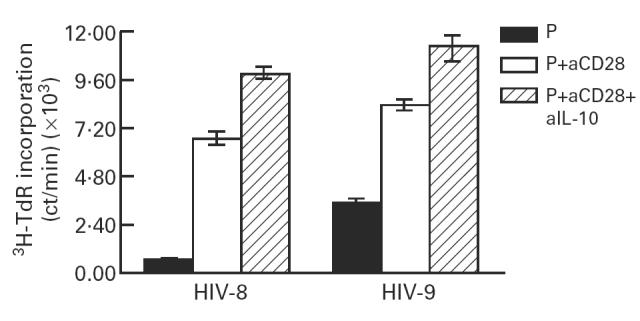
Effect of anti-IL-10 antibodies on the CD28-induced proliferative responses of CD4+ mononuclear cells. CD4+ mononuclear cells from HIV+ low IL-10 producers were stimulated with suboptimal concentrations of phytohaemagglutinin (PHA) and anti-CD28 antibodies in the presence of anti-IL-10 antibodies (10 μg/ml). Cells were pulsed with 3H-thymidine after 48 h of culture followed by measurement of 3H-thymidine incorporation 16 h later. Results from two representative HIV+ individuals are shown.

References

    1. Fauci AS. Host factors and the pathogenesis of HIV-induced disease. Nature. 1996;384:529–34. - PubMed
    1. Levy JA. Pathogenesis of human immunodeficiency virus infection. Microbiol Rev. 1993;57:183–289. - PMC - PubMed
    1. Giorgi JV, Fahey JL, Smith DC, Hultin LE, Cheng HL, Mitsuyasu RT, Detels R. Early effects of HIV on CD4 lymphocytes in vivo. J Immunol. 1987;138:3725–30. - PubMed
    1. Clerici M, Herkin FT, Venzon DJ, Blatt S, Hendrix GW, Wynn T, Shearer GM. Changes in interleukin-2 and interleukin-4 production in asymptomatic, human immunodeficiency virus-seropositive individuals. J Clin Invest. 1993;91:789–95. - PMC - PubMed
    1. Clerici M, Stocks NI, Zajac RA, Boswell RN, Lucey DR, Via CS, Shearer GM. Detection of three distinct patterns of T helper cell dysfunction in asymptomatic, human immunodeficiency virus-seropositive patients. Independence of CD4+ cell numbers and clinical staging. J Clin Invest. 1989;84:1892–9. - PMC - PubMed

Publication types