Population pharmacokinetics of gentamicin in patients with cancer
- PMID: 9764963
- PMCID: PMC1873687
- DOI: 10.1046/j.1365-2125.1998.00779.x
Population pharmacokinetics of gentamicin in patients with cancer
Abstract
Aims: The purpose of this study was to describe the population pharmacokinetics of gentamicin in patients with cancer, to identify possible relationships between clinical covariates and population pharmacokinetic parameter estimates and to examine the relevance of existing dosage nomograms in light of the population model developed in these patients.
Methods: Data were collected prospectively from 210 patients with cancer and were analysed with package NONMEM. Data were split into two sets: a population data set and an evaluation set. Creatinine clearance was estimated using measured creatinine concentrations and using 'low' creatinines set to a minimum of 60 micromol l(-1), 70 micromol l(-1) or 88.4 micromol l(-1)
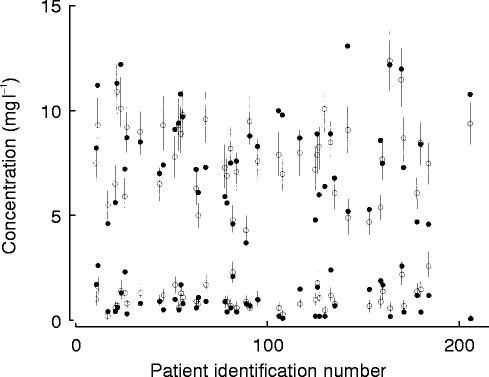
Results: A two compartment model was fitted to the concentration-time curve. Two best models were obtained, one that related clearance to estimated creatinine clearance (minimum creatinine value 60 micromol l(-1)) and the other that related clearance to age, creatinine concentration and body surface area. Volume of the central compartment was influenced by body surface area and albumin concentration. For both models 90% of measured concentrations lay within the 95% confidence interval of the simulated concentrations and the mean prediction errors were -7.2% and -6.6%, respectively. A final analysis performed in all patients identified the following relationship CL (1 h(-1))=0.88 x (1 + 0.043 x creatinine clearance) and central volume of distribution V1 (1)=8.59 x body surface area x (albumin/34)(-0.39). The mean population estimate of intercompartmental clearance (Q) was 1.301 h(-1) and peripheral volume of distribution (V2) was 9.801. Coefficient of variation was 18.5% on clearance and 28.2% on Q. Residual error expressed as a standard deviation was 0.36 mg l(-1) at 1.0 mg l(-1) and 1.32 mg l(-1) at 8.0 mg l(-1). The mean population estimate of clearance was 4.21 h(-1) and volume of distribution (Vss) was 24.61 (0.381 kg(-1)). The mean population estimates of half-lives were 1.8 h and 8.0 h.
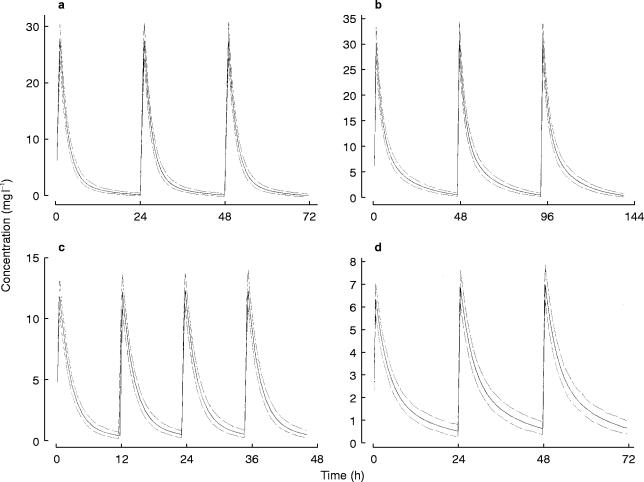
Conclusions: In the context of published nomograms this analysis indicated that both the traditional approach and the new, 'once daily' approach should achieve satisfactory concentrations in cancer patients although serum concentration monitoring is required to confirm optimal dosing in individual patients.
Figures
References
-
- International Antimicrobial Therapy Cooperative Group of the European Organization for Research and Treatment of Cancer. Efficacy and toxicity of single daily doses of amikacin and ceftriaxone versus multiple daily doses of amikacin and ceftazidime for infection in patients with cancer and granulocytopenia. Ann Intern Med. 1993;119:584–593. - PubMed
-
- Moore RD, Lietman P, Smith CR. Clinical response to aminoglycoside therapy: Importance of the ratio of peak concentration to minimal inhibitory concentration. J Infect Dis. 1987;155:93–99. - PubMed
-
- Manny RP, Huston PR. Aminoglycoside volume of distribution in hematology-oncology patients. Clin Pharm. 1986;5:629–632. - PubMed
-
- Higa GM, Murray WE. Alterations in aminoglycoside pharmacokinetics in patients with cancer. Clin Pharm. 1987;6:963–966. - PubMed
Publication types
MeSH terms
Substances
LinkOut - more resources
Full Text Sources
Medical