. 1998 Nov;72(11):8756-64.
doi: 10.1128/JVI.72.11.8756-8764.1998.

Three of the four nucleocapsid proteins of Marburg virus, NP, VP35, and L, are sufficient to mediate replication and transcription of Marburg virus-specific monocistronic minigenomes

Affiliations

Three of the four nucleocapsid proteins of Marburg virus, NP, VP35, and L, are sufficient to mediate replication and transcription of Marburg virus-specific monocistronic minigenomes

E Mühlberger et al. J Virol. 1998 Nov.

Abstract

This paper describes the first reconstituted replication system established for a member of the Filoviridae, Marburg virus (MBGV). MBGV minigenomes containing the leader and trailer regions of the MBGV genome and the chloramphenicol acetyltransferase (CAT) gene were constructed. In MBGV-infected cells, these minigenomes were replicated and encapsidated and could be passaged. Unlike most other members of the order Mononegavirales, filoviruses possess four proteins presumed to be components of the nucleocapsid (NP, VP35, VP30, and L). To determine the protein requirements for replication and transcription, a reverse genetic system was established for MBGV based on the vaccinia virus T7 expression system. Northern blot analysis of viral RNA revealed that three nucleocapsid proteins (NP, VP35, and L) were essential and sufficient for transcription as well as replication and encapsidation. These data indicate that VP35, rather than VP30, is the functional homologue of rhabdo- and paramyxovirus P proteins. The reconstituted replication system was profoundly affected by the NP-to-VP35 expression ratio. To investigate whether CAT gene expression was achieved entirely by mRNA or in part by full-length plus-strand minigenomes, a copy-back minireplicon containing the CAT gene but lacking MBGV-specific transcriptional start sites was employed in the artificial replication system. This construct was replicated without accompanying CAT activity. It was concluded that the CAT activity reflected MBGV-specific transcription and not replication.


Figures

FIG. 1
FIG. 1
Construction of artificial defective RNAs of MBGV. The minigenomes were inserted in transcription vector 2,0 (gray) between the T7 RNA polymerase promoter and the hepatitis delta virus ribozyme (hatched). For in vitro transcription, plasmids were linearized by using the SalI restriction site (right side). (A) Diagram of negative-sense minigenomic cDNA 215, consisting of 439 nt of the 5′ trailer (white) adjacent to the T7 RNA polymerase promoter, 668 nt of the CAT gene in a negative-sense orientation (black), and 106 nt of the 3′ leader (white) adjacent to the ribozyme. Above the scheme are indicated the boundary between the T7 RNA polymerase promoter sequence (underlined) and the 5′ end of the minigenome (negative-sense orientation) (left side) and the boundary between the ribozyme sequence (underlined) and the 3′ end of the minigenome (right side). The CAT gene is flanked by NotI and NdeI restriction sites. (B) Diagram of positive-sense minigenomic cDNA 2.1-CAT, consisting of 106 nt of the 3′ leader (white) adjacent to the T7 RNA polymerase promoter, the CAT gene in a positive-sense orientation (black), and 439 nt of the 5′ trailer adjacent to the ribozyme sequence (white). The boundaries between the T7 RNA polymerase promoter and the ribozyme sequence (underlined), respectively, and the MBGV-specific sequences are indicated. MBGV-specific sequences are shown in the plus-strand orientation. The CAT gene is flanked by NotI restriction sites. (C) Diagram of the cDNA coding for the copy-back-type negative-stranded minigenome cb-CAT. The minigenome consists of 439 nt of the 5′ trailer (white) adjacent to the T7 RNA polymerase promoter, the CAT gene in a negative-sense orientation (black), and, adjacent to the ribozyme sequence, 105 nt complementary to the last 105 nt of the trailer (designated as c-trailer; white), which serves as the leader region. The boundaries between the T7 RNA polymerase promoter and the ribozyme sequence (underlined), respectively, and the MBGV-specific sequences are indicated. MBGV-specific sequences are shown in the negative-sense orientation. The CAT gene is flanked by NotI and NdeI restriction sites. TC start, transcription start site of the NP gene, spanning nt 49 to 60 of the leader region; TC stop, transcription stop site of the L gene, spanning nt 353 to 363 of the trailer region (27). Transcription start and stop sites are indicated only for negative-stranded minigenomes. The cleavage site of the ribozyme is symbolized by a pair of scissors.
FIG. 2
FIG. 2
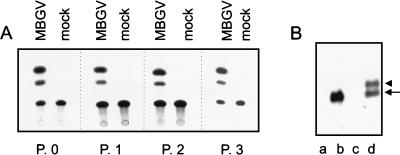
Rescue of minigenomic RNA in MBGV-infected cells. (A) Supernatants of MBGV- or mock-infected E6 cells (mock) that were transfected with the negative-sense RNA 215 were serially passaged to fresh E6 cells. At 5 days p.i., the cells were harvested and assayed for CAT activity. The number of passages is designated as P.0 (transfection) to P.3 (third passage). (B) E6 cells were infected with MBGV (lane a) or with serially passaged MBGV (P.3) containing artificial defective RNA particles 215 (lane b) or were not infected (lane c). At 5 days p.i., total cellular RNA was isolated and subjected to Northern blot analysis. As the probe, a digoxigenin-labeled positive-sense riboprobe DIG-2.1-CAT was used. As a control, in vitro-transcribed RNA 215 was separated on the gel (lane d). The arrowhead marks the position of uncleaved RNA 215 containing the ribozyme; the arrow marks the position of cleaved RNA 215 after removal of the ribozyme.
FIG. 3
FIG. 3
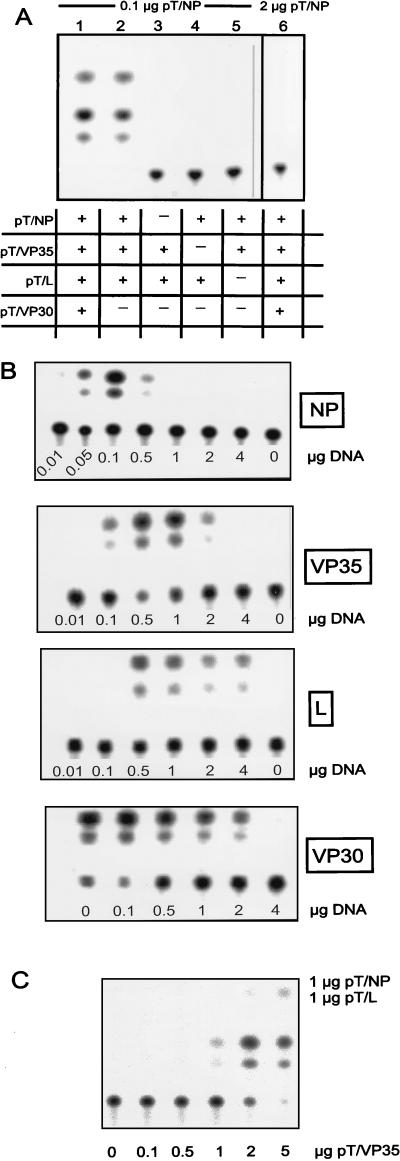
Reporter gene expression in cells transfected with plasmids encoding MBGV nucleocapsid proteins and transfected with negative-sense MBGV-specific minigenome 215. HeLa cells were infected with MVA-T7, transfected with pT/NP, pT/VP35, pT/L, and/or pT/VP30, and subsequently transfected with RNA 215. At 3 days p.i., cells were lysed, CAT activity was determined and acetylated products were separated by thin-layer chromatography. (A) DNA transfection was performed with 0.1 (lanes 1 to 5) or 2 (lane 6) μg of pT/NP, 0.5 μg of pT/VP35, 1 μg of pT/L, and/or 0.5 μg of pT/VP30 as indicated. (B) Titration of plasmids encoding the different nucleocapsid proteins. Titration experiments were performed with fixed amounts of three of the plasmids encoding nucleocapsid proteins (pT/NP, 0.1 μg; pT/VP35, 0.5 μg; pT/L, 1 μg; pT/VP30, 0.5 μg) and various amounts of one of the plasmids as indicated at the right side of each panel. (C) Titration of pT/VP35 at large amounts of NP input DNA. DNA transfection was performed with 1 μg of pT/NP, 1 μg of pT/L, and various amounts of pT/VP35 as indicated.
FIG. 4
FIG. 4
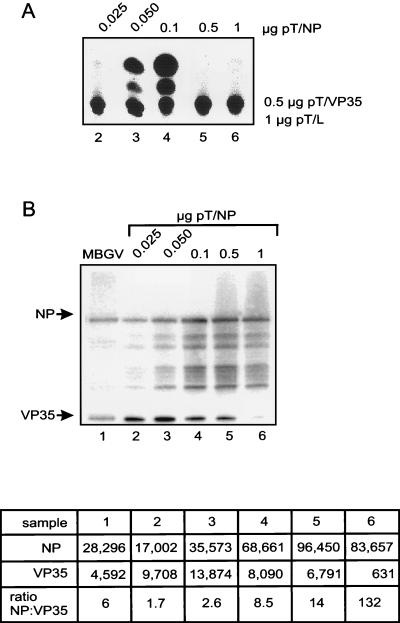
Determination of the NP/VP35 ratio. HeLa cells seated in 7-cm2 wells were infected with MVA-T7 and transfected with 0.5 μg of pT/VP35, 1 μg of pT/L, and various amounts of pT/NP as indicated. At 3.5 h after DNA transfection, cells were transfected with RNA 215. After incubation at 37°C overnight, the cells were harvested. Cell lysates were split and subjected to CAT assay and Western blot analysis. (A) CAT assay performed with 50% of each lysate. (B) Western blot analysis. Lysates corresponding to 3 × 10⁴ cells (lanes 2 to 6) and a lysate of MBGV-infected E6 cells (lane 1) were analyzed by Western blotting with monoclonal antibodies directed against NP (dilution, 1:10,000) and VP35 (dilution, 1:40,000). Chemiluminescence signals specific for NP and VP35 expression were quantified (given in relative densitometer units), and the NP/VP35 ratio was determined (table at bottom). For quantification of NP, degradation products were included. The antibody concentration was adjusted so that the chemiluminescence signals received could be quantitatively evaluated. The signal strength ratios therefore do not necessarily reflect the actual protein ratios.
FIG. 5
FIG. 5
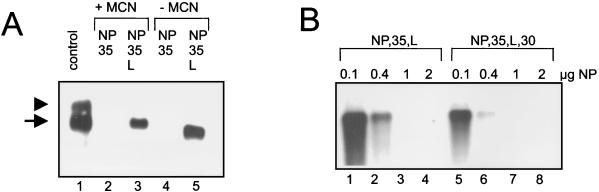
Replication of MBGV-specific positive-sense minigenome 2.1-CAT. (A) HeLa cells were infected with MVA-T7 and transfected with 0.1 μg of pT/NP, 0.5 μg of pT/VP35, 1 μg of pT/L, and 0.5 μg of plasmid DNA 2.1-CAT (lanes 3 and 5). As a negative control, pT/L was omitted (lanes 2 and 4). At 2 days p.i., the cells were lysed and the lysates were either treated with MCN (+) (lanes 2 and 3) or were not treated (−) (lanes 4 and 5). Then, total RNA was isolated and subjected to Northern hybridization, using the positive-sense digoxigenin-labeled riboprobe DIG-2.1-CAT. As a control, in vitro-transcribed negative-sense RNA 215 was used. The arrowhead indicates uncleaved RNA 215 containing ribozyme; the arrow indicates cleaved RNA 215. (B) HeLa cells were infected with MVA-T7 and transfected with various amounts of pT/NP as indicated, along with 0.5 μg of pT/VP35, 1 μg of pT/L, and 0.5 μg of plasmid DNA 2.1-CAT, without (lanes 1 to 4) or with (lanes 5 to 8) 0.5 μg of pT/VP30. At 2 days p.i., cells were lysed and treated with MCN. Total cellular RNA was isolated and subjected to Northern hybridization with the positive-sense digoxigenin-labeled riboprobe DIG-2.1-CAT.
FIG. 6
FIG. 6
Transcription of MBGV-specific negative-sense minigenome 215term. HeLa cells were infected with MVA-T7 and transfected with 0.1 μg of pT/NP, 0.5 μg of pT/VP35, either 25 ng of pT/VP30 (lanes 2 and 6) or 500 ng of pT/VP30 (lanes 1 and 5), 2 μg of plasmid DNA 215term, and 1 μg of pT/L. As a negative control, pT/L was omitted (lanes 4 and 8). At 2 days p.i., the cells were lysed and either treated with MCN (+) or not treated (−). Total cellular RNA was isolated and subjected to oligo(dT) purification. Northern blot analysis was performed with the negative-sense digoxigenin-labeled riboprobe DIG-BS/CAT. The blot exposure time was 30 s (A) or 30 min (B). unbound, RNA fraction which did not bind to oligo(dT) cellulose; bound, RNA fraction that bound to oligo(dT) cellulose; 25, 25 ng of pT/VP30; 500, 500 ng of pT/VP30. The arrows indicate the position of the replicated and transcribed RNA.
FIG. 7
FIG. 7
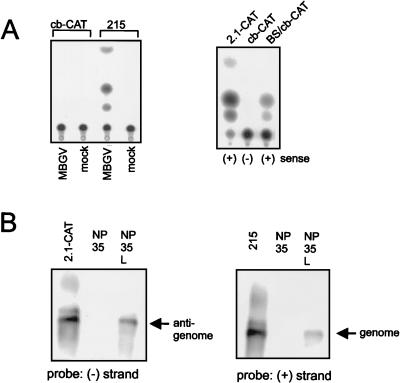
CAT gene expression reflects transcription. (A) Determination of CAT gene expression of cells transfected with copy-back RNA cb-CAT. Left panel: uninfected (mock) or MBGV-infected E6 cells were transfected with RNA cb-CAT or RNA 215. At 3 days p.i., cells were lysed and CAT activity was determined. Right panel: HeLa cells were infected with MVA-T7 and transfected with in vitro-transcribed positive-sense RNA 2.1-CAT, negative-sense RNA cb-CAT, or positive-sense RNA BS/cb-CAT. At 24 h p.i., the cells were lysed and assayed for CAT activity. (B) Replication of copy-back minigenome cb-CAT. HeLa cells were infected with MVA-T7 and transfected with 0.1 μg of pT/NP, 0.5 μg of pT/35, 1 μg of pT/L, and 0.5 μg of plasmid DNA cb-CAT (lanes NP/35/L). As a negative control, pT/L was omitted (lanes NP/35). At 2 days p.i., the cells were lysed and treated with MCN. Duplicate Northern blots were prepared from total cellular RNA, with either in vitro-transcribed positive-sense RNA 2.1-CAT (left panel) or in vitro-transcribed negative-sense RNA 215 (right panel) as a control. Both blots were subjected to Northern hybridization, using either the negative-sense digoxigenin-labeled riboprobe DIG-BS/CAT (left panel) or the positive-sense digoxigenin-labeled riboprobe DIG-2.1-CAT (right panel). The positive-stranded antigenome and the negative-stranded genome are marked by arrows.

References

    1. Becker, S., C. Rinne, U. Hofsäss, H.-D. Klenk, and E. Mühlberger. Interaction of Marburg virus nucleocapsid proteins. Virology, in press. - PubMed
    1. Becker S, Klenk H-D, Mühlberger E. Intracellular transport and processing of the Marburg virus surface protein in vertebrate and insect cells. Virology. 1996;225:145–155. - PubMed
    1. Becker S, Huppertz S, Klenk H-D, Feldmann H. The nucleoprotein of Marburg virus is phosphorylated. J Gen Virol. 1994;75:809–818. - PubMed
    1. Buchholz C J, Spehner D, Drillien R, Neubert W J, Homann H E. The conserved N-terminal region of Sendai virus nucleocapsid protein NP is required for nucleocapsid assembly. J Virol. 1993;67:5803–5812. - PMC - PubMed
    1. Bukreyev A A, Volchkov V E, Blinov V M, Dryga S A, Netesov S V. The complete nucleotide sequence of the Popp (1967) strain of Marburg virus: a comparison with the Musoke (1980) strain. Arch Virol. 1995;140:1589–1600. - PubMed

Publication types

LinkOut - more resources