. 1998 Nov;72(11):9217-23.
doi: 10.1128/JVI.72.11.9217-9223.1998.

The 5' and 3' TAR elements of human immunodeficiency virus exert effects at several points in the virus life cycle

Affiliations

The 5' and 3' TAR elements of human immunodeficiency virus exert effects at several points in the virus life cycle

A T Das et al. J Virol. 1998 Nov.

Abstract

The human immunodeficiency virus type 1 RNA genome contains a terminal repeat (R) sequence that encodes the TAR hairpin motif, which has been implicated in Tat-mediated activation of transcription. More recently, a variety of other functions have been proposed for this structured RNA element. To determine the replicative roles of the 5' and 3' TAR hairpins, we analyzed multiple steps in the life cycle of wild-type and mutant viruses. A structure-destabilizing mutation was introduced in either the 5', the 3', or both TAR motifs of the proviral genome. As expected, opening of the 5' TAR hairpin caused a transcription defect. Because the level of protein expression was not similarly reduced, the translation of this mRNA was improved. No effect of the 3' hairpin on transcription and translation was measured. Mutations of the 5' and 3' hairpin structures reduced the efficiency of RNA packaging to similar extents, and RNA packaging was further reduced in the 5' and 3' TAR double mutant. Upon infection of cells with these virions, a reduced amount of reverse transcription products was synthesized by the TAR mutant. However, no net reverse transcription defect was observed after correction for the reduced level of virion RNA. This result was confirmed in in vitro reverse transcription assays. These data indicate that the 5' and 3' TAR motifs play important roles in several steps of the replication cycle, but these structures have no significant effect on the mechanism of reverse transcription.


Figures
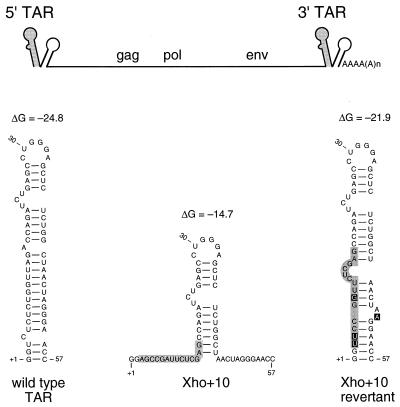
FIG. 1
FIG. 1
HIV-1 genomes with 5′ and 3′ TAR mutations. The upper schematic shows HIV-1 genomic RNA with a tandem hairpin motif encoded by the R region. The upstream hairpin is TAR (shaded); the downstream structure is the poly(A) hairpin motif (24). RNA secondary-structure predictions for the wild-type, Xho+10 mutant, and revertant TAR elements are shown below. The free energy for each structure was calculated with the Zuker algorithm (61) and is given in kilocalories per mole. The mutated region of TAR is shaded, and additional mutations in the revertant are boxed. Nucleotide numbers are relative to the RNA start site at +1.
FIG. 2
FIG. 2
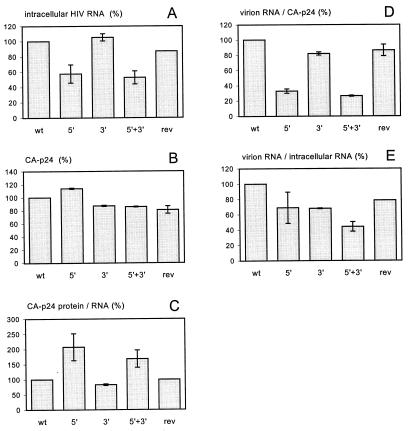
Analysis of wild-type, mutant, and revertant TAR constructs. C33A cells were transfected with the proviral constructs, and the intracellular HIV-1 RNA was quantitated by dot blot analysis (A). Virus production was measured in the culture supernatant by CA p24 ELISA (B). These values were used to calculate translational efficiency (C). Virion RNA levels were measured and compared either with the CA p24 values (D) or with the intracellular HIV-1 RNA levels (E). The former value represents the virion RNA content; the latter value represents the RNA packaging efficiency. All parameters were arbitrarily set at 100% for the wild-type HIV-1 construct. Standard errors were calculated for independent transfections (except for the TAR revertant in some panels). For panels C, D, and E, we first calculated the ratio per independent experiment and next calculated the mean value and standard error. wt, wild-type construct; 5′, 5′ TAR mutant, 3′, 3′ TAR mutant; 5′ + 3′, 5′ + 3′ TAR double mutant; rev, revertant construct (see the text).
FIG. 3
FIG. 3
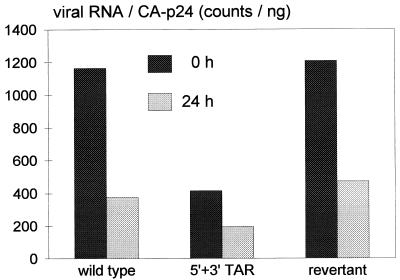
Stability of TAR-mutated RNA within virions. Wild-type, mutant (5′ + 3′ TAR), and revertant constructs were used to produce virions in transfected C33A cells. Virus particles produced between 48 and 64 h after transfection were harvested, and RNA was quantitated either directly (0-h sample) or after incubation of the virions for 24 h at 37°C in RPMI medium. The data are absolute PhosphorImager counts divided by the CA p24 levels.
FIG. 4
FIG. 4
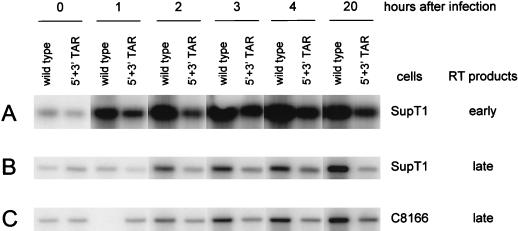
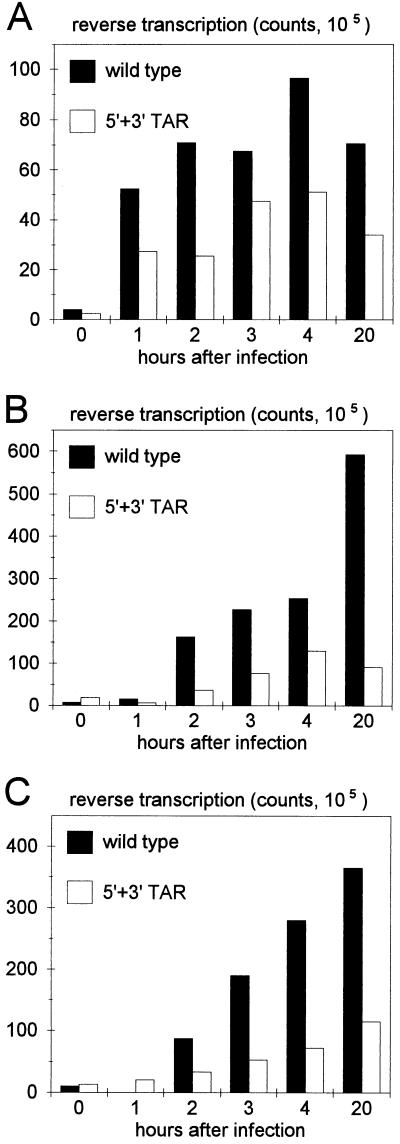
Reverse transcription of TAR-mutated viral transcripts in infected cells. Wild-type and 5′ + 3′ TAR mutant virus stocks (normalized by CA p24 levels) were used to infect SupT1 cells (A and B) or C8166 cells (C). Cell samples were harvested at the times indicated. Total cellular DNA was extracted, and HIV-1 cDNA was PCR amplified with primers that detect early or late DNA products of reverse transcription. PCR products were visualized on a Southern blot probed with a 32P-labeled HIV-1 fragment. Hybridization signals were quantitated with a PhosphorImager and are presented in Fig. 5. The same PCR protocol was performed on various amounts of the pLAI HIV-1 plasmid to check that the amplification was performed within the linear range.
FIG. 5
FIG. 5
Normal reverse transcription efficiency of TAR-mutated viral transcripts. See the legend to Fig. 4 for details.
FIG. 6
FIG. 6
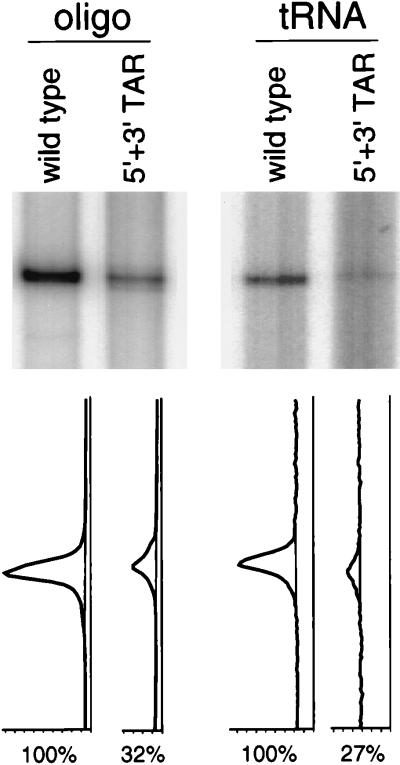
In vitro reverse transcription assays with the TAR-mutated transcript. The RNA genomes of the wild-type and 5′ + 3′ TAR mutant virus stocks (normalized by CA p24 levels) were phenol extracted and analyzed in vitro. Reverse transcription from the associated tRNA3Lys primer was initiated by addition of RT and deoxynucleoside triphosphates. In the oligonucleotide-primed reaction, an exogenous DNA-oligonucleotide primer was annealed to the virion RNA and extended by reverse transcription. The oligonucleotide-primed and tRNA extension signals were analyzed with a PhosphorImager, and their profiles are shown below. The relative level of cDNA production was set at 100% for the wild-type template in both primer extension assays.

References

    1. Aiyar A, Cobrinik D, Ge Z, Kung H J, Leis J. Interaction between retroviral U5 RNA and the TYC loop of the tRNATrp primer is required for efficient initiation of reverse transcription. J Virol. 1992;66:2464–2472. - PMC - PubMed
    1. Aldovini A, Young R A. Mutations of RNA and protein sequences involved in human immunodeficiency virus type 1 packaging results in production of noninfectious virus. J Virol. 1990;64:1920–1926. - PMC - PubMed
    1. Arts E J, Li X, Gu Z, Kleiman L, Parniak M A, Wainberg M A. Comparison of deoxyoligonucleotide and tRNA(Lys-3) as primers in an endogenous human immunodeficiency virus-1 in vitro reverse transcription/template-switching reaction. J Biol Chem. 1994;269:14672–14680. - PubMed
    1. Ashe M P, Pearson L H, Proudfoot N J. The HIV-1 5′ LTR poly(A) site is inactivated by U1 snRNP interaction with the downstream major splice donor site. EMBO J. 1997;16:5752–5763. - PMC - PubMed
    1. Auersperg N. Long-term cultivation of hypodiploid human tumor cells. J Natl Cancer Inst. 1964;32:135–163. - PubMed

Publication types