. 1998 Oct;118(2):617-26.
doi: 10.1104/pp.118.2.617.

Purification and characterization of NADP+-linked isocitrate dehydrogenase from scots pine . Evidence for different physiological roles of the enzyme in primary development

Affiliations

Purification and characterization of NADP+-linked isocitrate dehydrogenase from scots pine . Evidence for different physiological roles of the enzyme in primary development

J Palomo et al. Plant Physiol. 1998 Oct.

Abstract

NADP+-isocitrate dehydrogenase (NADP+-IDH; EC 1.1.1.42) is involved in the supply of 2-oxoglutarate for ammonia assimilation and glutamate synthesis in higher plants through the glutamine synthetase/glutamate synthase (GS/GOGAT) cycle. Only one NADP+-IDH form of cytosolic localization was detected in green cotyledons of pine (Pinus spp.) seedlings. The pine enzyme was purified and exhibited molecular and kinetic properties similar to those described for NADP+-IDH from angiosperm, with a higher catalytic efficiency (10(5) M-1 s-1) than the deduced efficiencies for GS and GOGAT in higher plants. A polyclonal antiserum was raised against pine NADP+-IDH and used to assess protein expression in the seedlings. Steady-state levels of NADP+-IDH were coordinated with GS during seed germination and were associated with GS/GOGAT enzymes during chloroplast biogenesis, suggesting that NADP+-IDH is involved in the provision of carbon skeletons for the synthesis of nitrogen-containing molecules. However, a noncoordinated pattern of NADP+-IDH and GS/GOGAT was observed in advanced stages of cotyledon development and in the hypocotyl. A detailed analysis in hypocotyl sections revealed that NADP+-IDH abundance was inversely correlated with the presence of GS, GOGAT, and ribulose-1,5-bisphosphate carboxylase/oxygenase but was associated with the differentiation of the organ. These results cannot be explained by the accepted role of the enzyme in nitrogen assimilation and strongly suggest that NADP+-IDH may have other, as-yet-unknown, biological functions.


Figures
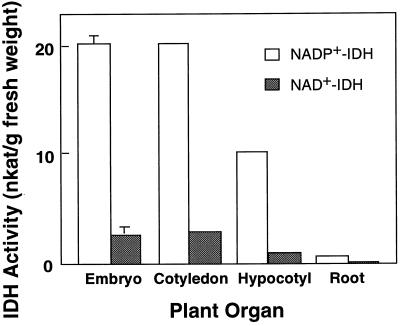
Figure 1
Figure 1
IDH activities in Scots pine seedlings. Values are the means ± se of at least three different experiments. Values of se lower than the thickness of the drawing line are not shown.
Figure 2
Figure 2
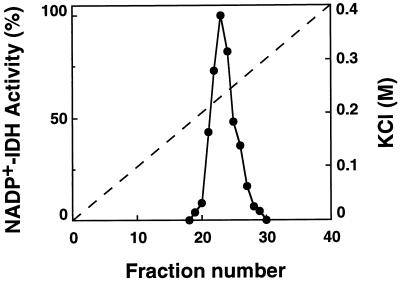
Elution profile of NADP+-IDH activity from pine cotyledon on a DEAE-cellulose column. Enzyme activity is expressed as a percentage of the maximum value. The linear gradient of KCl is shown as a broken line.
Figure 3
Figure 3
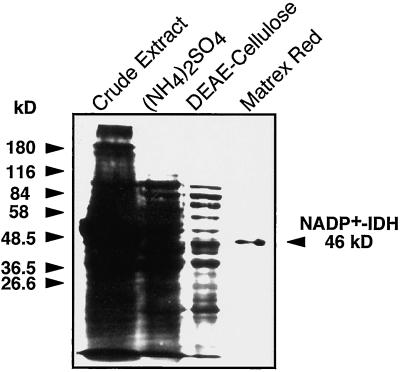
Analysis of polypeptides by SDS-PAGE of the purification steps of NADP+-IDH. Samples with 20, 10, 5, and 0.5 μg of proteins corresponding to the crude extract, ammonium sulfate precipitate, DEAE-cellulose, and Matrex Gel Red A, respectively, were separated by SDS-PAGE and stained with silver. The positions of molecular mass standards are indicated on the left. The migration of the NADP+-IDH subunit is marked on the right.
Figure 4
Figure 4
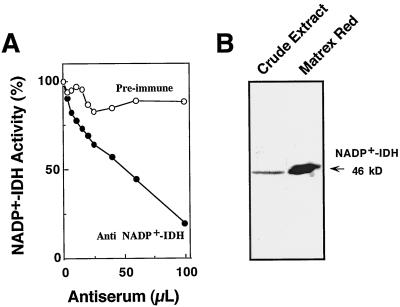
Specificity of the antiserum raised against pine NADP+-IDH. A, Inactivation of NADP+-IDH activity following the addition of the antiserum raised against the purified protein. Aliquots of a crude extract containing 0.16 nkat of enzyme activity were incubated with increasing volumes of the specific antiserum (•) or with a preimmune rabbit serum (○) for 4 h. The immunocomplexes formed were recovered by centrifugation at 20,000g for 5 min at 4°C, and enzyme activity was determined in the supernatant. B, Detection of NADP+-IDH by western analysis. Samples of proteins from a cotyledon extract (20 μg) and the purified preparation (0.5 μg) were subjected to SDS-PAGE, electrotransferred to a nitrocellulose filter, and probed with a 10,000-fold dilution of rabbit anti-NADP+-IDH antibodies. The position and size of the immunoreactive bands are indicated on the right.
Figure 5
Figure 5
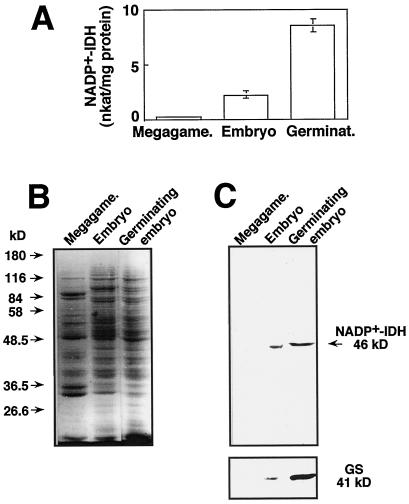
Expression of NADP+-IDH and GS in seeds and in in vitro germinating maritime pine embryos. A, Protein-soluble extracts were prepared from the megagametophyte (Megagame.) and embryos of water-soaked seeds (Embryo) and from in vitro germinating embryos collected upon the first symptoms of development (Germinat.) and the NADP+-IDH was determined. The results are the means ± se of at least three independent experiments. Proteins (20 μg) of the same samples in which enzyme activity was determined were separated by SDS-PAGE and stained with Coomassie blue (B) or blotted onto nitrocellulose filters and probed with the antibodies raised against pine NADP+-IDH or against pine cytosolic GS (C) (Cantón et al., 1996). The migration of protein molecular markers is indicated on the left. The position and size of the immunostained bands are marked on the right.
Figure 6
Figure 6
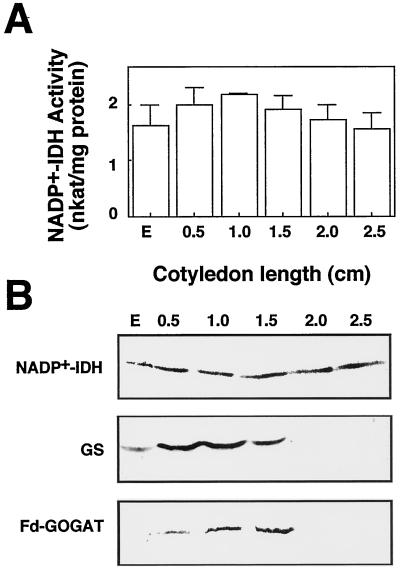
Analysis of NADP+-IDH, GS, and Fd-GOGAT during cotyledon development in Scots pine. A, NADP+-IDH activity quantified in protein extracts prepared from embryos of water-soaked seeds (E) and cotyledons of light- and dark-grown seedlings. The results are the means ± se of at least three independent experiments. B, Samples with 20 μg of proteins corresponding to the same extracts in which enzyme activity was determined were analyzed by western blotting with the antisera raised against pine NADP+-IDH, GS (Cantón et al., 1996), and Fd-GOGAT (García-Gutiérrez et al., 1995). Twenty micrograms of protein was loaded per lane in the gels prepared for the detection of NADP+-IDH and GS polypeptides, and 40 μg of protein was loaded per lane for the analysis of Fd-GOGAT.
Figure 7
Figure 7
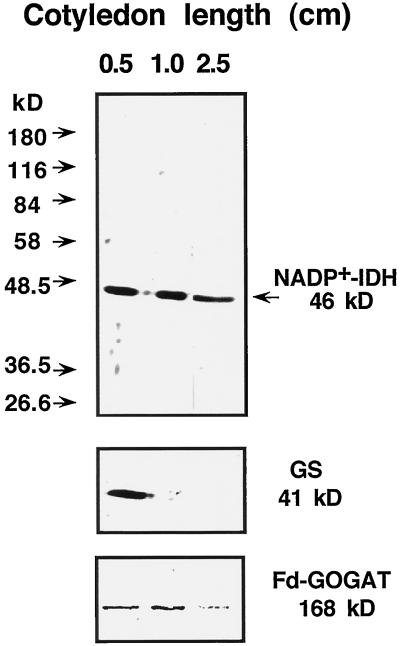
NADP+-IDH, GS, and Fd-GOGAT polypeptides in developing Scots pine hypocotyls. Samples of protein extracts prepared from the whole hypocotyl of seedlings with cotyledons 0.5, 2.0, and 2.5 cm in length were analyzed by western blotting for the detection of NADP+-IDH and GS polypeptides. The migration of protein molecular markers is indicated on the left. The position and size of the immunostained bands are marked on the right. Twenty micrograms of protein was loaded per lane in the gels prepared for the detection of NADP+-IDH and GS polypeptides, and 40 μg of protein was loaded per lane for the analysis of Fd-GOGAT.
Figure 8
Figure 8
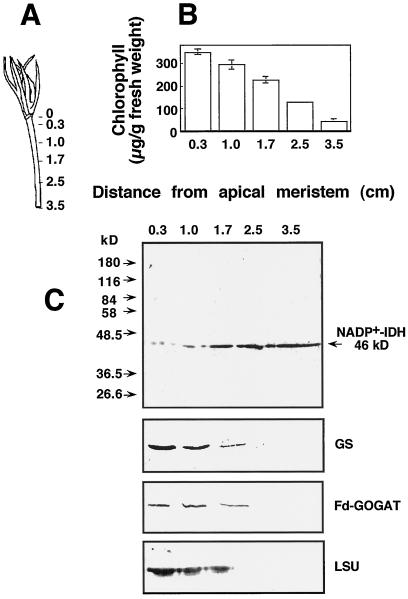
Pattern of NADP+-IDH, GS, Fd-GOGAT, and Rubisco polypeptides in the hypocotyls of pine seedlings. A, Serial dissection of the hypocotyl of a Scots pine seedling with cotyledons 2.5 cm in length. Numbers indicate the distance in centimeters from the apical meristem (the zero value). Total chlorophyll content was determined in the sections (B) and protein extracts were prepared for the analysis of NADP+-IDH, GS, and large subunit of Rubisco (LSU) by western blotting (C). Twenty micrograms of protein was loaded per lane in the gels prepared for the detection of NADP+-IDH and GS polypeptides, 40 μg of protein was loaded per lane for the analysis of Fd-GOGAT, and 5 μg of protein per lane was loaded for the analysis of Rubisco.

References

    1. Ahn JH, Choi Y, Kwon YM, Kim S-G, Choi YD, Lee JS. A novel extensin gene encoding a hydroxyproline-rich glycoprotein requires sucrose for its wound-inducible expression in transgenic plants. Plant Cell. 1996;8:1477–1490. - PMC - PubMed
    1. Bao W, O'Malley DM, Sederoff RR. Wood contains a cell-wall structural protein. Proc Natl Acad Sci USA. 1992;89:6604–6608. - PMC - PubMed
    1. Bradford MM. A rapid and sensitive method for the quantitation of microgram quantities of protein utilizing the principle of protein-dye binding. Anal Biochem. 1976;72:248–254. - PubMed
    1. Bray CM. Nitrogen Metabolism in Plants. London: Longman; 1983.
    1. Canino S, Nieri B, Pistelli L, Alpi A, De Bellis L. NADP+-isocitrate dehydrogenase in germinating cucumber cotyledons: purification and characterization of a cytosolic isoenzyme. Physiol Plant. 1996;98:13–19.

LinkOut - more resources