


Different phenotypic classes of Sinorhizobium meliloti mutants defective in synthesis of K antigen
- PMID: 9765576
- PMCID: PMC107593
- DOI: 10.1128/JB.180.20.5432-5436.1998
Different phenotypic classes of Sinorhizobium meliloti mutants defective in synthesis of K antigen
Abstract
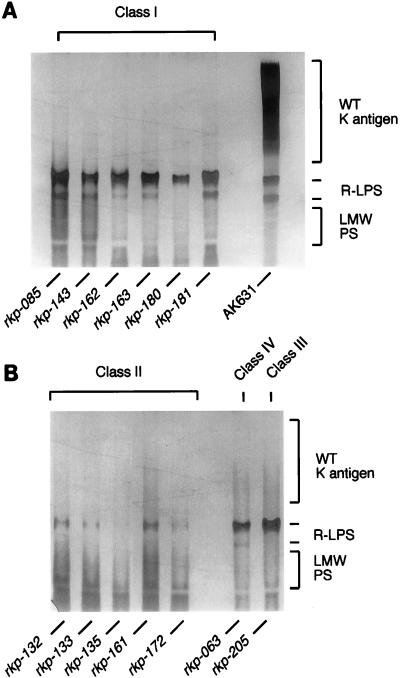
For Sinorhizobium meliloti (also known as Rhizobium meliloti) AK631 to establish effective symbiosis with alfalfa, it must be able to synthesize a symbiotically active form of its K antigen, a capsular polysaccharide containing a Kdo (3-deoxy-D-manno-octulosonic acid) derivative. Previously isolated mutants defective in the synthesis of K antigen are resistant to bacteriophage phi16-3. By screening ca. 100,000 Tn5-mutagenized R. meliloti bacteria for resistance to bacteriophage phi16-3, we isolated 119 mutants, 31 of which could not be complemented by genes previously identified as being required for K-antigen synthesis. Of these 31 new mutants, 13 were symbiotically defective and lacked the K antigen. Through genetic and phenotypic analyses, we have grouped these mutants into four distinct classes. Although all of these mutants lack the K antigen, many also have altered lipopolysaccharides (LPS), suggesting that the biochemical pathways for the synthesis of K antigen and LPS have common enzymatic steps. In addition, we have found that these and other classes of K-antigen-defective mutants of S. meliloti AK631 exhibit unique patterns of sensitivities to phage strains to which the parental strain was resistant. Our studies have identified new classes of genes required for both the synthesis of K antigen and the symbiotic proficiency of S. meliloti AK631. Some of these classes of genes also play a role in LPS synthesis.
Figures
References
-
- Becker A, Rüberg S, Küster H, Roxlau A A, Keller M, Ivashina T, Cheng H-P, Walker G C, Pühler A. The 32-kilobase exp gene cluster of Rhizobium meliloti directing the biosynthesis of galactoglucan: genetic organization and properties of the encoded gene products. J Bacteriol. 1997;179:1375–1384. - PMC - PubMed
-
- Buendia A M, Enenkel B, Köplin R, Niehaus K, Arnold W, Pühler A. The Rhizobium meliloti exoZ/exoB fragment of megaplasmid 2: ExoB functions as a UDP-glucose-4-epimerase and ExoZ shows homology to NodX of Rhizobium leguminosarum biovar viciae strain TOM. Mol Microbiol. 1991;5:1519–1530. - PubMed
-
- Canter-Cremers H C J, Batley M, Redmond J W, Eydems L, Breedveld M W, Zevenhuizen L P T M, Pees E, Wijffelman C J, Lugtenberg B J J. Rhizobium leguminosarum exoB mutants are deficient in the synthesis of UDP-glucose 4-epimerase. J Biol Chem. 1990;265:21122–21127. - PubMed
Publication types
MeSH terms
Substances
Grants and funding
LinkOut - more resources
Full Text Sources
