. 1998 Oct 13;95(21):12317-21.
doi: 10.1073/pnas.95.21.12317.

Normal hepatic glucose production in the absence of GLUT2 reveals an alternative pathway for glucose release from hepatocytes

Affiliations

Normal hepatic glucose production in the absence of GLUT2 reveals an alternative pathway for glucose release from hepatocytes

M T Guillam et al. Proc Natl Acad Sci U S A. .

Abstract

Glucose production by liver is a major physiological function, which is required to prevent development of hypoglycemia in the postprandial and fasted states. The mechanism of glucose release from hepatocytes has not been studied in detail but was assumed instead to depend on facilitated diffusion through the glucose transporter GLUT2. Here, we demonstrate that in the absence of GLUT2 no other transporter isoforms were overexpressed in liver and only marginally significant facilitated diffusion across the hepatocyte plasma membrane was detectable. However, the rate of hepatic glucose output was normal. This was evidenced by (i) the hyperglycemic response to i.p. glucagon injection; (ii) the in vivo measurement of glucose turnover rate; and (iii) the rate of release of neosynthesized glucose from isolated hepatocytes. These observations therefore indicated the existence of an alternative pathway for hepatic glucose output. Using a [14C]-pyruvate pulse-labeling protocol to quantitate neosynthesis and release of [14C]glucose, we demonstrated that this pathway was sensitive to low temperature (12 degreesC). It was not inhibited by cytochalasin B nor by the intracellular traffic inhibitors brefeldin A and monensin but was blocked by progesterone, an inhibitor of cholesterol and caveolae traffic from the endoplasmic reticulum to the plasma membrane. Our observations thus demonstrate that hepatic glucose release does not require the presence of GLUT2 nor of any plasma membrane glucose facilitative diffusion mechanism. This implies the existence of an as yet unsuspected pathway for glucose release that may be based on a membrane traffic mechanism.


Figures
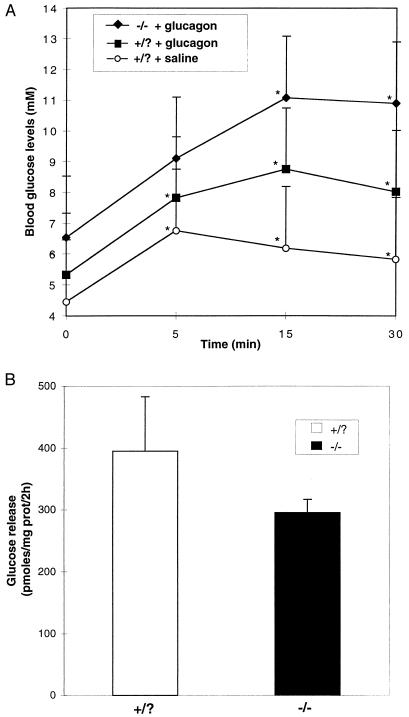
Figure 1
Figure 1
Hepatic glucose output proceeds unimpaired in the absence of GLUT2. (A) Control (+/?) or GLUT2−/− mice were injected i.p. with saline or glucagon and the blood glucose levels were measured at the indicated times. Glucagon induced a marked increase in glycemia in both control and GLUT2−/− mice. Results are expressed as mean ± SEM, n = 4–6. ∗, Different from glycemia at t = 0, P < 0.05. (B) Glucose output from freshly isolated hepatocytes of control (+/?) or GLUT2 −/− mice. Isolated hepatocytes were incubated for 2 hr at 37°C in DMEM without glucose but in the presence of 1 mM pyruvate and 10 mM lactate. The glucose released in the medium was not different between GLUT2−/− and control hepatocytes. The data are the mean ± SEM of nine experiments.
Figure 2
Figure 2
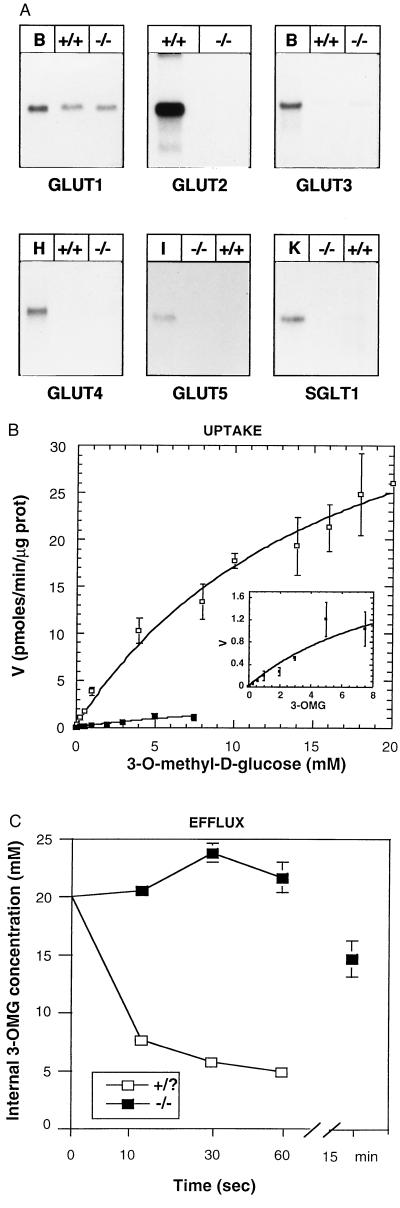
Absence of glucose facilitated diffusion transport mechanism in GLUT2−/− hepatocytes. (A) The expression of glucose transporter isoforms was assessed by Northern blot analysis using 5 μg of twice oligo(dT)-cellulose-selected liver poly(A)+ RNA from control or GLUT2−/− mice. For control tissues, 5 μg of total RNA was used. B, Brain; H, heart; I, intestine; K, kidney. SGLT1, Na+/glucose cotransporter 1. (B) 3OMG uptake by hepatocytes freshly isolated from control (+/?) and GLUT2−/− mice. Uptake by control cells proceeded with high Km (14 mM) and high Vmax (42.6 pmol/μg protein/min). In the absence of GLUT2, Km was 7 mM and Vmax was 1.6 pmol/μg protein/min. (Inset) Kinetics of uptake of GLUT2−/− hepatocytes with an expanded scale. (C) 3OMG efflux from preloaded control (+/?) and GLUT2−/− hepatocytes. Hepatocytes were preloaded with 3-O-methyl-[3H]glucose for 75 min. Efflux was initiated by rapid washing and dilution with cold medium. The data represent the mean ± SEM of three to eight experiments for each time point.
Figure 3
Figure 3
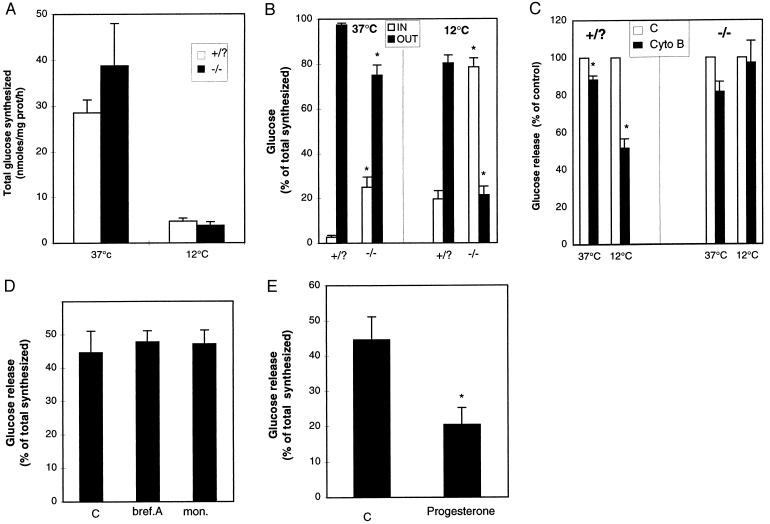
Release of pulse-labeled glucose from control and GLUT2−/− hepatocytes. Isolated hepatocytes were incubated in glucose-free medium containing 1 mM [14C]pyruvate. Newly synthesized [14C]glucose in the cell lysate or culture medium was then separated from gluconeogenic intermediates by ion exchange chromatography. (A) Total neosynthesis of [14C]glucose was similar in both control (+/?) and GLUT2−/− hepatocytes at 37°C or at 12°C. (B) At 37°C the release of glucose from control (+/?) hepatocytes was >95% whereas it was ≈75% in GLUT2−/− hepatocytes. At 12°C, ≈80% of newly synthesized [14C]glucose was released from control hepatocytes. Strikingly however, only 20% of newly synthesized glucose was released from GLUT2−/− hepatocytes. (C) Inhibition of glucose release by cytochalasin B. The release of glucose from control (+/?) hepatocytes pulse-labeled for 1 hr with [14C]pyruvate was not inhibited when the experiment was carried out at 37°C but a ≈50% inhibition was observed at 12°C. No inhibition of glucose release from GLUT2−/− hepatocytes could be observed either at 37°C or 12°C, in agreement with the absence of facilitated diffusion. (D) Glucose release from GLUT2−/− hepatocytes was not sensitive to the intracellular transport inhibitors brefeldin A (5 μg/ml) and monensin (1 μM). Hepatocytes were pulse-labeled for 1 hr with [14C]pyruvate, washed and then chased for 15 min at 37°C. Brefeldin A, monensin or diluent (C) were added 10 min before the end of the pulse and included in the washing and chase solutions. No inhibition of release could be observed. (E) Glucose release from GLUT2−/− hepatocytes pulse labeled as in D could be markedly reduced when the experiments were performed in the presence of progesterone (10 μg/ml). ∗, Significantly different from control with P < 0.05.

References

    1. DeFronzo R A. Diabetes. 1988;37:667–687. - PubMed
    1. DeFronzo R A, Bonadonna R C, Ferrannini E. Diabetes Care. 1992;15:318–368. - PubMed
    1. Pilkis S J, el-Maghrabi M R, Claus T H. Annu Rev Biochem. 1988;57:755–783. - PubMed
    1. Pilkis S J, Granner D K. Annu Rev Physiol. 1992;54:885–909. - PubMed
    1. Burchell A. FASEB J. 1990;4:2978–2988. - PubMed

Publication types

LinkOut - more resources