


Evidence for balancing selection operating at the het-c heterokaryon incompatibility locus in a group of filamentous fungi
- PMID: 9770498
- PMCID: PMC22843
- DOI: 10.1073/pnas.95.21.12398
Evidence for balancing selection operating at the het-c heterokaryon incompatibility locus in a group of filamentous fungi
Abstract
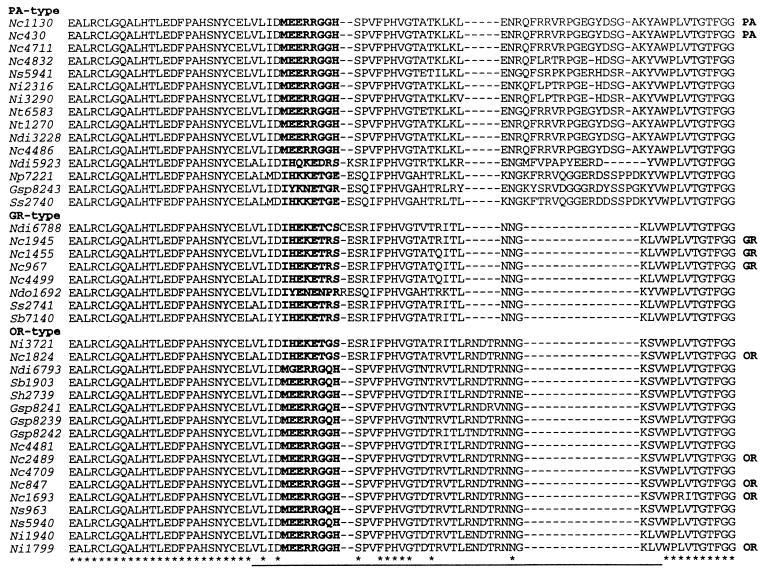
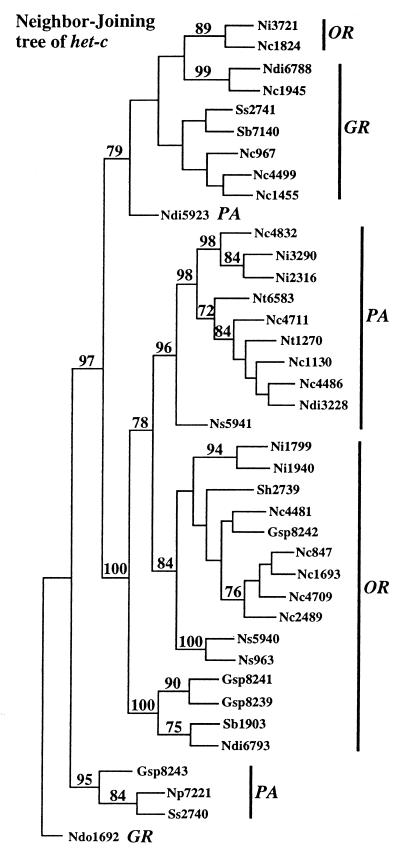
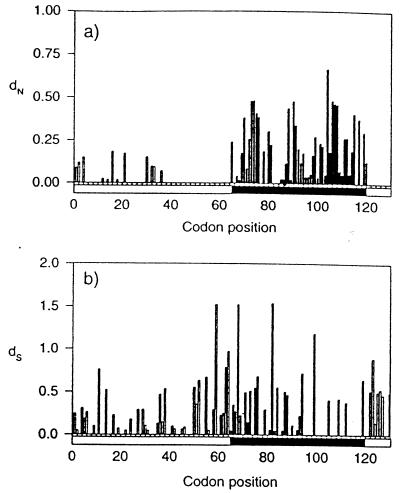
In filamentous fungi, het loci (for heterokaryon incompatibility) are believed to regulate self/nonself-recognition during vegetative growth. As filamentous fungi grow, hyphal fusion occurs within an individual colony to form a network. Hyphal fusion can occur also between different individuals to form a heterokaryon, in which genetically distinct nuclei occupy a common cytoplasm. However, heterokaryotic cells are viable only if the individuals involved have identical alleles at all het loci. One het locus, het-c, has been characterized at the molecular level in Neurospora crassa and encodes a glycine-rich protein. In an effort to understand the role of this locus in filamentous fungi, we chose to study its evolution by analyzing het-c sequence variability in species within Neurospora and related genera. We determined that the het-c locus was polymorphic in a field population of N. crassa with close to equal frequency of each of the three allelic types. Different species and even genera within the Sordariaceae shared het-c polymorphisms, indicating that these polymorphisms originated in an ancestral species. Finally, an analysis of the het-c specificity region shows a high occurrence of nonsynonymous substitution. The persistence of allelic lineages, the nearly equal allelic distribution within populations, and the high frequency of nonsynonymous substitutions in the het-c specificity region suggest that balancing selection has operated to maintain allelic diversity at het-c. Het-c shares this particular evolutionary characteristic of departing from neutrality with other self/nonself-recognition systems such as major histocompatibility complex loci in mammals and the S (self-incompatibility) locus in angiosperms.
Figures
References
-
- Charlesworth D. BioEssays. 1995;17:31–38.
-
- Klein J. Hum Immunol. 1987;19:155–162. - PubMed
Publication types
MeSH terms
Substances
Associated data
- Actions
- Actions
- Actions
- Actions
- Actions
- Actions
- Actions
- Actions
- Actions
- Actions
- Actions
- Actions
- Actions
- Actions
- Actions
- Actions
- Actions
- Actions
- Actions
- Actions
- Actions
- Actions
- Actions
- Actions
- Actions
- Actions
- Actions
- Actions
- Actions
- Actions
LinkOut - more resources
Full Text Sources
Research Materials
