


Effects of cyclical etidronate combined with calcitriol versus cyclical etidronate alone on spine and femoral neck bone mineral density in postmenopausal osteoporotic women
- PMID: 9771208
- PMCID: PMC1752624
- DOI: 10.1136/ard.57.6.346
Effects of cyclical etidronate combined with calcitriol versus cyclical etidronate alone on spine and femoral neck bone mineral density in postmenopausal osteoporotic women
Abstract
Objectives: Few data are available on the effects of combination therapy for the treatment of osteoporosis. The aim of this study was to compare the effects of intermittent cyclical etidronate (E) therapy alone with a combination of cyclical etidronate and calcitriol (E + C) on spine and femoral neck bone mineral density (BMD) at one year.
Methods: Postmenopausal women with at least one non-traumatic vertebral fracture or z score < -1.5 were randomly allocated to an E group (each cycle = oral etidronate 400 mg daily for 14 days followed by calcium 500 mg daily for 76 days) or an E + C group (as for E plus oral calcitriol 0.5 microgram daily). Lumbar spine and femoral neck BMDs were measured by dual energy x ray absorptiometry at baseline and at one year. The study design did not contain a placebo group.
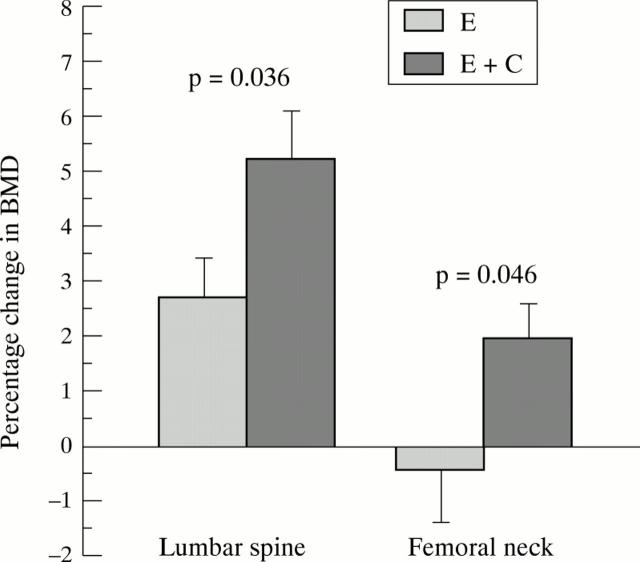
Results: The mean % increase in lumbar spine BMD was 5.2% (95% CI = 3.4 to 7.0) in the E + C group (n = 24), which was significantly greater than the 2.7% (95% CI = 1.3 to 4.1) increase in the E group (n = 23) (p < 0.05). The femoral neck BMD in the E + C group increased by 2.0% (95% CI = 0.8 to 3.2), which was significantly different from the E group where there was a -0.4% (95% CI = -2.4 to 1.6) change (p = 0.046).
Conclusions: These data show that a combination of cyclical etidronate and calcitriol is better than cyclical etidronate alone in terms of changes in BMD at both spine and femoral neck sites. Although further data are needed on fracture efficacy, this study suggests that combination therapies have additive therapeutic potential that may exceed that expected from their theoretical mode of action.
Figures
References
Publication types
MeSH terms
Substances
Grants and funding
LinkOut - more resources
Full Text Sources
Other Literature Sources
Medical
