Use of health services by children and young people according to ethnicity and social class: secondary analysis of a national survey
- PMID: 9774288
- PMCID: PMC28687
- DOI: 10.1136/bmj.317.7165.1047
Use of health services by children and young people according to ethnicity and social class: secondary analysis of a national survey
Abstract
Objective: To assess whether equity is achieved in use of general practitioner, outpatient, and inpatient services by children and young people according to their ethnic group and socioeconomic background.
Design: Secondary analysis of the British general household survey, 1991-94.
Subjects: 20 473 children and young people aged between 0 and 19 years.
Main outcome measures: Consultations with a general practitioner within a two week period, outpatient attendances within a three month period, and inpatient stays during the past year.
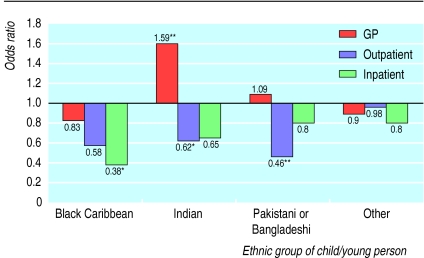
Results: There were no significant class differences in the use of health services by children and young people, and there was little evidence of variation in use of health services according to housing tenure and parental work status. South Asian children and young people used general practitioner services more than any other ethnic group after controlling for socioeconomic background and perceived health status, but the use of hospital outpatient and inpatient services was significantly lower for children and young people from all minority ethnic groups compared with the white population.
Conclusions: Our results differ from previous studies, which have reported significant class differences in use of health services for other age groups. We found no evidence that children and young people's use of health services varied according to their socioeconomic status, suggesting that equity has been achieved. A child or young person's ethnic origin, however, was clearly associated with use of general practitioner and hospital services, which could imply that children and young people from minority ethnic groups receive a poorer quality of health care than other children and young people.
Figures
Comment in
-
Use of health services by children. Study does not rule out effect of social class.BMJ. 1999 Mar 27;318(7187):876; author reply 877. BMJ. 1999. PMID: 10092283 Free PMC article. No abstract available.
-
Use of health services by children. Motivation for consultations may explain differential referral patterns.BMJ. 1999 Mar 27;318(7187):876; author reply 877. BMJ. 1999. PMID: 10223802 No abstract available.
-
Use of health services by children. Different data collection methods can lead to different findings.BMJ. 1999 Mar 27;318(7187):876-7. BMJ. 1999. PMID: 10223803 No abstract available.
-
Use of health services by children. Hospital care is not necessarily superior to primary care.BMJ. 1999 Mar 27;318(7187):877. BMJ. 1999. PMID: 10223804 No abstract available.
-
Use of health services by children. Objective measures of health status are essential.BMJ. 1999 Mar 27;318(7187):877. BMJ. 1999. PMID: 10223805 No abstract available.
References
-
- Forster DP. Social class differences in sickness and general practitioner consultations. Health Trends. 1976;8:29–32.
-
- Le Grand J. The distribution of public expenditure: the case of health care. Economica. 1978;45:125–142.
-
- Department of Health and Social Security. Inequalities in health: the Black Report. Harmondsworth: Penguin; 1982.
Publication types
MeSH terms
LinkOut - more resources
Full Text Sources
Medical
Miscellaneous